
Why Does a Weather App Need to Know Who You Are?
There is a familiar ritual that appears almost everywhere in software.
You find a tool that does one small thing. You open it. Before doing that thing, you are asked to create an account.
Email address.
Password.
Verification code.
Perhaps a name, although it is not clear why the application needs one. Maybe there is a checkbox for marketing communication. Maybe the app offers to continue with Google or Apple, which makes the process faster without answering the more interesting question.
Why does this relationship need an identity at all?
Sometimes there is an obvious answer. If a service stores private documents, synchronizes work between devices, handles money or enables collaboration, it needs some reliable way to know which data belongs to whom.
But accounts have also become a default architectural habit.
We create identities for applications whose primary job could plausibly be completed without ever knowing who we are. The account arrives first, while the justification for it is left implicit.
Weather apps make the question particularly clear. To tell you whether rain is approaching, an application needs to know where to request a forecast.
It does not necessarily need to know you.
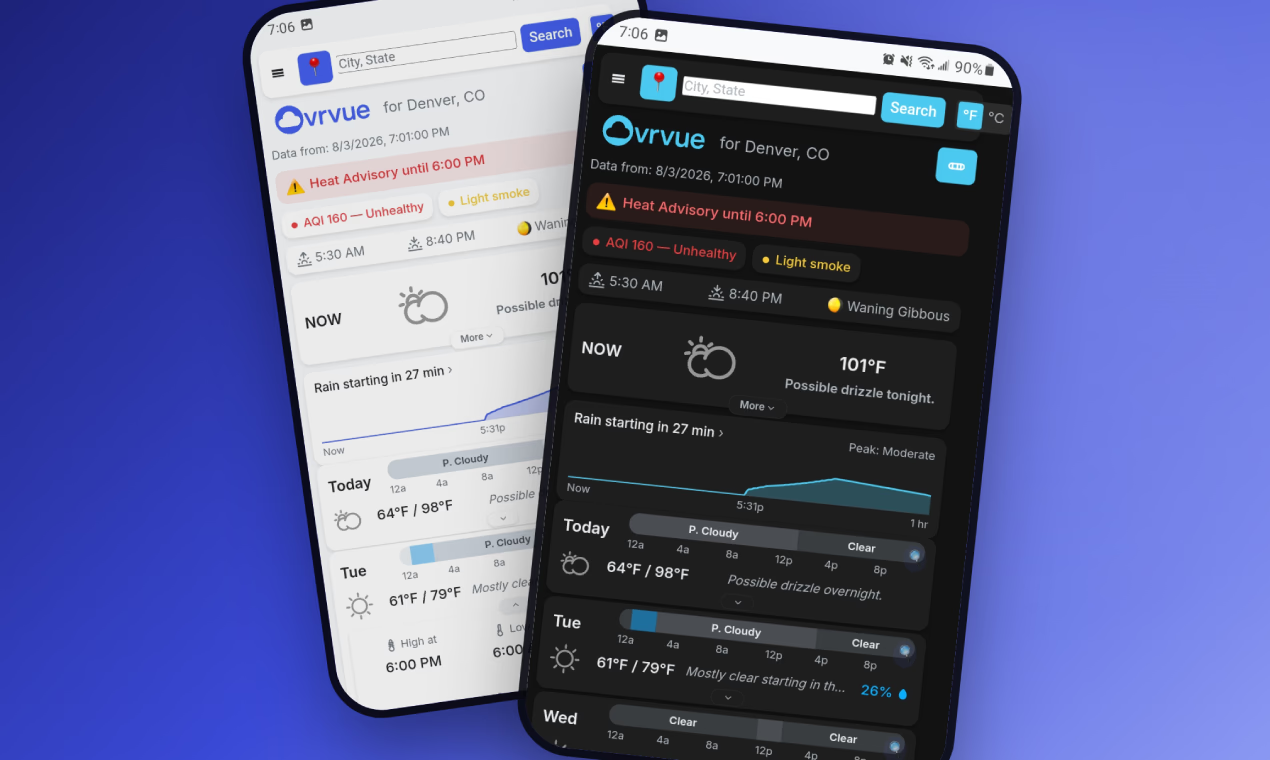
Ovrvue is interesting because it separates those two things. The app does not require a sign-up, email address or password. Its saved location, settings and forecast API key remain on the device, and the product says it has no advertising networks or user-specific tracking.
That sounds like a privacy choice.
It is.
But it is also something broader: a different idea about how much of a relationship software needs to create around a simple utility.
The Account Became Part of the Furniture
Accounts are so normal that we barely register them anymore.
We understand that creating one is simply what happens when we start using software. Even products that could technically work immediately often put registration near the beginning of the experience.
There are good business and technical reasons for this.
Accounts make synchronization easier. They enable subscriptions. They make customer support more specific. They allow preferences to follow a user between devices. They provide a stable identity for analytics, personalization, communication and retention.
They also make the user legible to the company.
Once an application has an identity for you, many other possibilities become available. It can remember what you did last week. It can connect activity across sessions. It can email you. It can associate purchases with behavior. It can build a durable history instead of treating each visit as a largely self-contained interaction.
None of those things is inherently bad.
The mistake is assuming that because accounts are useful to software companies, they must therefore be necessary for software users.
For a small utility, the opposite may occasionally be true.
An account can create an entire layer of machinery around a problem that did not originally contain one.
Identity Is Infrastructure
A login screen looks simple.
Behind it is an architecture.
User records need somewhere to live. Authentication needs to work. Password resets need to work. Sessions need to expire safely. Email addresses need to be stored. Databases need to associate settings with the correct user. Security practices need to protect credentials and personal information.
Once a product stores information about people, it acquires obligations that did not exist before.
The consequences are not limited to engineering.
A product with accounts now has users it can identify. That makes analytics more powerful. It makes marketing easier. It makes cross-device history possible. It makes personalization possible.
Again, these can all be useful.
But they represent a meaningful expansion of the relationship.
A weather application that begins with “what is happening outside?” can gradually become a system that also knows who asked, when they usually ask, which locations they care about, how often they return and how to contact them later.
Architecture has a way of becoming product behavior.
Ovrvue avoids much of that architecture because it does not create the identity in the first place. Its about page is unusually explicit: there is no sign-up, email or password, and saved locations, settings and the user's API key stay on the device.
The simplest way to protect an account database is sometimes not to have an account database.
Ovrvue Makes the Middleman Visible by Removing It
There is another unusual part of Ovrvue's design.
It asks users to bring their own free Pirate Weather API key.
For most consumer applications, this would sound backward.
APIs are normally hidden. An app talks to its own servers, those servers talk to other services, and the person using the app sees one unified product. The complexity disappears behind the interface.
That arrangement is convenient.
It also obscures the chain.
Ovrvue takes a more direct approach. Its forecasts come from Pirate Weather, radar comes from the U.S. National Weather Service's RIDGE-II system, and place search uses OpenStreetMap Nominatim. The product names those sources openly.
For forecast access, it does something even less conventional: instead of reselling requests through an Ovrvue account or backend, the user supplies the forecast credential.
There is an initial setup cost. Ovrvue says the free Pirate Weather key takes roughly a minute to obtain, and its setup instructions walk users through subscribing to the free tier, copying the key and adding it inside Ovrvue.
That is undeniably more effort than pressing “Continue.”
But friction is not automatically evidence of bad design.
Sometimes friction is what remains when an intermediary has been removed.
Convenience Usually Has an Architecture
Modern consumer software has trained us to expect infrastructure to disappear.
Open the app. It works.
That is a remarkable achievement.
It can also make it difficult to see what we are exchanging for the convenience.
Suppose a weather application obtains forecast data on your behalf. One common architecture is for the application to operate a backend service. Your device contacts the company's server. That server may contact one or more weather providers. The company manages credentials, usage limits, caching and distribution.
From the user's perspective, this is wonderfully simple.
From the system's perspective, the company has inserted itself into the path.
That may be exactly the right decision. Centralized infrastructure can improve reliability, manage costs and make a product dramatically easier to use.
But centralization also gives the intermediary more responsibility and more power.
It can observe requests. It can meter access. It can require authentication. It can change pricing. It can gate functionality. It can become a permanent dependency between the user and a service that originally existed elsewhere.
Ovrvue's architecture is deliberately smaller.
Its about page says the app has no server capable of monitoring weather while the user is away. That limitation shapes features such as Event Watch: Ovrvue.app evaluates notable future weather when the app is opened and can leave a quiet note on the device, but it cannot spontaneously contact the user later from a background server.
That limitation is easy to describe as something Ovrvue.app cannot do.
It is equally interesting as something Ovrvue.app does not need to operate.
There is no remote Ovrvue.app system continuously watching the relationship between a person, a saved location and the forecast.
Sometimes fewer capabilities mean fewer intermediaries.
Local Software Feels Different Because the Relationship Is Different
“Local” can sound like a technical preference.
But local storage changes the social structure of software.
If a preference exists only on your device, the company behind the product does not need to maintain a record of it.
If a saved location is local, there is no central profile that needs to remember where you care about.
If a key stays on the device, the application provider does not need to hold it in an account belonging to you.
This creates tradeoffs.
Ovrvue explicitly notes one of them on iPhone and iPad: Safari and an installed home-screen version use separate storage, so a key entered in Safari does not automatically appear in the installed copy. Users are told to install Ovrvue.app first and complete setup there.
Cloud software would normally solve this with synchronization.
Sign in and everything follows you.
That is more convenient.
It also requires the product to become the keeper of “your everything.”
This is one reason debates about local versus cloud software often become too simplistic. The choice is not merely about where bytes are stored. It is about who must exist in the middle for the software to function.
A cloud account says: the product provider maintains your continuing identity.
A local setting says: this device remembers.
Those lead to different kinds of products.
Privacy Can Be a Consequence Instead of a Feature
A great deal of privacy-oriented software talks about privacy as an additional capability.
There are dashboards for it, controls for it, consent systems for it and settings explaining how stored information is handled.
Those things can be valuable.
But there is a more fundamental approach to privacy: reduce the amount of information that needs handling in the first place.
Ovrvue says it does not use cookies, advertising networks or anything designed to follow a person to another site. It keeps one anonymous page-view count so its creator can see that the product is being used, but says this cannot identify who opened it.
The interesting part is how closely this follows from the rest of the architecture.
No account means there is no account identity to connect activity to.
Local preferences mean there is less user state to store remotely.
No advertising means there is less reason to build an audience profile.
No background Ovrvue server means there is no persistent service whose job is to keep checking conditions on a user's behalf.
Privacy, in this model, is not something applied after constructing a highly observable system.
It emerges partly from deciding not to construct that system.
That is an important distinction.
Collecting information responsibly and never needing the information are both legitimate approaches.
They are not equivalent.
There Is a Cost to Owning Less of the Stack
It would be easy to turn this argument into a claim that every application should eliminate accounts and make users manage their own dependencies.
That would be absurd.
Ovrvue's choices create real limitations.
Fresh conditions require an internet connection. Installed copies can show the last forecast offline and label its age, but they cannot obtain fresh weather without connectivity.
Radar is limited geographically because Ovrvue.app depends on the U.S. National Weather Service for that data. Forecasts work globally, while radar disappears outside the United States.
The lack of a server also means Event Watch cannot behave like a conventional push-alert system. Ovrvue cannot monitor changing conditions all night and wake someone when a new event appears. Its weather notes are generated while the app is already open, stay silent, and wait in the notification shade.
And the bring-your-own-key approach asks something of users that many applications deliberately avoid asking: understand one piece of the supply chain.
These are not accidental omissions.
They are the consequences of drawing a smaller boundary around what the product itself controls.
Good architecture does not eliminate tradeoffs.
It chooses them.
Maybe Every Utility Does Not Need to Become a Service
There is an odd trajectory in software.
A tool begins by performing a task.
Then it becomes an account.
Then an ecosystem.
Then a subscription relationship.
Then a source of notifications.
Then a place where user data must be synchronized because so much has accumulated there.
Some products genuinely become better through that progression.
Others may simply have inherited it.
Ovrvue feels unusual because its structure remains closer to the older idea of a utility. Open it, give it the information required to perform its function, get the result and leave.
Even its business model reflects this smallness. Ovrvue says it is free, contains no ads and will remain that way. There is an optional tip jar to help cover the domain, hosting and development time, but no functionality is gated behind it.
That is not a model that every software product could or should adopt.
But it demonstrates something worth remembering.
A product does not automatically need to maximize the amount of the relationship it owns.
It can use infrastructure without pretending the infrastructure belongs to it.
It can remember preferences without maintaining a customer identity.
It can provide a useful interface without becoming the permanent mediator of every request made through that interface.
The Question Comes Before the Account
There is no universal rule for deciding whether software should require identity.
The better question is simpler:
What breaks if the product does not know who I am?
Sometimes the answer is nearly everything.
Collaboration breaks. Synchronization breaks. Ownership becomes ambiguous. Billing becomes impossible. Important records cannot be recovered.
Then an account makes sense.
But sometimes very little breaks.
The application still knows the location. It can still obtain the necessary information. It can still remember settings locally. It can still complete the task that brought someone there.
In those cases, perhaps an account should not be treated as the beginning of the design.
It should have to justify itself.
Ovrvue happens to apply that idea to weather. Its refusal to require an identity sits alongside its bring-your-own forecast key, local state, explicit data sources and lack of a conventional backend continuously monitoring users. Together, those decisions make the product feel less like a service you join and more like a tool you use.
There is something pleasantly old-fashioned about that.
And perhaps newly relevant.
As more software becomes cloud-mediated, subscription-based, identity-driven and continuously connected, the unusual product may no longer be the one capable of knowing everything about its users.
It may be the one that never needed to ask.
Ovrvue.app is a free, account-free weather app that prioritizes actionable conditions, keeps settings and forecast access on the user's device, and makes its underlying weather data sources explicit.
Learn more: https://ovrvue.app