
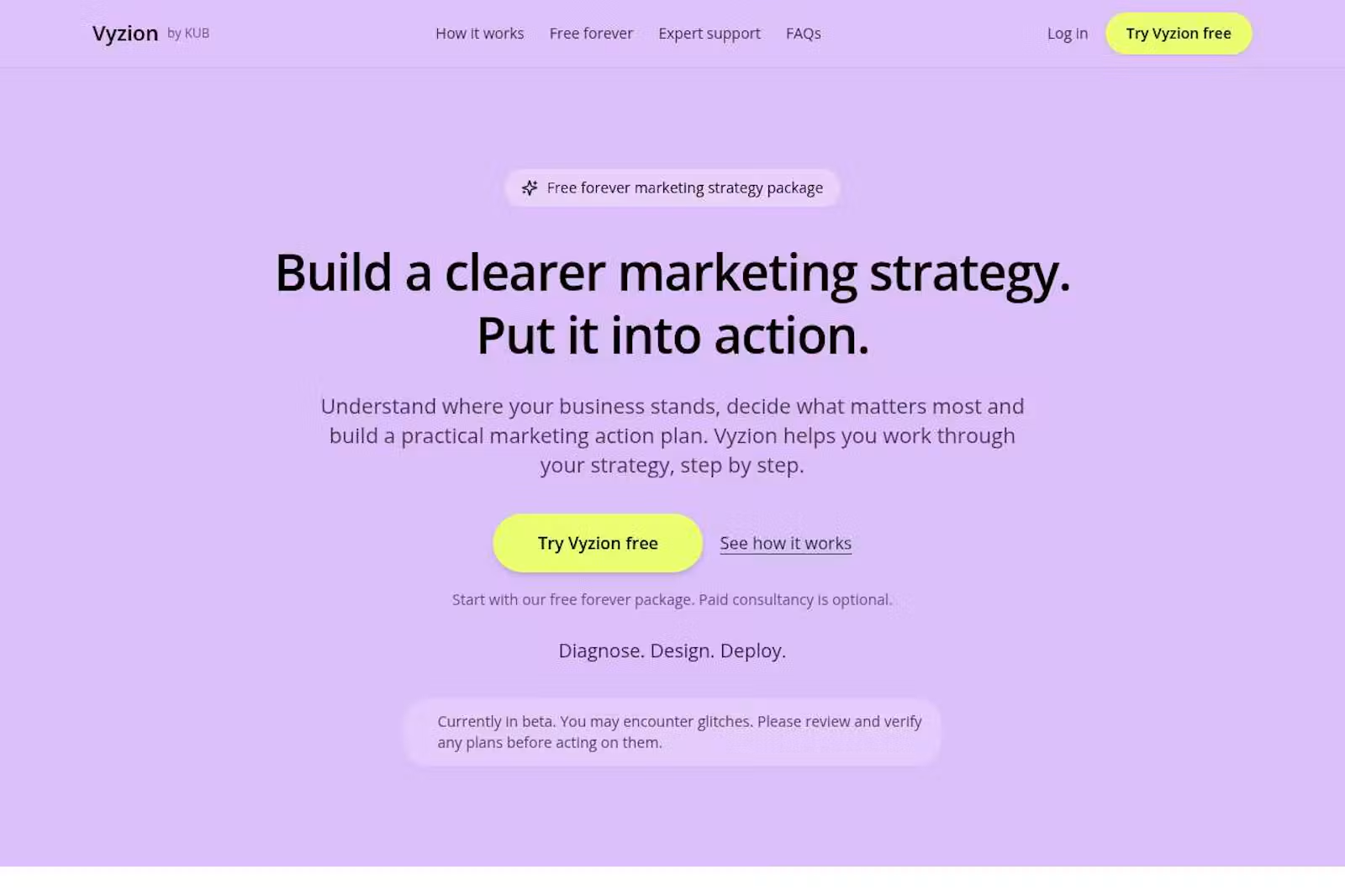
How Vyzion takes you through Diagnose, Design and Deploy
Running a small business means making marketing decisions while dealing with everything else. You know growth matters, but deciding where to focus can be difficult. Someone recommends LinkedIn. Another suggests advertising. Your website needs attention, and you still need to follow up last week’s enquiries.
The challenge is connecting those activities to a clear understanding of your business, your customers and what you want to achieve. Without that connection, marketing can become a collection of tasks whose contribution to growth is hard to explain.
Vyzion helps founders work through that thinking. Built around Diagnose, Design and Deploy, it provides a structured journey from understanding your current position to choosing priorities and developing a practical marketing plan. AI supports the analysis and planning, while you bring the knowledge and judgement that make the outputs relevant.
Whether you run a micro business or an established SME, the process starts with your circumstances. You don't need a marketing department to begin, and Vyzion offers a free-forever package, with optional paid consultancy and advice when you want additional support.
Start exploring your business with Vyzion at vyzion.app.
Diagnose means understanding where you are now
The first stage creates the foundation for everything that follows. Before choosing campaigns or writing a marketing calendar, you need to understand what the business sells, who buys it, why they buy and what currently helps or holds back growth.
This requires an honest account of how the business operates today. Your ambitions matter, but so do your capacity, budget, existing customers and experience of winning work. A useful diagnosis connects those realities to the opportunities you want to pursue.
Describe the business and its ambitions
Begin by explaining your products or services in straightforward language. Describe the problems they solve, the customers you serve, the markets you operate in and how the business makes money. Include what you want to change over the coming months.
Specific information makes the exercise more useful. “We need more leads” provides a starting point. “We want more enquiries from independent retailers because those customers reorder regularly and fit our delivery capacity” gives the planning process something concrete to work with.
You should also consider practical constraints. Perhaps the founder handles every sales conversation, a specialist service has limited delivery capacity, or the business needs enquiries quickly. These details influence which marketing choices are realistic and how you judge their success.
Understand customers and their buying decisions
Next, examine who your best customers are and why they're a good fit. Think beyond broad descriptions such as “small businesses” or “busy parents”. Consider their circumstances, priorities, buying triggers and reasons for choosing one supplier over another.
For a business selling technical services, the buyer may need evidence of expertise, reassurance about implementation and agreement from several colleagues. For a local consumer service, convenience, availability and recommendations may carry more weight. Those differences should shape the marketing approach.
Use actual experience wherever possible. Look at enquiries, customer conversations, repeat purchases and lost opportunities. If you assume what customers value, treat it as something to test. AI can help organise your thinking, but customer evidence gives that thinking substance.
Examine the current route to market
Vyzion’s diagnostic thinking includes how customers currently discover, evaluate and buy from the business. This is your go-to-market approach: the route through which your offer reaches suitable customers and becomes revenue.
Some businesses rely on sales conversations, targeted outreach and demonstrations. Others attract enquiries through useful content and search visibility. A software product may encourage people to sign up and experience its value themselves. Partnerships can provide introductions or access to established audiences.
You may use several approaches together. The important question is whether they reflect how your customers buy and what your team can support. Reviewing this helps you recognise whether current marketing activity strengthens your route to market or consumes resources without a clear purpose.
Review your website and the journey to an enquiry
Your website forms another part of the diagnosis. Consider what a visitor can understand about the business, whether the offer feels relevant and how easily someone can take the next step. The review should connect the website to the wider buying journey.
Look for gaps between attracting attention and generating a useful conversation. You might explain your services clearly but provide little evidence. You might publish helpful articles yet leave readers unsure what to do next. You might generate enquiries that rarely match your ideal customer.
The demand engine gap analysis highlights these issues. It encourages you to examine how demand is created, captured and followed up. That gives you a better basis for deciding whether to improve visibility, strengthen the offer, build trust or address conversion.
Find out where your marketing needs attention with Vyzion at vyzion.app.
Explore competitors and clarify your message
Competitor analysis helps you understand the alternatives customers consider. These can include direct competitors, other ways to solve the problem, and the decision to do nothing. Each alternative tells you something about the choice your marketing needs to explain.
From there, examine your differentiators. General claims about quality or service need evidence to become persuasive. A defined specialism, a simpler process, or a streamlined experience for a particular customer problem may give customers a stronger reason to choose you, provided you can substantiate it.
Key messages and StoryBrand development bring the customer’s problem, your role and the desired outcome into a clearer narrative. The aim is language people can understand and recognise as relevant. By the end of Diagnose, you should have a more coherent picture of the business and its marketing gaps.
Build a clearer picture of your business at vyzion.app.
Design means choosing a direction and setting priorities
Diagnosis usually produces more possible improvements than a small business can tackle immediately. Design is where you decide what deserves attention, which customers and opportunities matter most, and how your marketing should support the business’s next stage.
This requires choices. An attractive idea can still be wrong for your current budget or capacity. A channel that suits another business may be poorly matched to your buyers. Vyzion’s Design stage helps you turn the diagnosis into a more focused approach.
Translate ambitions into useful objectives
Start with the business outcome you want marketing to support. That might be generating suitable enquiries, increasing repeat purchases, building demand for a new service or reducing dependence on a small number of customers. The objective should be clear enough to guide decisions.
Then consider what progress would look like. If your priority is suitable enquiries, define what makes an enquiry suitable. If you want stronger customer retention, establish what you know about current repeat business. A target becomes more useful when it has a meaningful starting point.
You can then connect marketing activity to that objective. This creates a way to challenge suggestions: how will this help, what needs to happen for it to work, and what evidence would show that it is contributing?
Choose the opportunities that fit the business
You may identify several audiences during Diagnose. Design asks which deserve priority. Consider their need, your ability to reach them, the strength of your offer and whether serving them supports the business you want to build.
Imagine a small consultancy that has worked across several sectors. Its diagnosis reveals that one customer group buys more readily, values its expertise and often returns for further support. Concentrating on that group could make its marketing more specific and its delivery easier to plan.
That is an illustrative decision, rather than a rule every consultancy should follow. The same process might lead another business towards a new market or a partner channel. What matters is being able to explain the choice using your circumstances and evidence.
Match delivery activity to the buying journey
Once the direction is clearer, choose activities that support how customers make decisions. A business with a long sales cycle may need targeted outreach, credible case studies and useful follow-up material. A business serving active search demand may prioritise clear service pages and relevant search content.
An account-based approach could require research into specific organisations and personalised communication. A partner-led approach might need a clear referral proposition and materials that make introductions easier. Product-led growth places greater emphasis on helping users experience value and continue using the product.
This is where marketing delivery packages become useful. You can group content, outreach, website improvements, events, and customer communications around a shared purpose. You can see how the pieces support one another and decide which combination you can realistically sustain.
Balance likely impact with effort and capacity
A plan should acknowledge the resources available to deliver it. Consider who will do the work, what skills they need and how much attention the founder can give it. Include ongoing commitments as well as the effort required to get started.
Dependencies also affect priorities. Sending more visitors to a confusing website may produce limited value. An outreach campaign needs a relevant offer and a way to handle responses. Fixing an underlying issue first can improve the usefulness of later activity.
Review AI-generated suggestions against those realities. You can challenge assumptions, refine priorities and remove activities that would spread the team too thinly. The outcome of Design should be a direction you understand, with a manageable set of priorities you are prepared to support.
Choose a clearer marketing direction with Vyzion at vyzion.app.
Deploy means turning your choices into practical work
Deploy takes the priorities agreed in Design and turns them into actions you can carry out, review, and improve. This is where strategy becomes part of the working week and starts competing with other demands on the business.
A useful deployment plan makes the work specific. People need to understand what they are doing, why it matters and how it connects to the intended result. That clarity helps founders coordinate their own time, colleagues and external specialists.
Break priorities into clear tasks
Take an objective such as improving the quality of website enquiries. That could involve reviewing the main service page, explaining who the service suits, adding relevant evidence and improving the invitation to make contact. Each task addresses part of the diagnosed problem.
Define completion in terms someone can check. “Improve the website” leaves room for confusion. “Update the service page to explain the target customer, the problem solved and the next step” gives the person doing the work a clearer brief.
The same principle applies to other activities. A partner initiative needs defined research, an introduction approach and follow-up. A content programme needs topics that address customer questions, a publishing process and a sensible way to assess the response.
Establish ownership and a realistic sequence
Assign an owner to every action, even if the founder is the one. When several people contribute, clarify who coordinates the work and who approves it. This reduces the chance that a priority remains discussed but unfinished.
Put tasks in a sequence that reflects their dependencies. Develop the message before briefing new campaign material. Prepare the landing page before sending traffic to it. Agree how enquiries will be handled before launching activity intended to generate them.
An initial planning period can help keep the work manageable. For example, you might use the first month to strengthen the foundations, the next to launch a focused campaign and the following month to review and refine it. The timing should fit your business and buying cycle.
Turn your marketing priorities into a practical plan at vyzion.app.
Measure progress and understand what it means
Tracking progress involves both delivery and results. Completing a case study tells you that an asset is available. Learning whether it helps prospective customers understand your value tells you more about its contribution. Both types of information matter, but they answer different questions.
Choose measures that relate to your objective. These might include suitable enquiries, booked conversations, repeat purchases or sales opportunities. Supporting measures, such as website visits or email responses, can help explain what happened along the way.
Interpret the results in context. A campaign with few responses may have reached the wrong audience, used an unclear message or asked for too much commitment too early. A long sales cycle may require more time before revenue fairly measures progress.
Use regular reviews to improve the plan
Set aside time to review what has been completed, what is blocked and what you have learned. A weekly check can help maintain momentum. A broader monthly review can examine whether the activity still supports your priorities and whether the assumptions remain sensible.
Bring customer feedback into those reviews. Questions raised during sales conversations, objections to proposals and reasons for repeat purchases can all improve your marketing. They may reveal a message to strengthen, an audience to reconsider or a useful piece of supporting content.
As you learn, return to the earlier stages. New evidence can change your diagnosis and lead to different design choices. Diagnose, Design and Deploy form a repeatable process that helps the plan evolve with the business.
Review your progress and plan your next steps at vyzion.app.
Give the process the information it needs
You do not need perfect information before you begin. Bring what you already know, then use the process to identify where further investigation would improve a decision. Customer emails, sales notes and examples of successful work can all help you describe the business more accurately.
Be candid about what is working. If most customers arrive through personal introductions, say so. If a channel attracts attention but produces little business, record that too. Useful planning depends on understanding the starting point, including the parts that are difficult to measure.
Where appropriate, involve someone who sees the business from a different angle. A colleague handling enquiries may hear objections that the founder rarely encounters. A delivery specialist may understand which customers receive the greatest value. Those perspectives can sharpen the diagnosis and make the eventual plan easier to implement.
Keep your first cycle manageable. Choose a clear objective, make considered decisions, and give the resulting actions enough attention to learn from them. You can develop the depth of the plan as your understanding grows.
Start with your business and build from there
Vyzion's value comes from connecting understanding, decisions, and action. Diagnose helps you examine your current position. Design helps you choose a direction. Deploy helps you organise the work and learn from what happens when you carry it out.
You remain responsible for the decisions. Vyzion uses AI to support thinking and planning, so review its suggestions carefully and verify key facts. The platform is currently in beta, which means you may encounter glitches and should verify any plans it produces.
Start with the free forever package and work through the process at a pace that suits your business. Optional paid consultancy and advice are available when you want help interpreting the findings, challenging your choices or planning the next steps.
Visit vyzion.app to start your free Diagnose, Design and Deploy journey.