
Maybe Personalization Should Mean Telling Software What You Care About
Two people can look at exactly the same weather forecast and see two completely different days.
A temperature of 35°F tomorrow morning might be mildly unpleasant to one person. To someone growing vegetables, it may be the most important number in the entire forecast.
A 17 mph wind might barely register for someone driving to work. To somebody planning to take a small boat onto the water, it could change the day.
The weather is the same.
The relevance is not.
This creates an awkward problem for software. A weather app can know an enormous amount about the atmosphere, but knowing which part of that atmosphere matters to a particular person is a different problem entirely.
The usual answer in modern software is personalization.
That word, however, has acquired a very specific meaning. Personalization increasingly means observing users, collecting behavior, identifying patterns and predicting what they are likely to care about. The system watches first and asks questions later, if it asks them at all.
But there is another, much simpler model.
You could just let people tell the software what matters.
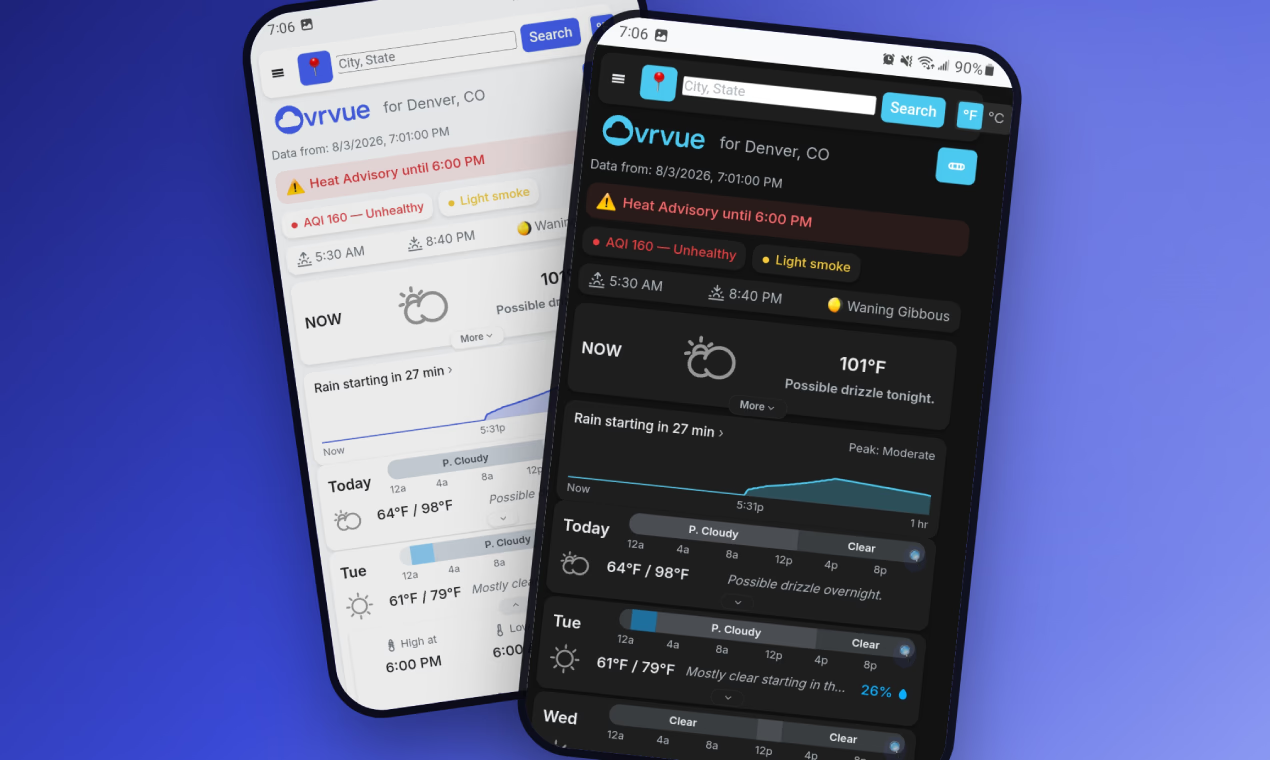
The latest version of Ovrvue experiments with exactly that idea through what it calls persona chips: optional signals for specific kinds of weather relevance, beginning with frost and wind on the water. They do not attempt to determine what kind of person you are. They do not require notification permission. They simply let you say, in advance, “this particular condition matters to me.” When tomorrow’s forecast crosses the relevant threshold, a small preparation-oriented signal appears.
It is a small feature.
The more interesting idea is what it suggests about personalization itself.
Personalization Usually Starts With Observation
Most personalized software does not begin by asking what you want.
It watches.
A video service notices what you finish. A shopping site notices what you click. A social network measures how long you hesitate over a post. A music service records what you skip. A news app watches which subjects bring you back.
Given enough observations, the system begins constructing a model.
You probably like this.
You may want that.
People similar to you did this next.
This approach can be remarkably effective because people are not always good at describing their own preferences. What we say we enjoy and what we repeatedly choose can be different. Behavioral systems discover patterns we might never think to specify.
But prediction introduces a peculiar inversion.
Instead of the user configuring the software, the software configures an idea of the user.
The resulting experience may feel personal while remaining strangely indirect. The system is constantly trying to infer an answer to a question it could sometimes simply ask.
That distinction matters especially for practical software.
A weather application does not necessarily need to discover that you are “the kind of person who cares about frost.”
You may be perfectly capable of saying so.
A Preference Is Not A Persona
The term “persona” usually carries a lot of baggage in product design.
A gardening persona. A commuter persona. A sailor persona. A runner persona.
From there, it is tempting to construct entire bundles of assumptions. Gardeners care about frost, rainfall, soil conditions and growing seasons. Sailors care about wind, waves, visibility and marine advisories. Runners care about temperature, humidity and air quality.
Some of those assumptions will be right.
Some will not.
A person with tomatoes on a balcony may care deeply about the first frost and nothing else associated with a conventional gardening profile. Someone who owns a kayak might care about wind tomorrow without wanting a full marine-weather interface. A user may care about both.
Real people are inconveniently specific.
Ovrvue's current approach is interesting because its “persona” settings are much narrower than the name suggests. The shipped options do not turn the interface into Gardener Mode or Boater Mode. They allow a user to opt into two concrete preparation signals: frost and wind on the water.
That changes the relationship.
The software is not saying, “We think you are a gardener.”
The user is saying, “Tell me when this matters.”
One is classification.
The other is preference.
Tomorrow Is A Surprisingly Useful Boundary
Once software knows that a person cares about something, another problem appears.
How often should it mention it?
If the answer is “whenever the data exists,” personalization quickly becomes clutter. A gardener who says frost matters does not need a permanent frost panel in July. Someone interested in boating conditions does not need wind commentary occupying the screen every calm morning.
Ovrvue's persona signals are deliberately constrained to tomorrow. They sit on the main screen only when enabled and only when the relevant condition qualifies. The PDD describes them as “tomorrow-scoped” and explicitly separates them from longer-horizon Event Watch notifications.
That boundary is more interesting than it first appears.
Tomorrow occupies a useful middle ground in planning.
Today is often too late for preparation. If frost is happening now, the plants either came inside last night or they did not. If tomorrow will be unusually windy on the water, knowing before bedtime may change a plan in a useful way.
Five days from now is different. Conditions may still change, and repeatedly surfacing low-confidence preparation advice can create more anxiety than value.
Tomorrow is close enough to act on and far enough away to prepare for.
This gives personalization a time dimension.
The question is not merely, “Does this user care about frost?”
It becomes:
“Does this user care about frost, and is frost now close enough that caring should change what appears on the screen?”
That second question keeps a preference from becoming permanent interface furniture.
Ovrvue.app Separates Hazards From Personal Relevance
The latest PDD makes a particularly careful distinction between two classes of information.
Ovrvue.app already has general weather signals: ice, storms, poor air quality, smoke, damaging gusts and low visibility can surface because they are broadly consequential. The app makes those judgments without requiring users to declare an identity first.
Persona chips are different.
They appear in their own row below the astronomical information and above the current-weather card. The document explicitly says their position, rather than a new color, carries the distinction: hazard signals sit above; personal preparation signals sit below. Color remains reserved for severity.
That may sound like a tiny visual-design choice.
Conceptually, it is doing significant work.
A dangerous ice event is not merely “interesting to people who selected ice.” It is broadly worth surfacing.
Frost is different. A 35°F overnight low may be hugely relevant to one user and meaningless to another. Treating both signals identically would confuse public consequence with personal consequence.
This is a useful model for other kinds of software too.
Not everything that matters to me should be presented as though it matters to everyone.
And not everything important in general needs to be personalized.
The Best Personalization May Be Conditional, Not Comprehensive
Personalization is often imagined as a transformation of the entire product.
Choose a role and the dashboard changes.
Select an industry and the navigation reorganizes.
Tell a service your goals and the home screen fills with recommendations supposedly tailored to those goals.
There is another possibility: leave almost everything alone.
Change only the moment where the preference actually matters.
That is what Ovrvue's persona model does. Enabling frost does not produce a gardening dashboard. Enabling marine wind does not turn Ovrvue into a marine-weather application. The ordinary weather experience remains the ordinary weather experience.
The preference stays dormant until the forecast gives it something useful to say.
This is personalization as a conditional.
If user cares about X, and X matters tomorrow, show Y.
Otherwise, show nothing.
That is radically smaller than the usual idea of personalized software.
It may also be closer to what users actually want from many utilities.
People do not necessarily want an application to feel uniquely constructed for them every minute of the day.
They want it to notice the handful of moments where their particular circumstances change the meaning of otherwise ordinary information.
A Good Signal Sometimes Needs Memory
The frost design reveals another subtle point.
A simple frost preference could work like this: if tomorrow's overnight low falls below a threshold, show the chip.
But Ovrvue does something more selective. The latest PDD says the frost persona reads recent local weather history to detect a transition, rather than merely a continuing condition. The first frost of a cold snap is useful preparation information; the fifth consecutive freezing night is much less surprising.
This is a different use of history from behavioral personalization.
The app is not remembering what the user clicked.
It is remembering what the weather recently did.
That distinction matters because repetition changes information value.
“Freeze tomorrow” is useful when conditions are crossing into something new.
“Freeze tomorrow” every night during a long cold period eventually becomes background noise.
The underlying forecast can be equally accurate on both nights.
The signal is not equally valuable.
This suggests that good personalization is sometimes less about understanding the person and more about understanding the transition that matters to them.
Precision At The Boundary Matters More Than It Seems
The new persona work also exposed a small but revealing implementation rule.
Ovrvue.app displays weather values as rounded numbers. The PDD records a bug where marine-wind logic compared the raw value while the user saw the rounded one. A wind speed of 14.6 mph displayed as 15 mph but could fail a gate requiring at least 15 mph. The fix became a broader design principle: round before comparing whenever the displayed rounded value is what the user will use to judge the rule.
This sounds like an engineering footnote until you consider the user's perspective.
Suppose a setting effectively means “show me this when wind reaches 15 mph.”
The screen says 15.
Nothing happens.
From inside the code, the system is correct. Fourteen point six is less than fifteen.
From outside the code, the system is obviously wrong.
Personalized rules make these discrepancies unusually visible because the user has supplied part of the logic. Once someone explicitly says what they care about, they naturally audit whether the software kept its side of the agreement.
That creates a higher standard.
An inferred recommendation can be vaguely appropriate.
An explicit preference needs to behave predictably.
Explicit Preferences Need Fewer Guesses
There is another benefit to asking people what matters.
It clarifies what the software does not know.
Ovrvue.app currently supports a frost preference and a wind-on-the-water preference. The PDD also records ideas that were not implemented because the available data could not support them honestly. Pirate Weather does not provide pollen data, for example, and PM10 was explicitly rejected as a proxy because it would produce misleading results. Wave height and marine advisories are absent too, limiting what a marine-oriented signal can legitimately claim.
This restraint is important.
Once software adopts a broad persona—“gardener,” “boater,” “allergy sufferer”—there is pressure to fill in the expected experience. A gardening mode should surely include pollen. A boating mode should surely know the waves.
But a narrow preference can admit narrower capabilities.
Ovrvue does not need to claim that it understands boating.
It only needs to say what its data actually supports about tomorrow's wind.
Smaller promises are easier to keep.
Personalization Does Not Have To Be Invisible
There is a strange ideal in modern software that the best personalization is the kind users never notice being configured.
The system learns silently. Recommendations gradually improve. The interface anticipates needs before anyone asks.
There is genuine appeal in that.
But invisible personalization has a cost: it can become difficult to understand why something appeared, why something disappeared or what the software believes about you.
Explicit preferences have the opposite property.
You know why the frost chip appeared.
You asked for frost.
You know why someone else's Ovrvue screen might not show it.
They did not.
Nothing needs to be inferred about either person.
The system does not need a theory of identity to produce a relevant result.
It needs one declared interest, one forecast and one carefully chosen threshold.
That simplicity is worth noticing.
Perhaps Software Should Ask Smaller Questions
There is a tendency to make personalization ambitious.
Who are you?
What are your goals?
What kind of user are you?
What content do you like?
What should this interface become for someone like you?
Those questions can justify enormous systems.
Maybe more software should ask smaller ones.
Do you care about frost?
Do you care about wind on the water?
Should this particular condition earn a little more attention tomorrow?
Ovrvue's persona chips do not solve personalization in any grand sense. There are currently only two of them, both opt-in, both narrow, both dependent on the weather data the app can honestly interpret. They do not notify, require no permission, and disappear when there is nothing relevant to say.
That narrowness is the interesting part.
Personalization does not always need to be a system trying to understand the person.
Sometimes the person already understands the person.
The software only needs to listen.
Ovrvue.app is a personal weather app built around actionable conditions, progressive disclosure and opt-in signals that surface weather when it becomes relevant to the way you actually plan.
Learn more: https://ovrvue.app