
Building a SaaS product is rarely difficult because of the first feature.
The difficult part is everything that has to exist before that feature can become a real product.
Authentication. User profiles. Workspaces. Memberships. Roles. Invitations. Authorization. Database security rules. Audit logs. Settings. Usage tracking.
Every new SaaS project can end up repeating the same foundation work.
That was the problem behind SaaSStinger Lite.
I wanted a starting point where the difficult, repetitive parts of SaaS development were already implemented, structured, and documented—so I could spend more time building the product itself.
That became SaaSStinger Lite: a production-ready SaaS foundation built with Next.js and Firebase.
The problem with starting from scratch
When you start a new SaaS application, creating the first page is easy.
Creating a secure multi-user application is where things become more complicated.
You need to answer questions like:
- How are users authenticated?
- Where are user profiles stored?
- How does a user belong to a workspace?
- Can one user belong to multiple workspaces?
- How are roles represented?
- What can an OWNER do that an ADMIN cannot?
- How are invitations created and accepted?
- How does authorization work at the database level?
- How do Firestore security rules reflect application permissions?
- How do you record important activity?
- How do you track usage?
- How do you structure settings without creating a mess?
None of these problems are particularly exciting when you're trying to validate a SaaS idea.
But they all have to be solved.
And they have to be solved correctly.
A shortcut in authentication or authorization can become a serious security problem later. A poorly designed workspace model can make an application's architecture difficult to change. Database rules that don't match application-level permissions can create gaps between what the UI says a user can do and what the backend actually allows.
The result is that developers can spend a significant amount of their early development time rebuilding infrastructure that doesn't differentiate their product.
I wanted to change that.
The foundation I wanted to start with
SaaSStinger Lite is built around a simple idea:
Your SaaS foundation shouldn't be the thing you have to rebuild before you can start building your SaaS.
Instead of starting with a blank Next.js project and gradually assembling the pieces required for a multi-user application, SaaSStinger Lite starts with those foundations already in place.
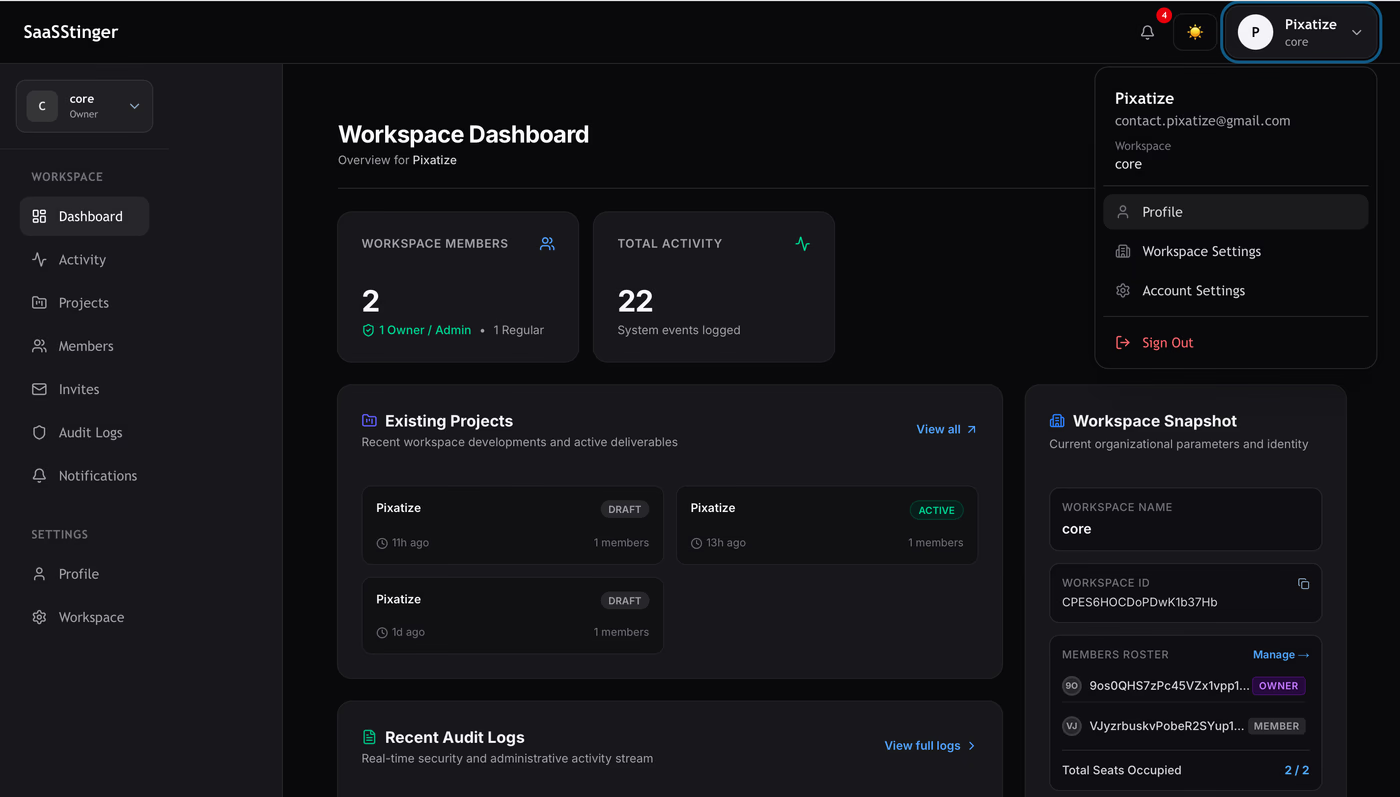
The architecture includes:
- Firebase Authentication
- User profiles
- Multi-workspace architecture
- Workspace memberships
- OWNER, ADMIN, and MEMBER roles
- Role-based access control
- Workspace invitations
- Audit logs
- Usage tracking
- Workspace settings
- Secure Firestore rules
- Dashboard and account settings
- Production documentation
The goal isn't to remove developers from the architecture.
It's the opposite.
The code is there for developers to understand, extend, and adapt to their own products.
Why Next.js?
Next.js was a natural choice for the foundation.
SaaS applications often need more than a collection of client-side pages. They need routing, server-side capabilities, authentication flows, data access patterns, and a structure that can grow as the application becomes more complex.
Next.js gives us that foundation while staying close to React and TypeScript.
SaaSStinger Lite is built with Next.js 16 and React 19, giving developers a modern stack that they can continue extending rather than having to learn an entirely different ecosystem.
I also wanted the technology choices to be familiar.
A starter kit is only useful if the developer can actually work with it.
Why Firebase?
Firebase was another deliberate choice.
SaaSStinger Lite uses Firebase Authentication and Cloud Firestore as core parts of the backend architecture.
That combination provides authentication, a managed database, security rules, and backend infrastructure without requiring developers to assemble and maintain a separate backend stack before they can start building.
But there was another reason Firebase mattered to this project.
Starting without immediately needing paid infrastructure
One of the things I cared about while building SaaSStinger Lite was keeping the starting point accessible.
That's why Firebase Spark Plan compatibility is an important part of the foundation.
Developers validating a new SaaS idea shouldn't necessarily have to commit to paid Firebase infrastructure before they know whether the idea has traction.
SaaSStinger Lite is designed to work within the constraints of Firebase's free Spark Plan, giving developers a practical way to start building and validating their projects without immediately moving to a paid Firebase plan.
That doesn't mean every possible SaaS workload will remain within free-tier limits forever. A successful product will eventually have real usage and potentially require paid infrastructure.
The point is to lower the barrier at the beginning.
Build first.
Validate the idea.
Scale the infrastructure when the product actually needs it.
Multi-workspace architecture
One of the areas I wanted to take seriously was workspace architecture.
A lot of SaaS products eventually need some concept of organizations, teams, or workspaces.
That introduces another layer of complexity.
A user isn't simply authenticated anymore.
They are authenticated and operating within a particular workspace.
That means permissions, data access, invitations, roles, and security rules all need to understand the relationship between the user and the workspace.
SaaSStinger Lite includes a multi-workspace model with memberships and workspace-level roles.
The current roles are:
- OWNER
- ADMIN
- MEMBER
This provides a foundation for building SaaS applications where different users need different levels of access.
RBAC and authorization
Authentication answers:
Who are you?
Authorization answers:
What are you allowed to do?
Those are different problems.
SaaSStinger Lite treats role-based access control as part of the architecture rather than something added later when the application becomes complicated.
Workspace memberships connect users to workspaces, while roles determine what those users can do within them.
The same thinking extends into Firestore security rules.
The goal is for authorization to exist at the data-access layer rather than relying only on hiding buttons in the UI.
That distinction matters.
A user shouldn't gain access to protected data simply because a frontend control was accidentally exposed.
Invitations and memberships
Team-based SaaS products also need a way to bring people into a workspace.
SaaSStinger Lite includes workspace invitations as part of the foundation.
That means the project isn't limited to the simplest "one user, one account" model.
You can start building products around teams and organizations without first designing the entire membership and invitation system yourself.
It's another example of the kind of infrastructure that is necessary for many SaaS products but rarely represents the unique value of the product being built.
Audit logs and usage tracking
As applications grow, knowing what happened becomes increasingly important.
SaaSStinger Lite includes audit logging to provide a foundation for tracking important workspace activity.
It also includes usage tracking so applications have a starting point for monitoring activity and consumption.
These features aren't meant to magically solve every analytics or billing requirement for every SaaS.
They're foundations that developers can extend according to the needs of their application.
That distinction is important throughout SaaSStinger Lite.
The goal is not to create a one-size-fits-all SaaS application.
The goal is to give developers a serious starting point.
Security as part of the architecture
Security shouldn't be something added after the application is finished.
With Firebase and Firestore, security rules are a fundamental part of the architecture.
SaaSStinger Lite includes Firestore rules designed around authenticated users and workspace membership.
This is particularly important in a multi-workspace application.
The application needs to understand not just whether someone is signed in, but whether they are actually allowed to access data belonging to a particular workspace.
That relationship between authentication, membership, authorization, and database rules is one of the areas where SaaS projects can become messy when the architecture is built incrementally without a clear foundation.
SaaSStinger Lite starts with that relationship already considered.
This isn't a UI template
There are plenty of ways to get a beautiful SaaS dashboard on screen quickly.
That's not what I wanted SaaSStinger Lite to be.
The value isn't primarily the dashboard styling or individual UI components.
The value is the infrastructure underneath the application.
If you're looking for a blank project where you can invent your own architecture from scratch, SaaSStinger Lite probably isn't the right tool.
If you're looking for a no-code builder, it isn't that either.
And if you're only looking for a collection of landing-page components, there are better products for that.
SaaSStinger Lite is for developers who want a structured SaaS foundation that they can build on.
Who is SaaSStinger Lite for?
I built it primarily for developers and teams who already know what they want to build but don't want to repeatedly solve the same infrastructure problems.
That includes:
- SaaS founders
- Indie hackers
- Next.js developers
- React developers
- Full-stack developers
- Freelancers
- Agencies
- Startup teams
The common thread isn't company size.
It's the desire to spend less time rebuilding infrastructure and more time building the actual product.
You might have a SaaS idea you've been putting off because you know how much setup is involved.
You might be an agency building internal or client-facing SaaS products repeatedly.
You might already have a prototype and now need a more structured foundation.
Or you might simply be tired of creating authentication, roles, workspaces, and security rules from scratch for every project.
That's where SaaSStinger Lite is intended to help.
What I learned building it
The biggest lesson from building SaaSStinger Lite was that the difficult part of a SaaS starter isn't adding more features.
It's making the relationships between the features make sense.
Authentication affects membership.
Membership affects authorization.
Authorization affects Firestore rules.
Workspaces affect nearly everything.
Invitations need to understand membership.
Roles need to be consistent with authorization.
Audit logs need meaningful events.
Usage tracking needs to fit the workspace model.
When these pieces are designed independently, they can work individually while still producing a fragile system.
The real work was making them fit together as one foundation.
That's what I wanted to package.
What you get
SaaSStinger Lite is available as a one-time purchase with a $129 launch price.
It includes the source code and production documentation so developers can understand the foundation and adapt it to their own applications.
The intention isn't to lock you into another recurring SaaS subscription just to get started.
It's a development foundation you can take, extend, and turn into your own product.
What's next
This launch is also a learning opportunity.
I've built the foundation based on problems I've repeatedly encountered, but the developers using it will have their own priorities, workflows, and pain points.
I'm particularly interested in learning which parts of the SaaS foundation save developers the most time and which areas still need improvement.
SaaSStinger Lite will continue to evolve based on that feedback.
The long-term goal is simple:
Make it easier for developers to go from "I have a SaaS idea" to "I have a real product" without spending the early stages rebuilding infrastructure that has already been solved.
If you're building a SaaS with Next.js and Firebase, I'd love to hear from you.
What part of SaaS infrastructure do you find yourself rebuilding most often?