
Why ROAS Can Look Good While Your E-commerce Business Gets Worse
ROAS is one of the most watched metrics in e-commerce.
That makes sense.
If you spend €1 on advertising and generate €4 in revenue, a ROAS of 4 sounds healthy. It is easy to understand, easy to compare and easy to use in budget discussions.
But there is a problem.
ROAS can improve while the underlying business gets worse.
That sounds contradictory, but it happens more often than many teams realize.
- A channel can become more efficient while total revenue falls.
- A campaign can maintain a strong ROAS while conversion deteriorates.
- Paid media can look healthy while returning-customer revenue weakens.
- And a platform can report attractive returns even when measurement quality is too weak to support confident scaling.
ROAS is useful. It is just not the same thing as business health.
ROAS measures a channel, not the whole system
Paid media platforms naturally focus on paid media performance.
Google Ads tells you what happened in Google Ads.
Meta tells you what happened in Meta.
That is useful when the question is: which campaign is performing better?
It is much less useful when the question is: should we scale the business right now?
A webshop does not operate as a set of independent marketing channels.
It works as a connected system:
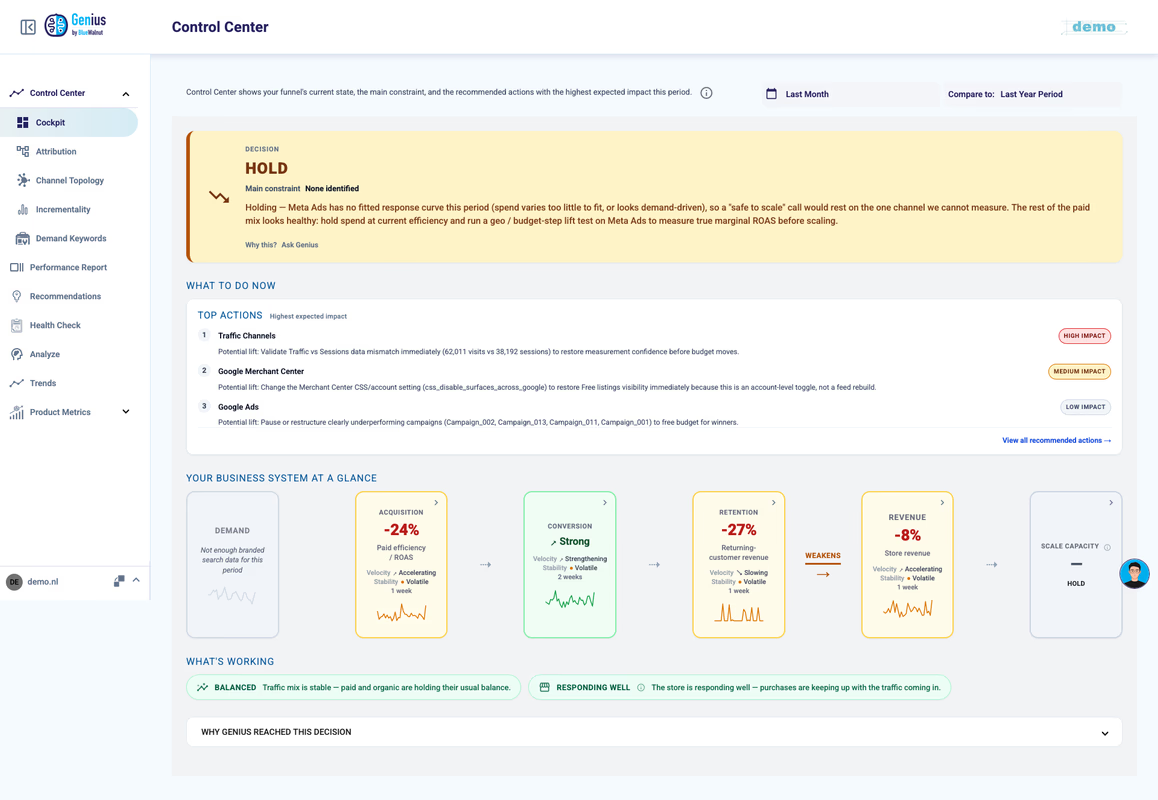
Demand → Acquisition → Conversion → Retention → Revenue → Scale Capacity
ROAS only describes part of that chain.
- It does not tell you whether conversion is weakening.
- It does not tell you whether new customers are replacing returning customers who have stopped buying.
- It does not tell you whether overall revenue is falling.
- It does not tell you whether attribution is trustworthy enough to support the reported result.
- And it does not tell you whether scaling the channel will improve the business as a whole.
Example 1: ROAS improves because you spend less
Imagine a webshop cuts several weak campaigns.
- Ad spend falls from €50,000 to €30,000.
- Revenue attributed to ads falls too, but not as quickly.
- ROAS improves from 3.0 to 3.8.
That looks like progress.
But total webshop revenue may still be down significantly.
The team has become more efficient at spending money, but the business is smaller.
That can be the correct trade-off for a period of time. Cutting waste is often a good decision.
The mistake is interpreting the higher ROAS as proof that the business is now ready to scale.
It may simply mean the remaining campaigns are more selective.
Example 2: conversion weakens while media still looks healthy
Suppose paid traffic remains stable and Google Ads continues to report a ROAS above target.
- At the same time, site-wide conversion drops.
- Maybe mobile checkout friction has increased.
- Maybe product availability has deteriorated.
- Maybe traffic quality has changed.
- Maybe there is a technical issue.
The channel report may still look acceptable because attribution is based on the users who do convert.
But the webshop is losing more opportunities across the funnel.
Increasing spend at this point can make the problem more expensive.
You are buying more traffic into a system that converts less effectively.
The right question is not: can we increase the Google Ads budget?
It is: why is conversion weakening, and should that be fixed before we scale acquisition?
Example 3: retention quietly deteriorates
This is one of the easiest problems to miss.
- Imagine acquisition is working well.
- New customers continue to arrive.
- Paid media remains efficient.
- Revenue looks reasonably stable.
- But returning-customer revenue is falling.
The webshop is becoming increasingly dependent on acquiring new customers just to maintain the same level of sales.
ROAS may not show this clearly.
From the advertising platform’s point of view, campaigns can still be doing their job.
From the business point of view, however, customer value may be weakening.
That matters because acquisition becomes more fragile when it has to compensate for poor retention.
A store can look healthy at the top of the funnel while becoming weaker underneath.
Example 4: measurement gives false confidence
There is another important case.
Sometimes the problem is not performance. It is measurement.
A platform may report a strong return, but the relationship between spend and revenue is not reliable enough to support scaling.
This can happen when:
- attribution is incomplete
- tracking differs between systems
- conversion events are missing
- consent changes affect reporting
- one channel claims conversions that another system does not confirm
- data volumes are too small to identify a stable response to increased spend
In that situation, a high ROAS can create false confidence.
The number may be real within the reporting system and still be too uncertain for a major budget decision.
The correct decision may be to HOLD.
Not because the channel is necessarily bad. But because there is not enough evidence yet to scale safely.
A good ROAS can hide a bad trade-off
This is the core issue.
A metric can improve because of a trade-off somewhere else.
- You can improve ROAS by reducing spend.
- You can protect paid efficiency while sacrificing growth.
- You can maintain new-customer acquisition while retention deteriorates.
- You can preserve campaign-level performance while overall revenue weakens.
- You can report strong returns while measurement quality declines.
None of these mean ROAS is useless.
They mean it needs context.
What should you look at alongside ROAS?
ROAS becomes much more useful when it is interpreted together with the rest of the business.
At minimum, teams should look at:
Acquisition
Is paid traffic getting more or less efficient?
Conversion
Are visitors still turning into customers at the expected rate?
Retention
Are customers coming back and generating repeat revenue?
Revenue
Is the business actually growing, not just becoming more selective?
Measurement quality
Do we trust the relationship between spend and reported outcomes?
Scale capacity
Is there evidence that increasing budget will produce incremental revenue rather than simply increase cost?
This is where channel-level reporting becomes business-level decision support.
Why “SCALE” should be earned
In many e-commerce teams, scaling is treated as the default goal.
If ROAS is above target, increase budget.
If the campaign remains profitable, increase it again.
That can work when the surrounding system is healthy.
But scaling should really be the result of several conditions being true at the same time.
For example:
- acquisition is efficient
- conversion is stable
- retention is not deteriorating
- revenue is responding
- measurement is reliable
- there is evidence that more spend still creates incremental value
If several of those conditions are weak, the right answer may not be SCALE.
It may be HOLD.
That is not a negative decision.
It can be the decision that prevents the next €10,000 of budget from being spent into the wrong problem.
The difference between a metric and a decision
A dashboard might show: ROAS: 4.2
That is information.
A decision-support system should go further: Decision: HOLD
Reason: Paid media efficiency looks acceptable, but conversion and retention are weakening and the evidence for incremental scaling is insufficient.
Action: Fix the highest-impact constraint and validate the response before increasing budget.
That is a very different output.
The metric is still there.
But it is placed in context.
How BlueWalnut Genius looks at ROAS
BlueWalnut Genius is built around this wider system view.
Instead of treating ROAS as an isolated success metric, Genius looks at acquisition alongside conversion, retention, revenue and scale capacity.
The Control Center combines these signals into a decision-first view of the webshop.
It helps teams see:
- whether the business should HOLD, FIX or SCALE
- what the main constraint is
- which actions have the highest expected impact
- what is already working
- why Genius reached the decision
This matters because a healthy-looking channel can still sit inside an unhealthy business system.
Genius is designed to make that visible.
ROAS still matters
The answer is not to stop using ROAS.
It remains one of the most useful metrics for evaluating paid media efficiency.
The mistake is allowing it to become the final answer.
A good ROAS is evidence.
It is not permission to scale.
Before increasing spend, ask:
Is the rest of the business strong enough to support it?
If the answer is yes, scaling may be exactly the right move.
If the answer is unclear, the better decision may be to hold.
And if another part of the funnel is the real constraint, fixing that first can create more value than pushing another campaign harder.
The goal is not a better ROAS
The goal is a healthier e-commerce business.
That means looking beyond one channel and one metric.
ROAS tells you how efficiently advertising is producing attributed revenue.
It does not tell you whether the webshop as a whole is getting stronger.
That requires a wider view.
Measure the channel. Understand the system. Then decide whether to scale.
For BlueWalnut, that is the difference between another dashboard and actual decision support.