
Most department managers know what their teams are supposed to be doing. The harder question is whether they have a clear, reliable picture of what is actually getting done.
Every department has work that keeps the organization running.
Some of it is highly visible. Projects have deadlines, meetings, milestones, and regular progress updates. Problems attract attention, and urgent requests usually find their way to a manager's desk.
But much of the work that keeps a department functioning happens quietly in the background.
Monthly financial reconciliations. Quarterly access reviews. Equipment inspections. Vendor evaluations. Compliance checks. Employee onboarding activities. Routine maintenance. Administrative procedures.
These activities may not attract much attention when everything is going well. Yet when something gets missed, the consequences can be significant.
For department managers, this creates a persistent challenge: How do you maintain visibility into dozens or hundreds of operational activities without spending your day asking people for status updates?
The Difference Between Assigned Work and Completed Work
Assigning work is relatively straightforward.
A manager identifies something that needs to be done, determines who should handle it, and establishes an expected completion date.
But assigning work does not guarantee its completion.
Consider an IT department responsible for conducting quarterly user access reviews. Someone may be assigned to perform the review, and the department may have a documented procedure explaining how it should be completed.
That establishes responsibility, but several important questions remain:
- Has the review actually started?
- Is it approaching its deadline?
- Has something prevented its completion?
- Was the required documentation submitted?
- Is the work waiting for approval?
- Has the review been completed, or is everyone simply assuming it was?
Without a centralized system for tracking these activities, answering those questions may require checking spreadsheets, searching emails, reviewing shared documents, or contacting individual employees.
Multiply that effort across every recurring responsibility in a department, and operational visibility becomes a management problem of its own.
The Work That Doesn't Make It Into Status Meetings
Department meetings tend to focus on priorities, problems, projects, and upcoming deadlines.
That makes sense. Meeting time is limited, and managers naturally concentrate on activities that require decisions or coordination.
However, routine operational work does not always fit neatly into those discussions.
An employee may complete a monthly report without mentioning it. Another may postpone a maintenance task because something more urgent came up. A required review may be waiting on information from another department.
Individually, these events may seem minor.
Collectively, they determine whether the department is operating reliably.
The challenge is that work that isn't discussed is not necessarily work that is being completed.
Managers need a way to distinguish between routine activities proceeding as expected and those that require intervention.
Otherwise, visibility depends heavily on what employees remember to report.
Recurring Work Creates a Different Management Challenge
Project management software has become an established part of how organizations coordinate work.
Projects generally have a defined objective, a beginning, and an eventual completion.
Department operations are different.
- A monthly reconciliation doesn't permanently disappear after it is completed. Another reconciliation is due the following month.
- A quarterly security review doesn't end the department's responsibility for security. It represents one occurrence of an ongoing obligation.
- A completed equipment inspection doesn't eliminate the need for future inspections.
This creates two distinct things that managers need to understand:
The ongoing responsibility: What the department is accountable for maintaining.
The recurring work: The individual activities that must be completed to fulfill that responsibility.
When those concepts are disconnected, managers may know that someone owns a responsibility without knowing whether the work supporting it is actually being performed.
A responsibility can appear properly assigned while its recurring activities are overdue, blocked, or otherwise incomplete.
Effective operational management requires visibility into both.
Ownership Is Only Part of the Picture
One of the most common operational questions is:
"Who's responsible for that?"
It's an important question, but it is only the beginning.
Suppose a department has assigned responsibility for server backups to an IT employee.
That employee may be the correct primary owner. A backup owner may also be designated in case the primary person is unavailable.
Those assignments establish accountability and coverage.
But they don't establish whether backup verification is being completed.
To understand the operational picture, a manager also needs to know whether the related work is scheduled, assigned, overdue, blocked, or completed.
This distinction matters because having someone responsible for a function is not the same as knowing the function is being maintained.
Ownership answers who is accountable.
Work tracking answers what is happening.
Together, they provide a more meaningful view of department operations.
The Cost of Managing by Exception Without Visibility
Most managers don't want to review every completed task in their department.
They want to know when something needs their attention.
That's a reasonable approach. A department may perform hundreds of routine activities each month, and most should not require direct management involvement.
The difficulty arises when managers have no dependable way to identify exceptions.
Without centralized visibility, problems often become apparent through indirect signals:
- A deadline passes.
- Someone asks why a report wasn't submitted.
- A customer or another department follows up on an unfinished request.
- An audit identifies missing evidence.
- An employee goes on vacation, and nobody knows who is covering an important responsibility.
By the time the issue reaches the manager, the opportunity to address it early may have passed.
A better approach is to make operational exceptions visible as they develop.
That means identifying overdue work, blocked activities, approaching deadlines, missing ownership, and gaps in responsibility coverage without requiring managers to manually inspect every assignment.
What Department Managers Actually Need to See
A useful department management system should help managers answer several questions quickly.
1. What is our department responsible for?
Managers need a clear inventory of ongoing responsibilities, not merely a collection of individual tasks.
This provides context for understanding what functions the department is expected to maintain.
2. Who owns each responsibility?
Every important responsibility should have clear accountability.
Where appropriate, backup ownership provides additional continuity when the primary owner is unavailable.
3. What recurring work supports those responsibilities?
Managers should be able to connect ongoing accountability with the activities required to fulfill it.
This makes it easier to identify responsibilities that have defined ownership but insufficient operational follow-through.
4. What work is overdue, blocked, or coming due?
Managers need timely visibility into exceptions and upcoming obligations.
A list of everything ever assigned is less useful than a clear picture of what needs action now.
5. What is happening across my team?
Department-level visibility is important, but managers also need to understand individual workloads and assignments.
Knowing which employees are responsible for particular activities helps managers coordinate work, address gaps, and make better decisions.
6. What evidence exists that required work was completed?
Some activities require more than a completed checkbox.
Inspections, compliance reviews, approvals, and other operational processes may require forms, checklists, or supporting documentation.
That information should remain connected to the work it supports.
How DeptOps Helps Close the Visibility Gap
DeptOps was developed to give organizations a dedicated place to manage department responsibilities and ongoing operational work.
Rather than treating every recurring activity as another project, DeptOps connects the people, responsibilities, work, and supporting processes involved in keeping departments running.
For department managers, several capabilities work together to improve operational visibility.
Responsibilities and Ownership
DeptOps allows organizations to document ongoing departmental responsibilities and assign primary and backup owners.
Managers can see who is accountable for functions such as access management, financial reporting, vendor administration, employee onboarding, and maintenance.
Responsibilities can also be connected to related work and operational resources, helping preserve important context as employees and assignments change.
Recurring and One-Time Work
DeptOps supports recurring work on daily, weekly, monthly, quarterly, annual, and custom schedules, along with one-time operational assignments.
Work can include assignees, priorities, due dates, checklists, forms, and related documentation.
Instead of repeatedly recreating the same operational activities in spreadsheets or task lists, departments can establish recurring schedules and track individual work occurrences.
This gives managers a clearer view of both upcoming obligations and work already performed.
Needs Attention
One of the most valuable capabilities for managers is identifying work that requires intervention.
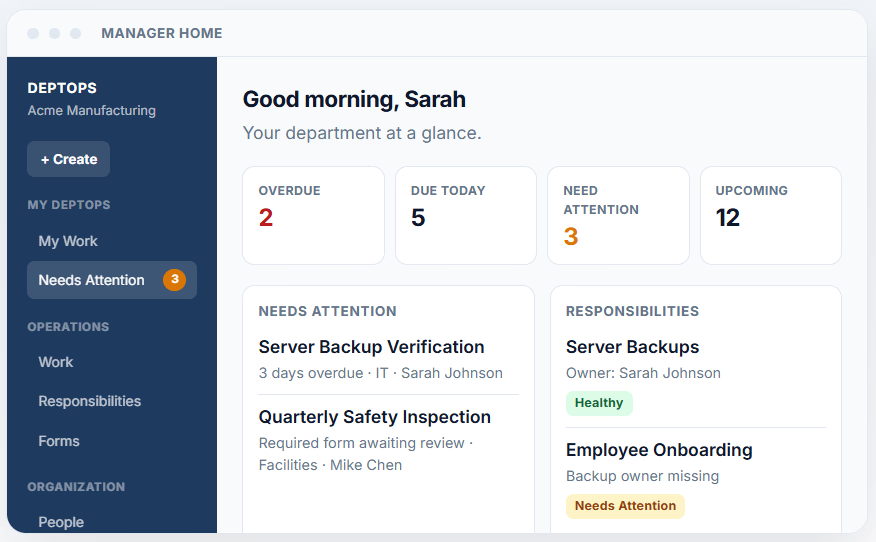
DeptOps provides a Needs Attention experience that surfaces operational exceptions, including overdue or blocked work and responsibility ownership concerns.
Rather than reviewing every activity individually, managers can concentrate on issues that may affect the department's ability to operate reliably.
This supports a more practical management approach: allow routine work to proceed while bringing exceptions into view.
My Team and Direct Reports
Department managers often need visibility at more than one level.
DeptOps provides team-oriented operational views and Direct Reports visibility on supported plans.
These capabilities help managers examine responsibilities and work associated with the people they oversee.
The distinction is important. A department manager may need to understand work across a department, while a direct supervisor may need a more focused view of the employees who report to them.
Both perspectives help answer the same fundamental question: what is happening with the work I'm responsible for overseeing?
Operational Health and the Operations Map
DeptOps also provides operational health information and, on supported plans, an Operations Map.
Operational health evaluates responsibility ownership and linked-work conditions, distinguishing between Critical, Needs Attention, Healthy, and Not Evaluated states.
This is particularly useful because the absence of a detected problem does not always mean a responsibility has been verified as healthy.
The Operations Map visually connects departments, people, responsibilities, and work, allowing managers to explore operational relationships and identify areas that may need attention.
These views help move department oversight beyond individual task lists toward a broader understanding of operational accountability.
Forms, Procedures, and Supporting Documentation
Many operational activities depend on established procedures or require information to be collected during completion.
DeptOps connects structured forms and supporting documentation with operational work.
For example, an inspection can require a completed form, and supported plans can route submissions through approval workflows.
This helps keep the work and its supporting information together rather than scattered across separate applications and shared folders.
Better Visibility Doesn't Mean More Micromanagement
There is an important distinction between managing operational work and monitoring every employee's activity.
Managers don't necessarily need to know what every person is doing every minute.
They need to know whether the department's responsibilities are being fulfilled.
That requires clear ownership, defined work, realistic deadlines, reliable completion records, and visibility into exceptions.
When that information is organized, managers can spend less time gathering status updates and more time resolving problems, coordinating priorities, and supporting their teams.
Employees also benefit from clearer expectations.
They can see what has been assigned to them, when work is due, and what is required for completion.
The goal is not to add another layer of reporting.
The goal is to make the operational information that already matters easier to see and act upon.
From Reactive Management to Operational Awareness
Consider two department managers.
The first relies on a combination of spreadsheets, email reminders, meetings, and employee updates to understand department activity.
The second has a structured view of responsibilities, ownership, recurring work, due dates, completion status, and operational exceptions.
Both managers may have capable employees and well-established procedures.
But the second has a more direct way to identify where attention is needed.
When an important activity becomes overdue, it can be identified without waiting for someone to mention it.
When responsibility coverage is incomplete, the gap can be made visible.
When employees change roles, the responsibilities and related work provide context for reassignment.
And when leadership asks how the department is performing, the manager has organized operational information to support the discussion.
That doesn't eliminate every operational problem. No software can guarantee that assigned work will be completed correctly or on time.
But it can reduce the uncertainty created when critical information is scattered across disconnected tools and individual memory.
The Real Question for Department Leaders
Most department managers already know how to assign work.
The challenge is maintaining a reliable picture of everything that must continue happening after those assignments are made.
- Who owns the responsibility?
- What work supports it?
- When is that work due?
- Has it been completed?
- What is falling behind?
- Where does management need to intervene?
These questions shouldn't require hours of searching, meetings, and follow-up messages.
They should be part of the department's normal operational visibility.
Because managing a department shouldn't mean guessing whether the work that keeps it running is actually getting done.
DeptOps gives department leaders a dedicated place to manage responsibilities, recurring work, ownership, and operational activity.
Departments, managed.
Learn more at DeptOps.com.