
Meal planning sounds simple in theory. Decide what you are going to eat during the next few days, put those meals on a calendar, buy what you need, and follow the plan.
In practice, that often means starting with an empty screen and making a long series of decisions. What should I cook on Monday? What about Tuesday? Which ingredients do I need? What is already in the fridge? Will I actually feel like making any of these meals when the day arrives?
That is why Delixio approaches meal planning from a different direction. Instead of beginning with an empty calendar, it begins with a much more concrete question: what can I make with what I already have?
Once a useful recipe has been found, planning becomes a continuation of a decision that has already been made rather than another planning task to complete.
The blank-calendar problem
Many meal-planning experiences start at the end of the process.
The user sees seven days, several empty meal slots and a large number of decisions waiting to be made. Even if the interface is excellent, the cognitive work still belongs to the person using it.
This can make meal planning feel surprisingly similar to maintaining another to-do list.
There is also a disconnect between the plan and the kitchen. A theoretically perfect weekly menu is not necessarily useful if it ignores the half-used vegetables in the refrigerator, the ingredients already sitting in the cupboard or the food that someone simply feels like using tonight.
For an ingredient-first cooking app, it makes more sense to reverse that sequence.
Start with something real
Delixio begins with ingredients.
A user might have zucchini, chickpeas, tomatoes and feta. Instead of asking them to construct a weekly plan around those ingredients manually, Delixio can first help answer the immediate question: what could these become?
AI is useful here because the starting combination is unpredictable. There is no fixed catalog that can anticipate every possible refrigerator.
But generating ideas is only the first step. Once a user finds a recipe they genuinely want to cook, something important has happened: one future food decision has already been made.
That is the natural moment for planning.
The user can cook the recipe now, save it for later or schedule it for a future meal. Planning becomes attached to something concrete rather than something hypothetical.
From recipe discovery to future intention
This distinction may sound small, but it changes the role of the planner.
A conventional planner asks, “What do you want to eat next week?”
An ingredient-first planner can instead ask, “You already found something useful. When do you want to make it?”
The second question is much easier to answer.
It also allows recipe discovery and meal planning to exist as one continuous workflow rather than two independent features. The recipe is not generated and then forgotten in a long history of AI responses. It can become an intention for tomorrow or another day.
This is one of the reasons Delixio includes planning alongside recipe generation rather than treating AI output as the end of the experience.
Planning should reduce decisions
There is a common temptation in productivity software to add more structure: more categories, more views, more controls and more ways to organize information.
For meal planning, however, the real value may be the opposite.
A good planning experience should reduce the number of decisions someone needs to make when they are hungry.
Imagine coming home tomorrow evening and already knowing what you intended to cook. The recipe was chosen earlier, when you had the ingredients in front of you and enough time to think about them.
That is useful not because the calendar itself is sophisticated, but because a decision has been moved away from the moment when it is hardest to make.
AI can help with the creative part of that process. Planning gives the result somewhere to go.
The grocery list becomes more focused too
Meal planning is closely connected to shopping, but there are two very different ways to approach that relationship.
One model begins with a weekly menu and creates a large shopping list for everything required to execute it.
The other begins with what is already available and identifies only what is still missing.
Delixio is designed around the second mindset.
If a recipe makes good use of ingredients the user already has but still requires something else, Grocery List can become part of the same cooking workflow. The goal is not to invent a shopping trip simply because a meal plan exists. It is to bridge the gap between the ingredients already available and the meal the user has decided to make.
That difference matters because a kitchen rarely starts empty.
Saved recipes are decisions worth keeping
Planning also works better when it is connected to memory.
Not every useful recipe needs to be scheduled immediately. Sometimes a user discovers something interesting but already has dinner sorted, or simply wants to remember the idea.
That is where Saved Recipes becomes part of the same system.
A saved recipe represents a decision that does not need to be made again from scratch. Instead of returning later and asking an AI to generate another set of possibilities, the user already has something they previously considered worth keeping.
The planning layer can then help turn that stored possibility into an actual meal.
This is a broader product principle for AI applications: useful output should not disappear when the conversation ends.
Your kitchen is part of the context
Delixio also includes My Kitchen, where users can keep track of ingredients they have at home, together with Use First for ingredients they would prefer to prioritize.
These features point toward the same idea: food planning becomes more useful when it has context.
A meal planner that knows nothing about the kitchen can organize dates very well, but it still starts from abstraction. An ingredient-centered workflow begins closer to the physical reality of cooking.
What is available? What should be used? What recipe has already looked appealing? What could be cooked later rather than now?
The planner does not need to replace all of those decisions. It needs to connect them.
AI should help before and after generation
Consumer AI products are often evaluated by the quality of the moment when the model produces an answer.
For cooking, that is an incomplete measure.
A beautifully generated recipe still has little value if the user forgets it five minutes later. The more interesting question is whether the product can help move the user from possibility to action.
That means thinking beyond generation.
A useful cooking workflow can connect several moments: discovering an idea, choosing the full recipe, saving it, scheduling it, managing what is missing and eventually cooking it.
The AI is important, but it does not need to dominate every stage. Some of the most useful parts of the experience are ordinary product features working around the intelligence.
The goal is not to make every interaction feel like talking to an AI. The goal is to make deciding what to cook easier.
Planning around real life
There is also a reason not to make meal planning too rigid.
People change their minds. Plans move. Someone may eat out unexpectedly, have leftovers or simply not want the meal they scheduled three days earlier.
That is normal.
A cooking planner should therefore be useful even for someone who does not want to prepare an entire seven-day menu every Sunday.
Scheduling one recipe for tomorrow is still planning.
Saving something for the weekend is still planning.
Adding the one missing ingredient to a grocery list is still planning.
The system becomes more approachable when planning is treated as a collection of small useful decisions rather than a weekly administrative exercise that must be completed perfectly.
From “what can I cook?” to “what will I cook?”
The original question behind Delixio is intentionally simple:
What can I cook with what I have?
AI makes that question much easier to answer because the possible ingredient combinations are effectively endless.
But there is a natural second question:
What will I actually cook?
That is where planning becomes important.
Recipe generation helps turn ingredients into possibilities. Saving keeps good possibilities from disappearing. Grocery tools help bridge missing pieces. Scheduling turns one of those possibilities into a future intention.
Together, those steps move an AI recipe generator closer to a practical cooking workflow.
And that may be the more useful role for AI in everyday food: not generating an endless supply of recipes, but helping people make a good decision with what they have — and remember that decision when it is time to cook.
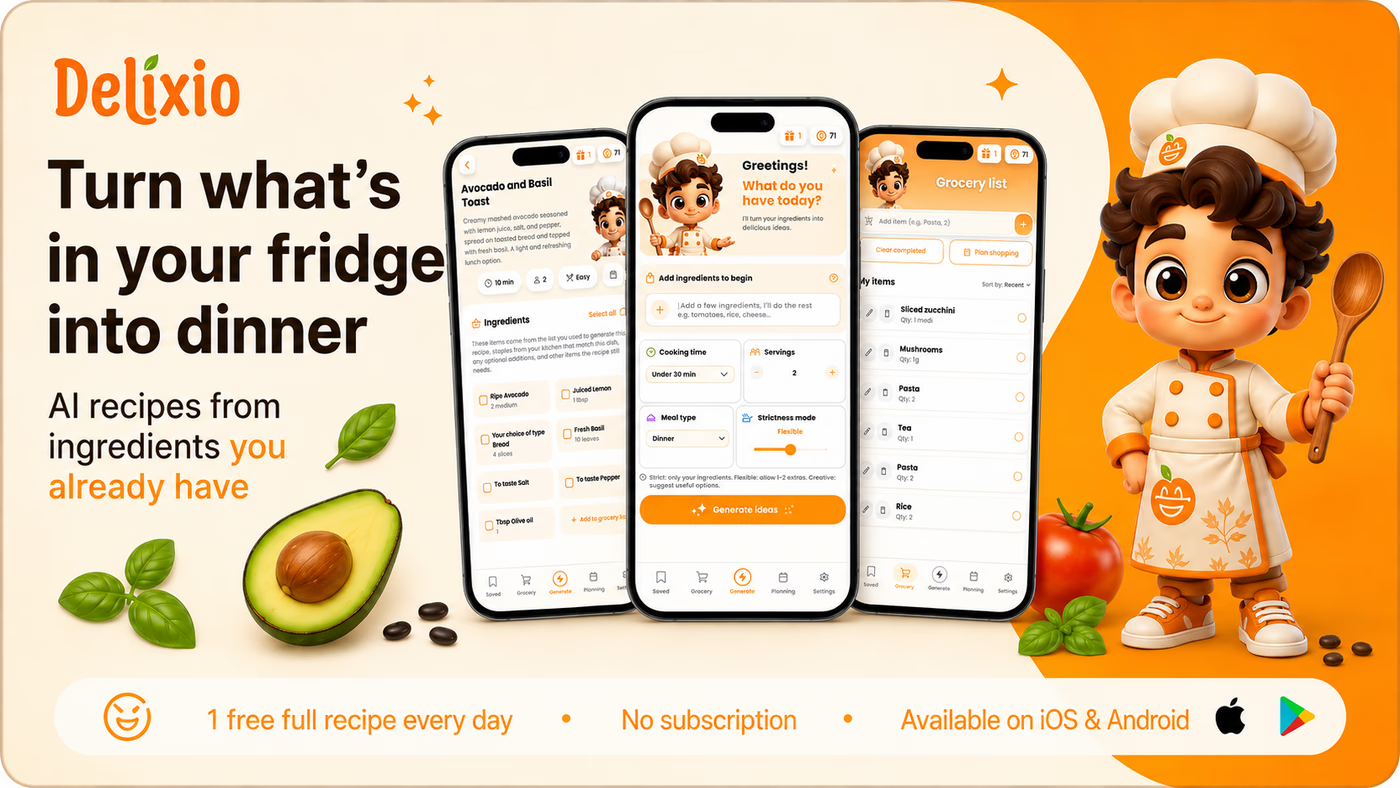
Delixio is an AI-powered cooking app for iPhone and Android built around ingredients you already have. Users can discover recipe ideas, unlock full recipes, save recipes they want to keep, organize ingredients with My Kitchen and Use First, manage Grocery Lists, and schedule meals for later.
Learn more at delixioapp.com.