
Moving to another country can look incredibly exciting from the outside.
A new city. A new culture. New opportunities. A completely different lifestyle.
Then you arrive.
Suddenly, the exciting parts of relocation are mixed with practical problems you did not fully expect. You need to understand how things work. You need to communicate in a language you may not speak confidently. You need to meet people. You need to figure out where to go, what to do, and how to turn a place that initially feels unfamiliar into somewhere that actually feels like home.
That is the part of moving abroad that often gets overlooked.
Relocation gets you to a new country. Integration is what helps you build a life there.
The hidden challenge of starting over
When people talk about moving abroad, they usually focus on the obvious things: visas, housing, jobs, paperwork, flights and finances.
Those things matter.
But once they are sorted, another challenge begins.
How do you actually build a social life?
You might spend your first few weeks exploring the city alone. You may want to meet people but not know where to start. You might understand the local language but hesitate to speak it because you are afraid of making mistakes.
Even simple situations can become surprisingly difficult.
Joining a conversation with a group of locals. Going to an event alone. Starting a conversation with someone you have never met. Understanding a joke in another language. Knowing which communities actually welcome newcomers.
None of these problems are solved by a relocation checklist.
They are solved by connection.
Language is not just about communication
Learning a language is often treated as an educational objective.
Learn vocabulary. Study grammar. Pass a test.
But for someone living abroad, language has a much bigger role.
Confidence matters just as much as correctness.
You may know the grammar and still struggle to speak spontaneously. You may understand what someone says but need several seconds to formulate your response. You may be perfectly capable of communicating but avoid conversations because you do not feel comfortable making mistakes.
Real-life conversation changes that.
Speaking with people regularly helps you become faster, more natural and more confident. It also teaches something a textbook cannot fully provide: how people actually communicate.
Expressions. Slang. Humor. Informal phrases. Cultural references. The little things that make a language feel alive.
That is why conversational practice can be so valuable for people living abroad.
You do not need to sound perfect.
You need to feel comfortable participating.
Your social circle does not appear automatically
One of the strangest parts of moving abroad is discovering how difficult it can be to make friends as an adult.
At school or university, meeting people happens naturally. You see the same people every day. Conversations happen between classes. Friendships develop without requiring much planning.
Adult life is different.
People have jobs, routines and established social circles. Making new connections often requires a conscious effort.
That can be especially difficult for someone who has just moved to a new country.
You might search for events online and find dozens of possibilities, yet still have no idea which ones are actually worth attending.
You might join a community but never move beyond introductions.
Or you might simply decide it is easier to stay home.
That is where events and communities become important.
A good event gives people a reason to show up.
A good community gives them a reason to come back.
And repeated interactions are often where genuine friendships begin.
The importance of doing things together
There is a major difference between meeting people and building relationships.
You can exchange names with twenty people at an event and remember almost none of them a week later.
Shared experiences are different.
Playing a sport together. Going to a language exchange. Attending a workshop. Exploring a new part of the city. Going to a social event with people who are also new to the area.
These situations create natural opportunities for conversation.
You already have something to talk about.
You already have something happening around you.
The interaction feels less forced.
This is one reason communities built around activities can be so powerful for people relocating abroad.
The goal is not simply to collect contacts.
It is to create opportunities for genuine connection.
Technology can help—but it cannot replace people
There are thousands of apps designed to make moving abroad easier.
You can search for accommodation, translate signs, find restaurants, navigate unfamiliar streets and communicate across languages in seconds.
Technology has made relocation dramatically easier in many ways.
But there is a limit.
An app can help you find an event.
It cannot create the feeling of belonging by itself.
An AI translator can help you understand a sentence.
It cannot replace the confidence that comes from having a real conversation.
A map can show you where people are.
It cannot make those people your friends.
The most useful technology is therefore not necessarily the technology that replaces human interaction.
It is the technology that helps people reach it.
This is where Fluoverse comes in
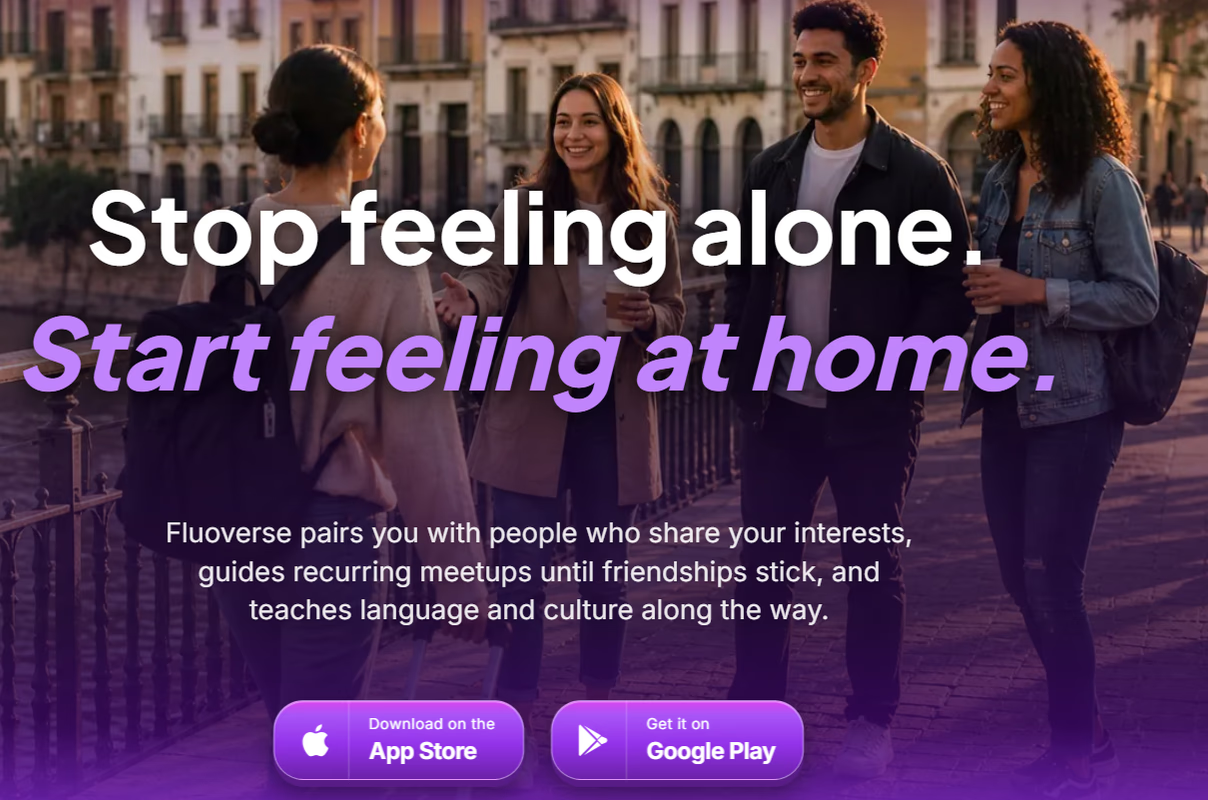
Fluoverse is built around a simple idea: moving abroad should not mean starting your social and language life from zero.
The platform combines opportunities to discover events and communities with language learning based around real conversational practice.
Instead of treating language as something you only study, Fluoverse focuses on using it.
Instead of treating social discovery as a directory of random activities, it aims to make it easier to find opportunities to actually meet people and participate.
The two things reinforce each other.
The more you use a language in real situations, the more confident you become.
The more people you meet, the more opportunities you have to practice.
And the more comfortable you become, the easier it is to participate in your new city's social life.
You do not need to “fit in” immediately
Another mistake people make when moving abroad is expecting everything to feel normal quickly.
It probably will not.
There may be days when you miss home.
There may be days when the language feels exhausting.
There may be moments when you wonder why everyone else seems to have already figured everything out.
That is normal.
Building a life somewhere new takes time.
The goal is not to become a local overnight.
The goal is to gradually create routines, relationships and experiences that make the place feel like yours.
Your first friend.
Your favorite café.
The event you start attending every month.
The local expression you finally understand.
The person you can call when you need help.
Those small things are what turn relocation into belonging.
The best way to settle in is to participate
You cannot fully experience a new country from your apartment.
You have to participate.
Speak the language, even when you make mistakes.
Go to the event, even when you do not know anyone.
Start the conversation, even when it feels awkward.
Explore the city.
Join communities.
Say yes to plans.
And keep doing it.
Because eventually, something changes.
The city becomes familiar.
The language becomes easier.
Faces become names.
Names become friends.
And the place you once described as “the country I moved to” starts becoming simply “home.”
That is the real challenge of moving abroad—and the real opportunity.
Fluoverse is built to help make that transition a little easier: by bringing language practice, events and human connection closer together.
Because relocating somewhere is only the beginning.
Building a life there is the real journey.