
When growth slows, the first instinct in e-commerce is often simple:
We need more traffic.
Increase Google Ads. Push Meta harder. Launch another campaign. Improve SEO. Send more email.
Sometimes that is exactly the right move.
But very often, it is not.
If the real problem is that visitors do not convert, customers do not return, measurement is unreliable, or profitable channels are already saturated, more traffic does not solve the problem. It simply sends more people into the same weak system.
That can make the numbers look busier while the underlying business gets worse.
The better question is not:
How do we get more traffic?
It is:
What is actually holding the business back right now?
A webshop is a system, not a collection of channels
Most e-commerce analytics tools organize the business by channel.
Google Ads has one report. Meta has another. SEO has another. Email has another. GA4 shows traffic and conversion. Shopify shows orders and revenue.
That is useful, but it encourages a channel-by-channel way of thinking.
The webshop itself does not work that way.
A store behaves more like a connected system:
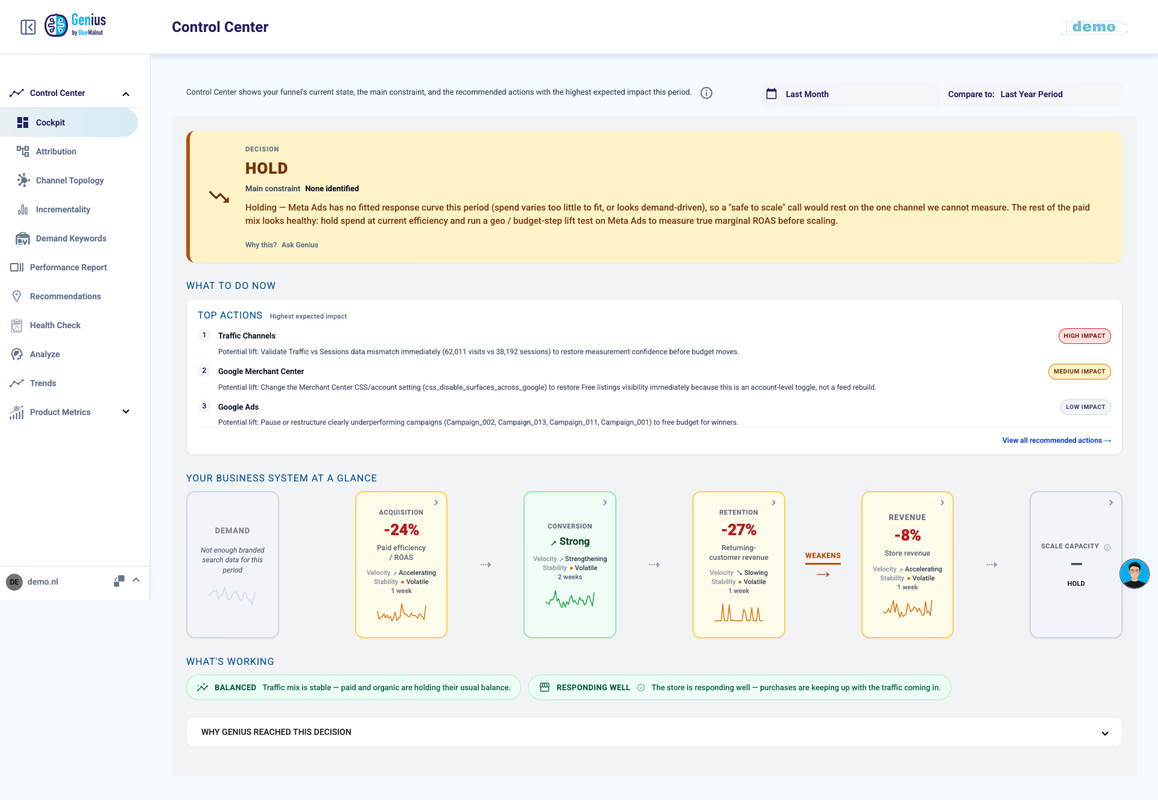
Demand → Acquisition → Conversion → Retention → Revenue → Scale Capacity
Each part influences the next.
If demand is weak, buying more traffic becomes harder and more expensive.
If acquisition is inefficient, the store may get visitors but destroy margin.
If conversion is weak, more traffic simply pushes more people through a leaking funnel.
If retention is falling, new-customer acquisition can temporarily hide the problem.
If measurement is unreliable, scaling decisions become guesses.
And if several of those areas are weakening at once, increasing spend may be exactly the wrong move.
This is why more traffic should not be the automatic answer to slower growth.
More traffic can amplify the wrong problem
Imagine a webshop with a conversion rate that has fallen sharply.
The marketing team notices revenue is down and increases paid traffic.
Sessions go up.
Spend goes up.
But orders do not improve enough to justify the extra budget.
At first glance, the problem still looks like a traffic problem because revenue is low.
In reality, the extra traffic has made the conversion problem more expensive.
The same can happen with retention.
A webshop may continue acquiring new customers while returning-customer revenue slowly deteriorates.
Paid media performance may still look acceptable for a while.
But underneath, the business is becoming more dependent on constantly replacing customers who do not come back.
Again, more traffic can hide the problem instead of fixing it.
The key is to identify the constraint
Every webshop has many things that could be improved.
That is not the same as knowing what should be improved first.
A Health Check may uncover technical issues.
SEO analysis may reveal lost rankings.
Google Ads may contain underperforming campaigns.
Meta may have unclear incrementality.
Merchant Center may contain rejected products.
Email may have untapped revenue.
Conversion may be weak.
Retention may be declining.
All of these can be true at the same time.
The challenge is prioritization.
Which issue is currently placing the biggest limit on growth?
That is the constraint.
And once you know the constraint, a lot of other decisions become easier.
If conversion is the main constraint, increasing traffic is usually premature.
If retention is the main constraint, fixing repeat purchase behavior may create more leverage than buying more visitors.
If acquisition is the main constraint and conversion is healthy, then increasing traffic may finally make sense.
If measurement quality is too poor to judge performance, the correct decision may be to pause scaling until the data is trustworthy.
The important point is that the right action depends on the system state.
Why dashboards often struggle with this
Dashboards are good at showing what happened.
Traffic is down 18%.
ROAS is 2.1.
Revenue is down 8%.
Conversion is 1.4%.
Returning-customer revenue is down 27%.
All useful numbers.
But the user still has to answer the hard question:
What matters most?
A dashboard can show ten problems at once.
It usually does not tell you which one deserves attention first.
That is where decision support becomes more useful than another layer of reporting.
Instead of asking the user to interpret all the metrics, the system should help answer:
What is the main constraint?
What should we do now?
Why?
An example: when HOLD is the right answer
Suppose acquisition efficiency is deteriorating, returning-customer revenue is weakening, and Meta Ads does not yet have enough reliable evidence to support further scaling.
A traditional workflow might still focus on campaign optimization:
Which ad should we pause?
Which audience should we expand?
Where can we increase budget?
But the better decision may be:
HOLD.
Do not increase paid spend yet.
First restore confidence in measurement, address the highest-leverage problem, and test whether the system responds.
That does not mean stop marketing.
It means do not scale blindly.
A HOLD decision can be just as valuable as a SCALE decision if it prevents wasted budget.
What this looks like in practice
A useful e-commerce decision layer should not start with a wall of KPIs.
It should start with the conclusion.
For example:
Decision: HOLD scaling for now
Main constraint: Conversion
Reason: Site-wide conversion has weakened while acquisition and revenue are also softening
What to do first: Fix the highest-impact conversion issue before increasing spend
Only after that should the user drill into the supporting evidence.
The detailed reports still matter.
The Health Check still matters.
Channel analysis still matters.
Attribution still matters.
But they should support the decision rather than compete for attention.
How BlueWalnut Genius approaches this
BlueWalnut Genius is designed around this constraint-first view.
Instead of treating every channel as a separate optimization problem, Genius combines signals across:
Acquisition, Conversion, Retention, Revenue and Scale Capacity.
The Control Center then tries to identify the part of the system that currently deserves the most attention.
Recommendations are ranked by expected impact.
The Health Check adds structural and technical evidence.
The Performance Report provides deeper monthly analysis.
And Genius Chat lets the user ask questions such as:
Why is conversion the main constraint?
Why should I hold Meta spend?
What should I fix first?
The goal is not to replace analytics.
It is to turn analytics into a decision.
More traffic is sometimes exactly right
None of this means traffic is unimportant.
Sometimes acquisition really is the constraint.
If conversion is healthy, retention is stable, measurement is reliable, and there is clear evidence that profitable demand can be captured, then increasing traffic may be the best move.
The point is not “do not buy traffic.”
The point is:
Do not assume traffic is the answer before you know what is limiting growth.
Find the leak before opening the tap
E-commerce teams are surrounded by ways to create more activity.
More campaigns.
More content.
More channels.
More traffic.
But activity is not the same as progress.
If the system has a leak, opening the tap further can simply waste more water.
Before increasing spend, it is worth asking one question:
What is actually holding the webshop back?
Once you know that, the next move becomes much clearer.
BlueWalnut Genius is built around that question.
Find the constraint. Fix what matters first. Then scale.