
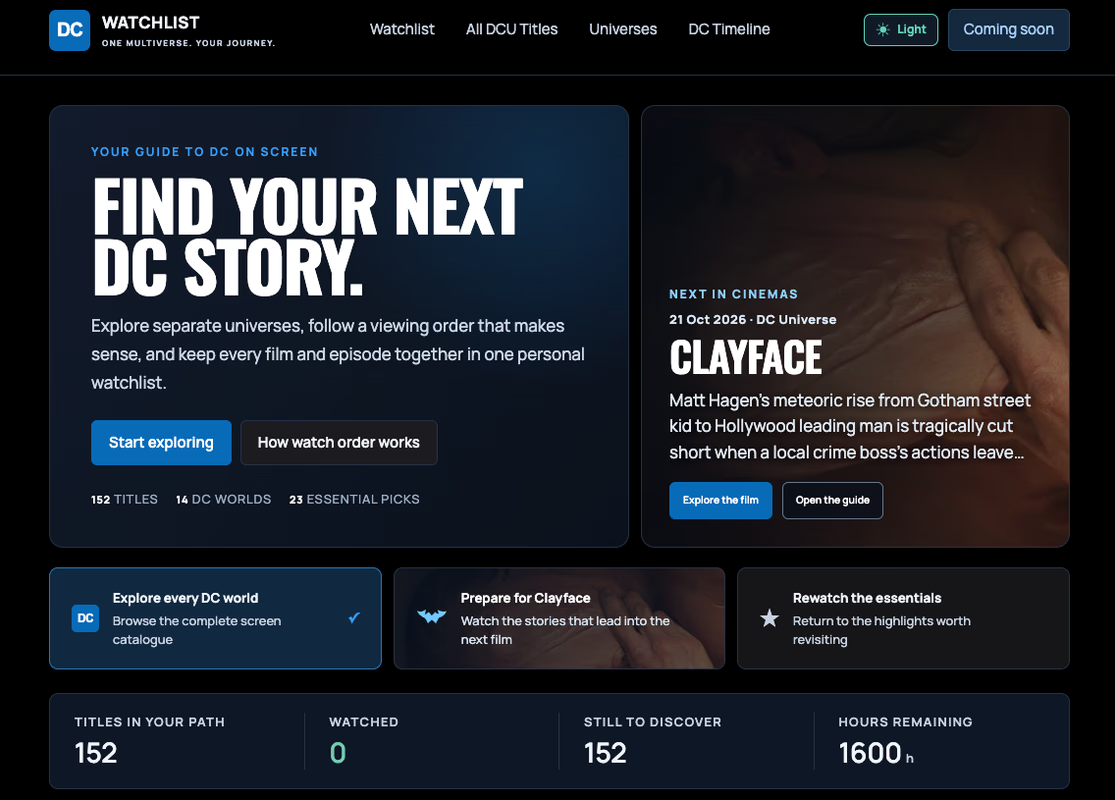
Streaming platforms keep adding DC titles faster than most fans can keep track of, and that pace has turned a simple question, "what should I watch next," into a genuine research project.
Movies from different eras sit next to each other on the same menu screen, characters share names across timelines that have nothing to do with each other, and a newcomer trying to start somewhere reasonable can end up more confused after an hour of searching than before they started.
DC Watchlist was built to solve exactly that problem, and it does so by treating the DC catalogue less like a random pile of titles and more like a set of separate, navigable worlds.
Mapping 152 Titles Across 14 Universes
At its core, the site is a structured database. It currently tracks 152 titles, split between 112 films and 40 television series, spread across 14 distinct universes and catalogue collections. That number matters because DC has never told one continuous story on screen.
The Dark Knight Trilogy, the DC Extended Universe, the newer DC Universe launched under James Gunn, the DC Animated Universe from the 1990s, and several Elseworlds projects all exist independently of each other, and mixing them up is the fastest way to ruin a viewing plan.
DC Watchlist keeps each continuity in its own lane, labeling every title so a viewer never mistakes one universe's Superman for another's.
Universe Order vs. Release Order
What makes the catalogue useful rather than just accurate is the choice it gives people about how to move through it. Two sorting options sit at the center of the experience: universe order and release order.
- Universe order groups connected stories together regardless of when they came out, which suits anyone trying to follow a single continuity from start to finish without noticing the real-world gaps between projects.
- Release order does the opposite, presenting titles in the sequence audiences actually saw them, which works better for viewers who want the historical experience or who are researching how the franchise evolved over decades.
Neither approach is presented as the "correct" one, and that matters, because DC fandom has argued about ideal watch order for years without ever settling it.
Tracking, Filtering, and Building a Schedule
Beyond ordering, the site layers in tools that turn browsing into planning. Every title can be marked watched or skipped, so a running list builds itself as someone works through a universe instead of relying on memory or a separate notes app.
Filters narrow the catalogue by universe, by format, and by watched status, which becomes genuinely useful once a list runs past a hundred entries. A synopsis toggle lets people choose whether they want spoiler-free browsing or full context before committing to a title, a small detail that shows some thought went into how differently people actually browse.
For anyone treating a rewatch like an event, there's also a schedule builder that turns a stack of runtimes into an actual marathon plan, which saves the tedious math of adding up episode lengths by hand.
1,600 Hours of DC, and Where to Actually Start
That runtime math turns out to be worth knowing on its own. According to the site's own tally, watching every released film and aired episode currently in the catalogue would take roughly 1,600 hours. Put another way, that's more than 66 straight days of screen time, and it's the kind of number that reframes how anyone thinks about "catching up" on DC.
Nobody reasonably plans to watch all of it, and the site doesn't pretend otherwise. Instead, it leans on curated Essential Picks, a smaller subset of titles flagged as the strongest entries within their universe, giving people a realistic starting point instead of an overwhelming full list.
Prepping for the Next Release
New releases get their own layer of attention. Upcoming films such as Clayface, Man of Tomorrow, and The Batman: Part II each come with dedicated prep guides that answer a narrower, more practical question: what actually needs to be watched before this specific film makes sense.
Rather than sending someone back through an entire universe, the guide points to a small handful of prerequisite titles and explains why each one was chosen, whether that's a returning character, a plot thread, or a tonal setup the new film builds on. That kind of targeted recommendation is far more practical than a blanket "watch everything first," especially for casual fans who mainly want context before a theater trip.
News, Updates, and Character Archives
The site also runs a news section covering DC announcements, casting updates, and release date changes, along with a "what's new" log that tracks additions to the catalogue itself.
Combined with a character archive spanning 30 entries, the effect is a resource that functions less like a static list and more like a living reference, one that gets updated as the franchise keeps moving.
Ratings and metadata are pulled from TMDB, while the actual viewing sequences and universe groupings are put together and maintained by the DC Watchlist team, which is worth knowing if you're wondering where the recommendations come from.
Who Actually Benefits From This
Casual viewers get the most obvious win, since they can walk in knowing nothing about DC's tangled screen history and walk out with a short, sensible list instead of a wall of unfamiliar titles. Longtime fans get something different but just as useful: a way to track what they've already seen across a catalogue too large to hold in memory, plus a quick reference whenever a new project drops and they need to know what actually connects to it.
Anyone planning a themed marathon, whether that's every Batman film in one sitting or a full runthrough of a single animated continuity, gets the scheduling math done for them instead of having to piece it together from IMDb pages and guesswork.
An Independent Guide, Not an Official One
DC Watchlist describes itself as an unofficial fan project, not an affiliate of DC or Warner Bros, and that independence shows in how the site is built. There's no pressure to push every title as must-watch content, no inflated runtimes to pad engagement, and no incentive to blur universes together for the sake of a bigger recommended list.
What's left is a tool built around a fairly simple goal: help people find the DC story that actually fits what they're looking for, without wasting an evening figuring out where to start.