Medical imaging - including MRI, CT, and X-ray scans - often marks a turning point in a patient’s health journey. Yet, receiving a radiology report after your scan can feel overwhelming: the language is technical, the findings may seem disconnected from your symptoms, and next steps are not always obvious. Many patients have more questions than answers, especially while waiting for a doctor’s appointment to clarify results.
Read Your Scan exists to bridge this gap, making imaging easier to understand, act on, and share - all while respecting your privacy and reinforcing the central role of your healthcare providers. Designed for patients, caregivers, and tech-savvy users alike, Read Your Scan provides clear explanations, mapped findings, and secure digital tools to help you take charge of your medical information.
Every tool is informational only and cannot replace licensed clinical expertise. Instead, Read Your Scan arms you with knowledge and clarity, empowering better conversations and confident decision making with your care team. Strict privacy policies protect your data: before any information leaves your device, identifying details are removed in your browser. You remain in control of your files at all times.
What follows is a plain-language overview of what Read Your Scan delivers, how it works, and how it helps you stay informed and prepared throughout your medical care.
Why choose Read Your Scan
Read Your Scan was created to address the challenges patients face when dealing with medical imaging - from confusing language to concerns about privacy and data control. Here are the key advantages:
- Faster understanding after your imaging appointment: Plain-language explanations and mapped findings are available within minutes, helping reduce anxiety and uncertainty while you wait for medical appointments.
- Plain-language explanations that make reports clearer: Complex medical terms are rewritten in everyday language. Instead of “unremarkable,” you’ll see “normal,” and unfamiliar findings are demystified without technical jargon.
- Better preparation for your doctor visits: Severity scores and visual highlights help you organize your questions, so you can make the most of your next conversation with your clinician.
- Easier sharing of your scan and report with family or caregivers: Generate private, read-only links to securely share your images and mapped reports, supporting informed discussions with loved ones.
Feature | Patient Benefit |
|---|---|
Plain-language summary | Converts clinical jargon into clear, comprehensible details |
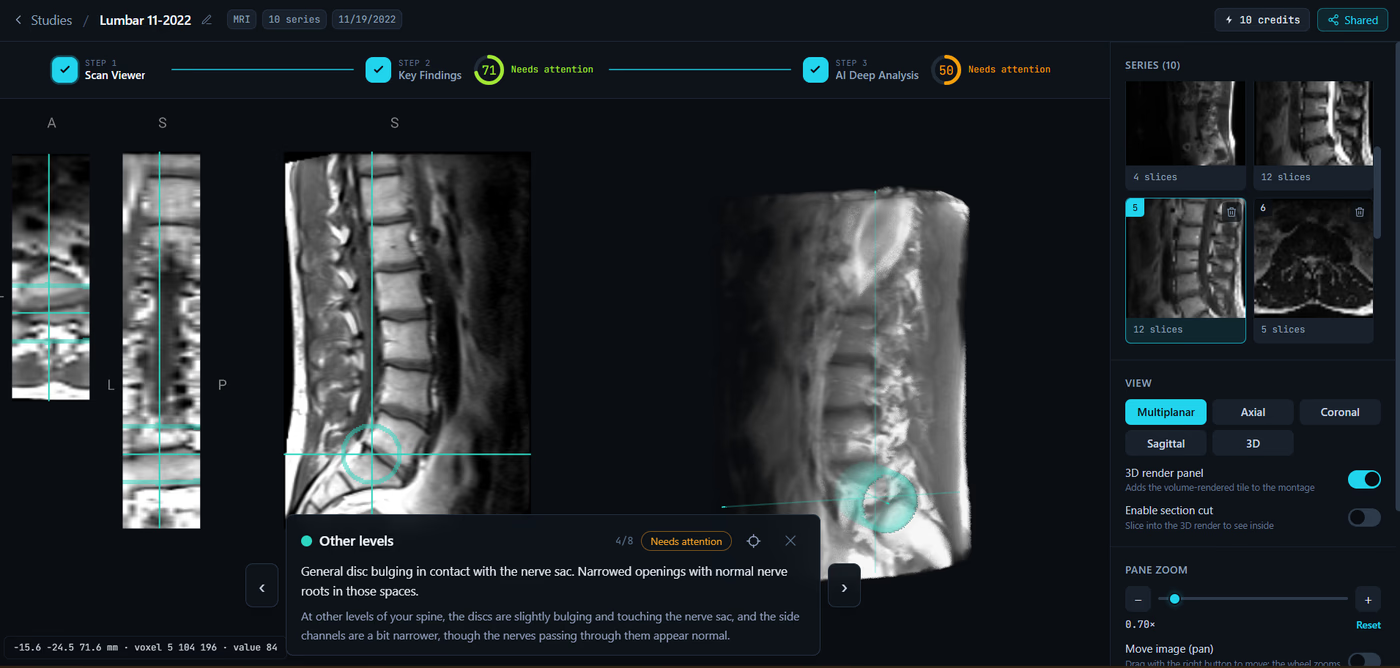
Findings mapped on your own images | Connects words in your report to exact locations in your scan |
Severity score | Provides a visual signal for follow-up urgency |
3D viewer | Shows your scan volume interactively in your browser |
Free tools | Removes financial and technical barriers to basic access |
Private sharing options | Lets you share only with whom you choose, on your terms |
Independent AI reading | Offers a fresh review - always as information, not diagnosis |
What Read Your Scan helps you do
Read Your Scan’s practical features put accessible health information in your hands:
- Understand technical radiology reports with mapped findings: Upload your report to see each finding explained in simple terms and visually connected to your images.
- See findings on your own MRI, CT, or X-ray images: Findings are highlighted on your scan, making it easier to understand what each comment refers to in your actual body.
- Get an independent AI-based second opinion reading: Order an independent AI second opinion on your MRI or CT scan for an informational review, separate from your radiologist’s summary - especially valuable if your symptoms and written report do not align.
- Access free tools like the 3D viewer and image converters: Use free medical imaging tools including viewers and converters to handle DICOM, NIfTI, or image file types directly in your browser - no need for downloads or signups.
These features are designed to be intuitive and empowering, supporting informed questions and helping you prepare for medical appointments with clarity and confidence.
How it works
Read Your Scan’s process is designed for privacy, simplicity, and clarity at every step:
- Upload your medical imaging files or radiology report (PDF, DICOM, JPG, PNG): Add your MRI, CT, or X-ray scans (accepted formats include DICOM, NIfTI, JPG, or PNG), or provide your radiology report PDF. Both scans and reports can be uploaded together for optimal mapping.
- All personal details are removed in your browser: Identifying information - such as your name, date of birth, and patient IDs - are automatically stripped from files before upload, so your data leaves your computer de-identified.
- The AI creates a plain-language explanation and maps findings onto your images: Using specialized algorithms, the system translates report language into simple explanations, connects each finding to its location on your scan, and assigns a severity score for easy triage.
- Review a severity score and suggested questions to ask your doctor: Each mapped finding is accompanied by a score (for example, “normal,” “needs attention,” or “significant”) with practical questions to discuss at your next visit.
- Share your de-identified study securely with your family or doctor: Easily generate a private, access-controlled link for sharing your mapped images and summaries with others.
For more information about the advanced reading process and patient pricing, visit the pricing details for Deep Analysis and other services page.
If you want to focus on having your existing report explained and mapped, explore the dedicated plain-language explanation and mapping of your radiology report service for full details.
What types of scans or reports it supports
You can use Read Your Scan with a wide variety of medical images and documents, making it accessible to most patients and caregivers. Specifically, the platform supports:
- MRI, CT, and X-ray images in DICOM or common image formats: Upload files in DICOM (the standard from medical imaging centers and hospital CDs), as well as JPG or PNG. DICOM files often include the most data, but simpler image formats are accepted for convenience.
- Radiology report PDFs in any language for plain-language mapping: Bring in PDF copies of your written report - even in non-English languages. Findings are extracted and mapped where images are provided.
- Support for NIfTI files and conversion from DICOM to NIfTI: NIfTI is commonly used for neurology studies. The service includes a converter for handling these advanced research formats, even if you’re not a technical user.
- Use of the free 3D viewer for volume rendering: The in-browser 3D viewer allows you to explore your full scan, slice by slice or in true volume, with no installation required.
A note on DICOM: DICOM (Digital Imaging and Communications in Medicine) is the international format hospitals use for radiology data. It combines scan images with technical information. If your files end in .dcm or you copied them from a CD, they are almost certainly DICOM. Other formats, like JPGs and PNGs, may be previews or exports, which are accepted but may have fewer technical details.
Input Type | Service Output |
|---|---|
DICOM scan (MRI, CT, X-ray) | Mapped findings, plain-language summary, severity score |
JPG/PNG image files | Mapped findings (if possible), plain summary, score |
NIfTI files | 3D viewing, summary with Deep Analysis |
Radiology report PDF | Plain-language findings, mapped if images also uploaded |
No registration is required for basic viewing or tool use; more advanced features and mapping are available with a free account.
Why plain-language imaging summaries matter
Standard radiology reports are written for fellow clinicians - not for patients - making them difficult to interpret for the people who need the information most. Making these documents accessible helps you be informed and active in your care:
- Medical reports are often hard to understand for patients: Terms like “effusion” or “attenuation” may be unfamiliar, or you may see “no acute abnormality” without any clear advice on what happens next.
- Plain language helps you know what needs attention: Mapped findings, clearly labeled (“normal,” “needs attention,” or “significant”), help you focus your questions and avoid unnecessary worry.
- Supports clearer communication with your doctor: The easier your summary is to grasp, the more you can participate in decisions. Bringing mapped findings to office visits ensures you and your clinician are literally “on the same page.”
- Improves ability to share and discuss findings with caregivers: Shared access to understandable information means family, advocates, or caregivers are truly informed and able to help.
To learn what common scan findings really mean, explore Read Your Scan’s comprehensive library of plain-language scan guides to better understand MRI, CT, and X-ray reports and terminology.
Privacy, security, and responsible use
Protecting your medical data is essential. Read Your Scan takes several steps to keep your information confidential and support informed, responsible use:
- Your data stays private - identifying info is stripped in your browser before upload: All personal information (name, date of birth, IDs) is erased from scan files before any upload happens, so your de-identified data never leaves your device.
- Read Your Scan is informational only, not a medical diagnosis: Every reading, summary, or explanation is for your understanding and preparation. The service cannot and does not offer clinical recommendations or diagnoses.
- AI readings provide additional insights but do not replace your doctor’s interpretation: Information is provided to complement - not supplant - your clinical care. Bring all findings and questions to your licensed provider for interpretation.
- Credits refunded automatically if an AI reading fails to complete: If a system error, incompatibility, or network problem prevents a reading, any purchased credits are restored automatically. Credits do not expire.
Informational, not advice: All results and summaries are meant for education, context, and preparation - never as a substitute for medical consultation. If you have new symptoms, feel unwell, or notice urgent findings, contact your healthcare provider directly.
Who it is for
Read Your Scan is designed with diverse users in mind:
- Patients who want to better understand their radiology reports: Anyone who wants plain-language insights, mapped findings, and practical follow-up questions can benefit.
- People seeking independent second opinions on scans: If symptoms and reports do not match, the service makes it possible to request an independent AI reading - useful as an informational “fresh eyes” review.
- Caregivers managing imaging histories for loved ones: Parents, adult children, or family caregivers can organize and explain scans for dependents, tracking imaging across years and visits.
- Medical imaging professionals and tech-savvy users seeking tools: Use free browser-based viewers, file converters, and secure sharing features for education, research, or remote consultations.
Whether you manage a single scan or dozens, Read Your Scan is built to simplify organization, interpretation, and communication.
When to contact a clinician urgently
Your safety is always the priority. The Read Your Scan service supports your understanding, but is not equipped for emergency care. Take these steps if you are concerned:
- If you feel unwell or have severe symptoms, contact your doctor or urgent care promptly: Do not wait for AI summaries or mapped reports if you experience chest pain, sudden numbness, confusion, shortness of breath, or any worrying change.
- Use the severity score as a prompt to arrange a follow-up if it’s in the amber or red zone: When flagged as “needs attention” or “significant,” findings should spur a timely medical visit (but are not, by themselves, emergencies).
- Do not rely solely on AI explanations for emergency decisions: These tools are not meant for urgent diagnosis or life-and-death decisions.
- Keep your original reports and share all findings with your healthcare team: For the most accurate advice, always bring both AI-assisted summaries and the original radiologist report to clinical appointments.
Frequently asked questions
What does Read Your Scan actually do?
The service translates technical radiology reports and scans into plain language, maps findings onto your images, assigns a severity score, and generates practical follow-up questions. It can also provide a fresh, informational review of your scan images, independent of your initial report.
Is it the same as getting a radiologist’s diagnosis?
No. Explanations and AI readings offer interpretive support only. Only licensed doctors and radiologists can diagnose, make recommendations, or provide authoritative medical advice.
What kinds of files can I upload?
Supported formats include DICOM (standard for medical imaging), JPG/PNG images, NIfTI neuroscience files, and PDF radiology reports. The service allows direct viewing, conversion, and mapping as appropriate.
How fast do results typically come back?
Most plain-language summaries and mapped findings are returned within minutes for standard files. Timing may vary based on file size and system demand.
Can I use the service if I only have a radiology report PDF?
Yes. The system can extract and explain findings from report PDFs alone, and will map findings onto scan images if both are provided.
How does it help me prepare for a doctor visit?
By clarifying findings, scoring urgency, and suggesting relevant questions, Read Your Scan helps you organize your concerns and supports more productive conversations with your healthcare team.
Is my information private and secure?
Yes. All uploads are stripped of identifying details in your browser before leaving your device. You control access for private sharing and can review, download, or delete your data at any time.
What should I do if the summary suggests something urgent?
An amber or red scoring, or any mapped finding labeled as “needs attention” or “significant,” should prompt a call or appointment with your doctor. If you feel unwell, seek medical attention immediately - do not wait for further summaries or rely solely on AI reports.
Can this replace a medical consultation?
No. All results are strictly informational. Only clinical professionals can interpret your imaging results and help you decide on treatment or next steps.
Read Your Scan is here to support you in understanding your medical imaging. By combining plain-language explanations, mapped findings, privacy-first technology, and clear educational guides, it puts you at the center of your own healthcare - always with respect for the expertise and authority of your clinical team.