
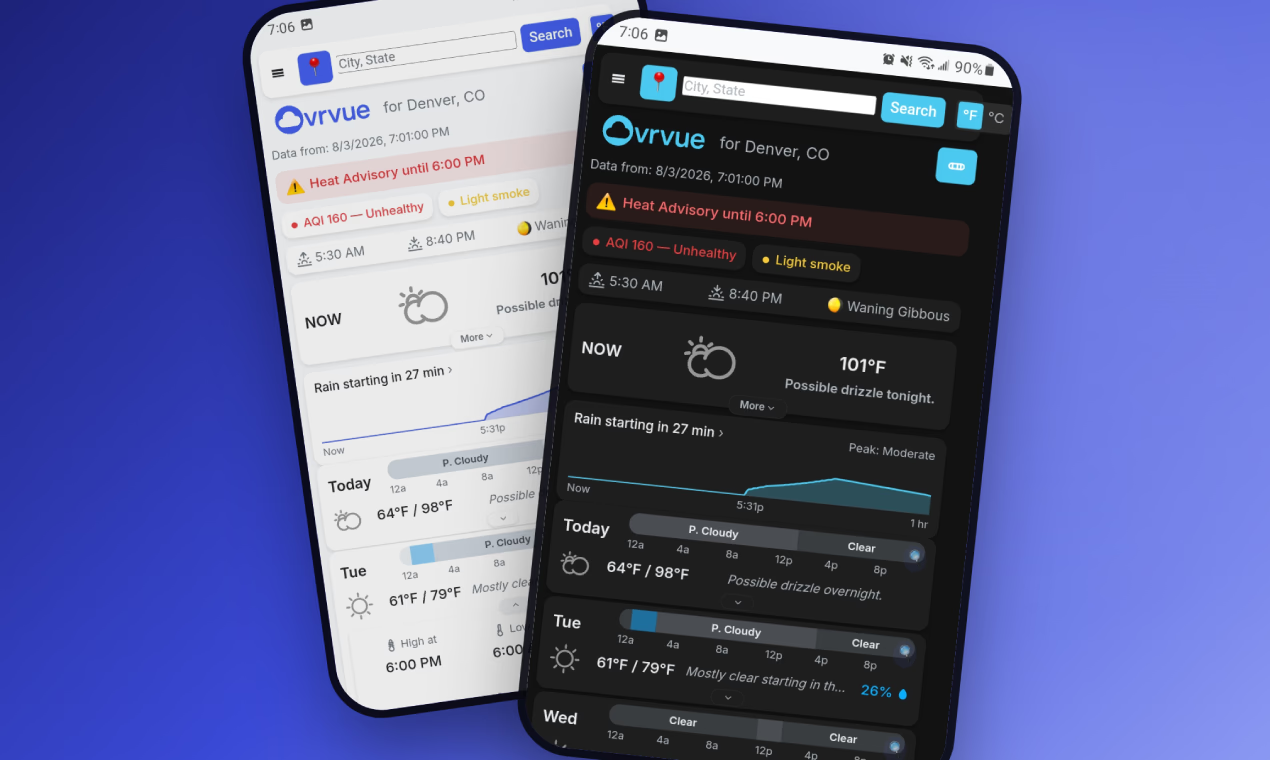
What If Your Weather App Couldn't Interrupt You?
Most software products are designed around capability.
Can it send notifications?
Can it run in the background?
Can it monitor continuously?
Can it reach the user even when the application is closed?
Can it bring someone back?
These questions usually have an obvious preferred answer.
Yes.
More capability means more options. A product that can send a notification does not necessarily have to send one. A service that can monitor continuously can theoretically exercise restraint. A company can build powerful infrastructure and then write policies explaining when that power should and should not be used.
That is the normal logic of modern software.
Ovrvue makes a stranger argument.
Its weather app has no backend continuously watching conditions while you are away. A browser-based PWA cannot simply wake itself whenever it wants, and Ovrvue has deliberately not added the server infrastructure required to overcome that limitation.
As a result, it cannot behave like a conventional weather-alert service.
It cannot spend all night checking the forecast.
It cannot discover something new at 3:12 a.m. and decide to buzz your phone.
It cannot manufacture reasons to bring you back into the product.
Its Event Watch feature only evaluates weather while the app is already open, then—if the user has explicitly opted into a relevant category—can leave a silent note in the phone's notification shade for later.
The Product Definition Document describes the principle behind this in unusually direct terms:
“Incapability as a guarantee.”
That deserves more attention than the feature itself.
We normally think good software should be capable of more and disciplined enough to use that capability responsibly.
But perhaps some kinds of software are better when certain forms of bad behavior are not merely discouraged.
They are impossible.
Notification Permission Is Really Power
A notification permission dialog appears tiny.
Allow.
Don't allow.
Behind those buttons is a much larger decision.
Giving an application permission to notify you grants it access to a scarce piece of your life: the ability to place information in front of you without being invited at that moment.
That is very different from opening an app.
When you open software, you have volunteered attention.
When software notifies you, it requests attention on its own schedule.
Sometimes that is exactly what you want.
A tornado warning should not politely wait until your next weather check.
A message from your child's school may matter immediately.
A banking alert about suspicious activity has a legitimate reason to interrupt.
But once a platform makes interruption technically available, almost every product can invent an argument for why its own information deserves the same privilege.
The package shipped.
The package moved.
The package will arrive tomorrow.
Someone posted.
Someone you don't follow posted.
A sale started.
A sale is ending.
Your weekly summary is ready.
You have not opened the app recently.
The technical difference between “possible to notify” and “appropriate to notify” is zero.
The product has to supply the restraint.
That is harder than it sounds.
Software Companies Have Reasons to Bring You Back
Notifications are often discussed as a user-experience feature.
They are also a distribution channel.
If a product can place a message on your lock screen, it has a direct route back to your attention that does not depend on you remembering the product exists.
That route is economically useful.
For products driven by engagement, advertising, subscriptions or retention metrics, an unused notification capability can start to look like wasted infrastructure.
This creates an awkward incentive.
A team can sincerely begin with high-value alerts.
Then somebody discovers that notifications improve return visits.
The threshold moves.
A feature whose original purpose was “tell the user when something truly important happens” quietly becomes “tell the user something whenever we can justify it.”
No villain is required.
The system itself creates pressure.
That is why architectural limits are interesting. They do something policy cannot.
They remove temptation.
Ovrvue.app Cannot Become a Background Nag Without Becoming a Different Product
Ovrvue is a static web application. According to its PDD, it has no backend, no framework and no account system. Its state lives locally on the device, while forecast information comes from external data sources.
That architecture creates obvious limitations.
One of them is that a PWA cannot simply wake itself whenever it chooses.
The PDD records the alternatives explicitly. Notification Triggers never became a dependable general browser capability. Periodic Background Sync is limited and throttled. Conventional Web Push would require a server to hold subscriptions and perform scheduled work.
Ovrvue could solve this.
Build a backend.
Collect push subscriptions.
Run scheduled jobs.
Check forecasts remotely.
Decide when something qualifies.
Send the notification.
This is how many perfectly legitimate services work.
But doing that would not be a small implementation detail.
It would change what Ovrvue is.
The product would become an always-on intermediary between the user and the forecast. It would need remote state. It would gain the ability to reach people who were not currently using it.
It would also gain a new class of responsibility:
deciding how often to exercise that power.
Ovrvue instead keeps the limitation.
The Event Watch system evaluates forecast data only when the application already has the user's attention. It does not make additional weather API calls. It does not fetch in the background. It can place a silent notification while open, and that notification can remain in the shade after the application closes.
The product borrows attention that has already been volunteered.
Then it goes back to sleep.
A Limitation Can Be Stronger Than a Setting
Software often tries to solve behavioral problems with preferences.
Turn off promotional notifications.
Choose notification frequency.
Mute this category.
Disable recommendations.
Set quiet hours.
These controls are useful, but they share a weakness: the underlying system remains fully capable of doing the thing.
The user has to trust configuration.
Ovrvue's missing backend is different.
There is no “we promise not to monitor you constantly” setting.
The architecture cannot monitor constantly.
That is a stronger guarantee.
This principle appears elsewhere in computing.
A camera without a microphone cannot secretly record audio.
A device with no network connection cannot quietly upload its contents.
A service that never receives a particular piece of information cannot later decide to analyze it.
The guarantee comes from absence of capability rather than responsible use of capability.
That changes the trust model.
You do not have to ask whether the product will behave.
You can ask whether it is able to misbehave in the first place.
Event Watch Still Has to Earn the Right to Speak
Architectural restraint does not eliminate product judgment.
It only raises the floor.
Ovrvue's Event Watch feature still needs to decide what conditions deserve a note.
The PDD records seven opt-in categories: snow, ice, storms, rain, wind, UV and smoke. All begin unchecked. The user must explicitly enable the categories they care about.
Even after that, the thresholds are deliberately different from the weather signals shown inside the app.
This matters.
Something notable enough to display while a person is already looking at the forecast is not automatically important enough to place in their notification shade.
Ovrvue's PDD makes that distinction explicit.
Its ordinary Layer 0 signals ask, essentially, whether something is notable today.
Event Watch asks a more expensive question:
Is this notable enough to warn someone about days ahead?
For storms, Event Watch uses only the stronger instability tier. Rain requires an additional probability floor. Smoke uses a substantially higher concentration threshold than the ordinary in-app smoke chip.
The PDD states the principle plainly: a gate that works for the main interface does not automatically work for notification.
That sounds obvious.
Software routinely forgets it.
Every Surface Has a Different Cost
A piece of information has no universal importance.
Its cost depends on where you put it.
A number buried inside a detail view can afford to be mildly interesting.
A chip on the main screen has to earn more attention.
A notification has to earn more still.
A sound or vibration should clear an even higher threshold.
Ovrvue.app effectively assigns different editorial prices to these surfaces.
The main app uses conditional signals.
Its newer persona chips are opt-in and appear only when a tomorrow-specific condition becomes relevant.
Event Watch goes further out into the future but requires explicit category selection and stronger gates.
And the notification itself is silent.
No sound.
No vibration.
No heads-up banner.
It simply exists in the notification shade.
This is an unusually literal interpretation of priority.
Ovrvue is not only deciding what to say.
It is deciding how loudly the information deserves to exist.
A Blizzard and UV Index Should Not Have the Same Lead Time
Notification systems often flatten time.
Something qualifies, so the alert goes out.
Ovrvue's Event Watch instead gives different categories different horizons.
Snow can qualify for an early note up to five days ahead and another closer to the event. Strong storms have a shorter early window. Ice shorter still. Rain and wind receive only close-stage warnings. UV can appear within two days. Smoke has its own limited horizon.
The reasoning is practical.
A snowstorm can affect flights, travel plans, grocery trips and work schedules days in advance.
Tomorrow's rain generally does not need Monday's attention.
Convective storms become unreliable when pushed too far out.
Different phenomena create different planning windows.
This seems like a weather-specific design problem.
It is really an attention problem.
Software often treats notification timing as a delivery optimization:
When is the user most likely to engage?
A utility should ask a different question:
When does this information first become actionable?
Those are not the same objective.
There Is a Two-Notification Ceiling
Another unusual constraint in Event Watch is the notification budget.
According to the PDD, one qualifying event can generate no more than two notifications: an early stage and a close stage. The system keeps a local ledger recording what has already fired so a flickering forecast does not continually reset the event and produce repeated alerts.
This is worth dwelling on.
Most software limits notifications through frequency controls.
No more than one per hour.
No more than X per day.
Those limits regulate volume.
Ovrvue limits them by event.
That matches how people think.
If Thursday has a snowstorm coming, it is one thing happening in the world.
It does not become a brand-new thing every time a forecast model changes its accumulation estimate.
The first note says: this may matter.
The second says: it is getting close.
Then the software is done.
No daily countdown.
No “storm update” merely because another forecast cycle arrived.
No repeated attempt to reclaim attention.
A hard ceiling forces the product to decide which moments are actually worth spending.
Uncertainty Makes Restraint More Important
Weather forecasting contains another complication.
Predictions change.
A storm may weaken.
Snow may shift north.
A smoke plume may miss the city.
Something worth mentioning four days out may disappear two days later.
This creates what the PDD calls the downgrade dilemma.
You could avoid false alarms by never warning early.
Then early warning becomes useless.
Or you could issue confident statements and retract them later.
Then users learn that notifications may be wrong.
Ovrvue's answer is partly technical and partly linguistic.
It can retract tagged notifications when the app is reopened and the event no longer qualifies.
More importantly, the wording preserves uncertainty.
“Storms possible Thursday.”
“Smoke possible Saturday.”
The PDD specifically refuses to convert smoke concentration into probability because concentration measures how thick a plume would be if it arrives, not how certain its arrival is.
That distinction is subtle.
It also represents a useful rule for notifications generally.
Interruption creates authority.
When software reaches out to us first, we tend to assume it has a good reason.
That makes hedging more important, not less.
The Best Notification System May Be One That Cannot Escalate
There is an appealing product philosophy hidden inside Ovrvue's implementation.
Most notification systems are built with enormous capability and then narrowed by rules.
Ovrvue starts narrow.
The app cannot wake itself.
It cannot continuously monitor.
It cannot send unlimited notifications from a remote service.
It evaluates only while open.
Categories are opt-in.
Notes are silent.
An event has a two-notification lifetime.
Thresholds are stricter than in-app signals.
The architecture and the product rules point in the same direction.
This alignment matters.
Policies can drift.
Teams change.
Metrics change.
Business models change.
A capability added for one responsible reason can later be used for another.
Architecture is harder to negotiate with.
If a product literally does not possess the machinery required to interrupt users continuously, no future growth experiment can flip a setting and start doing so.
Someone would first have to change the product itself.
That friction is valuable.
We Usually Ask What Software Can Do
Technology culture naturally celebrates capability.
Faster.
More automated.
Always connected.
Always available.
Running continuously.
Predicting before you ask.
Reaching you wherever you are.
For many problems, those are genuine improvements.
But capability is not neutral.
Every new ability creates a new decision about when it should be exercised.
An app that cannot notify you has no notification ethics problem.
An app that can notify you whenever it wants needs one.
Ovrvue's Event Watch does not prove that every product should reject background infrastructure. Severe weather services, medical systems, security products and countless other applications have legitimate reasons to run continuously and interrupt people when necessary.
The more useful lesson is narrower.
We should stop assuming that being technically capable of doing more is automatically an improvement.
Sometimes a missing capability protects the character of a product.
Sometimes a limitation prevents an incentive from becoming a behavior.
Sometimes “we can't” is a stronger promise than “we won't.”
Ovrvue happens to express that idea through weather notifications.
Its backend cannot wake up because there is no backend to wake up.
And that means the app cannot casually decide that its forecast deserves more of your day than the attention you already chose to give it.
For software, that may sound like a weakness.
For the person carrying the phone, it can feel remarkably close to respect.
Ovrvue.app is a personal weather app built around actionable conditions, progressive disclosure and deliberately restrained attention. Its optional Event Watch can leave silent notes about meaningful future weather without a backend continuously monitoring or interrupting you.
Learn more: https://ovrvue.app