The Goldmine Hidden in Plain Sight
If you have ever worked in B2B sales, growth marketing, or lead generation, you know that the best leads don't always come from neatly packaged API databases or expensive tools like ZoomInfo. Sometimes, the most high-intent, hyper-targeted leads come in the absolute worst format imaginable: a massive, clunky PDF file.
Think about it. Chamber of Commerce directories, industry association member lists, trade show attendee sheets, conference exhibitor guides, and corporate financial reports—these are absolute goldmines for Sales Development Representatives (SDRs). But they are almost always distributed as PDFs. Sometimes they are properly exported documents, but often, they are scanned pages or images crammed together into a single file.
For years, the workflow for a sales rep dealing with this has been miserable. You either spend hours manually copying and pasting emails into an Excel spreadsheet, risking carpal tunnel syndrome, or you outsource the job to a virtual assistant and wait 48 hours for the results.
There had to be a better way. But when I looked at the market, the existing solutions were fundamentally broken. That frustration was the genesis of PDF2Emails.
The Three Deadly Sins of Existing Lead Extraction Tools
When I started researching how people were solving this problem, I noticed three major issues that plagued the industry:
1. The Data Privacy Nightmare
If you search for "PDF to CSV converter" or "extract emails from PDF," you will find dozens of free online tools. But as the saying goes, "If you aren't paying for the product, you are the product." When a B2B agency uploads a proprietary, highly confidential client list to a random server, they are essentially giving away their data. Those free tools often scrape, store, and resell the emails you upload. For a legitimate lead generation agency bound by NDAs, uploading a client’s PDF to a third-party server is a massive compliance risk.
2. The Fragmented Workflow
Let’s say you actually manage to extract the emails safely. Your job still isn't done. PDF directories are notorious for having duplicate contacts. They also include generic emails (info@, support@) and personal emails (@gmail.com, @yahoo.com) which are terrible for B2B cold outreach. Finally, because these lists are often outdated, a large percentage of those emails will bounce.
To get a list ready for an outreach campaign, a marketer had to use Tool A to extract, Tool B to filter and deduplicate, and Tool C to run SMTP verification. It was a fragmented, expensive, and time-consuming mess.
3. The Subscription Fatigue
SaaS pricing has gotten out of control. Most lead generation and data cleaning tools force you into a $49 to $99 per month subscription minimum. But what if you only get a new trade show directory once every three months? Paying a recurring monthly fee for a one-off task is infuriating. Buyers are exhausted by subscriptions.
Building PDF2Emails: A Privacy-First Approach
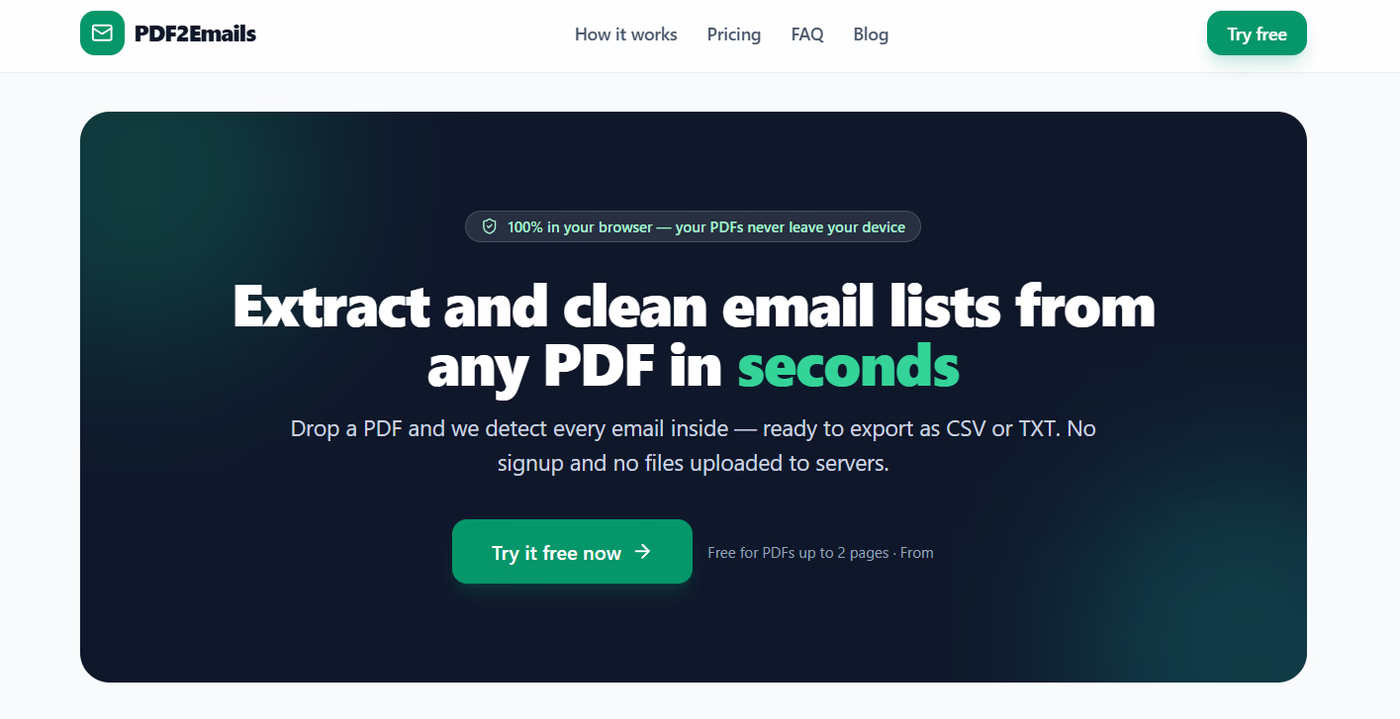
I decided to build a product that solved all three of these problems simultaneously. The vision for PDF2Emails was simple: A unified tool that extracts, deduplicates, filters, and verifies emails from any PDF, completely on-demand, with zero subscriptions.
But the most important architectural decision I made was regarding privacy. I wanted to guarantee to my users that I could never, ever steal their leads.
To achieve this, PDF2Emails was built to run 100% locally in the user's browser. Using modern web technologies like WebAssembly (WASM), all the heavy lifting—including Optical Character Recognition (OCR) to read scanned PDFs and images—happens entirely on the client side. Your device's CPU does the work. The file never leaves your computer, and it is never uploaded to my servers or any cloud storage.
The only time data touches our backend is when the user explicitly requests an SMTP verification check (to ensure the emails won't bounce). In that case, only the extracted email strings are pinged to our verification server, never the underlying proprietary document.
By building it this way, PDF2Emails became a zero-risk tool for enterprise SDRs and agencies.
The Launch: When Good Tech Meets Bad UX
With the tech stack finalized, I launched the product. The UI was clean, the OCR was lightning-fast, and the local processing worked exactly as intended. Traffic started coming in, and users were dragging and dropping their PDFs into the app.
But then, reality hit me in the face.
My conversion-to-paid rate was sitting at an abysmal 1.2%. People were successfully processing their PDFs, seeing the preview of the extracted emails, clicking the checkout button... and then abandoning the cart at the last possible second.
As a technical founder, my first instinct was to blame the pricing. "Maybe it's too expensive," I thought. But rather than blindly lowering prices and racing to the bottom, I decided to do something terrifying: I asked for a brutal, unfiltered UX teardown from a neutral product auditor.
I didn't want compliments; I wanted someone to tell me exactly why my product was failing to close the sale. The feedback I received was painful, but it was the most valuable lesson I’ve learned in my entrepreneurial journey. The auditor pointed out two massive blind spots that I had created.
Mistake #1: The "A La Carte" Pricing Trap
Because I wanted to be "fair" to the user, I had implemented a granular, pay-for-what-you-use pricing model at the checkout screen. When users clicked export, a modal popped up with six different checkboxes. They could pay $11.99 to unlock the PDF, add $2.49 for anti-spam verification, add $4.99 to enrich with names, add $1.49 to clean the data, etc.
To my developer brain, this was logical and modular. To the user, it felt like flying a budget airline where they charge you extra for a seatbelt and a carry-on bag. It created immense decision fatigue. Users didn't want to do mental math; they just wanted their list.
The Pivot: I completely scrapped the checkboxes. I bundled everything into simple, easy-to-understand packages. You either buy the "Basic Extraction" or you buy the "Premium Verified & Enriched" package. One click. Total clarity.
Mistake #2: The Privacy Contradiction
This was the most embarrassing mistake. My entire landing page shouted: "100% Privacy. Processed locally. Your files never leave your device." It was my biggest unique selling proposition.
Yet, in my checkout modal, right above the credit card form, I had a text input field that asked: "What email address should we send the processed list to?"
I had put that there simply because I wanted to send them a receipt and a backup link of their file. But to a skeptical B2B marketer, this was a massive red flag. Their internal monologue went like this: "Wait a minute... if this tool is processing my data locally in my browser, how can they email me the list? They MUST be uploading it to their servers! They lied!"
I had unknowingly destroyed my own trust signals at the most critical step of the funnel.
The Pivot: I completely removed the email input field from the extraction process. Now, the moment the payment is confirmed via our payment gateway, the application uses local browser memory to instantly generate a downloadable Blob URL (CSV or Excel). The user gets their file instantly, straight from their own RAM, proving that the data never left their machine.
The Power of the Pivot and the Pay-As-You-Go Philosophy
Within a week of swallowing my pride and implementing these UX changes, the results were staggering. Checkout abandonment dropped by 60%. My conversion rate jumped from 1.2% to a highly sustainable 4.5%.
The tech hadn't changed at all. The value proposition was exactly the same. But by reducing cognitive friction and aligning the UI perfectly with my privacy promises, the users finally felt comfortable pulling out their credit cards.
Today, PDF2Emails stands as a testament to the power of micro-SaaS and the pay-as-you-go model. In a world where every software company wants a ring on your finger and a monthly drain on your bank account, we offer a refreshing alternative: come when you have a problem, pay a few dollars to solve it instantly, and leave until you need us again.
Looking Ahead: The Future of Lead Extraction
The landscape of cold email and outbound sales is changing rapidly. With Google and Yahoo enforcing strict new spam policies, deliverability is everything. You cannot afford to blast emails to unverified lists anymore; a bounce rate over 0.3% can land your entire domain on a blacklist.
That is why combining extraction with real-time SMTP verification is no longer just a "nice-to-have" feature—it is mandatory for survival in B2B sales.
Building PDF2Emails has taught me that the best software doesn't just automate a task; it respects the user's time, protects their data, and asks for a fair price only when value is delivered.
If you are an SDR, an agency owner, or a bootstrapped founder staring at a massive PDF directory right now, dreading the next few hours of copy-pasting... give PDF2Emails a try. Drop your file in, watch the engine extract the data right in front of your eyes, and get back to doing what you actually do best: closing deals.