
Most 16 year olds spend their evenings on homework, sports, or just hanging out. Rhev Williams spent his tinkering with a Raspberry Pi in rural Idaho, quietly laying the groundwork for a company that would eventually reach a six figure valuation. Today he's the founder and CEO of Botifex, an AI powered deal discovery platform that helps resellers and bargain hunters spot opportunities across marketplaces before anyone else does.
There was no Silicon Valley pedigree here. No accelerator program, no co-founder with a computer science degree, no seed round from a friendly angel investor. Just a kid on a farm with an internet connection, a coding class, and an idea he couldn't quite let go of. It's the kind of story that sounds almost too tidy when you say it out loud, but the timeline actually backs it up, and that's what makes it worth telling.
From a Coding Class to a Side Hustle
Rhev's path into software started somewhere pretty unremarkable: a high school programming class that happened to cover web scraping, which is basically the practice of writing code that automatically pulls information off websites. For most students in that class, it was probably just another assignment to get through before the bell rang. For Rhev, it clicked into something bigger almost right away.
He'd already been reselling on the side, the same grind a lot of people quietly do on evenings and weekends. Find something undervalued, buy it, flip it for a profit. It's simple in theory and genuinely tedious in practice, because most of the work isn't the selling part, it's the searching. You're refreshing Facebook Marketplace fifty times a day hoping to catch a good listing before someone else does.
Web scraping gave Rhev an idea that seems obvious in hindsight but wasn't something most 16 year olds would act on: what if the searching itself could just run in the background? What if instead of him hunting for deals, the deals came to him?
SuperBot: Chasing a Dream Car
Like a lot of good ideas, this one started out pretty personal. Rhev wanted a C3 Corvette. Not a business plan, not a market he'd researched, just a car he liked and couldn't afford to keep checking for manually every day. So he built a tool to do it for him.
In May of 2025 he finished his first working prototype, which he named SuperBot 1. It ran on a single Raspberry Pi, a computer roughly the size of a deck of cards, and it did exactly one job: scan Facebook Marketplace listings for C3 Corvettes and flag anything that popped up. It wasn't polished and it definitely wasn't meant to be. It was scrappy, it worked, and that was the whole point.
Around this same stretch of time, Rhev made a choice a lot of founders will recognize even if they'd never put it this way themselves. He pulled back from a chunk of his social life to put the time into the project instead. Less hanging out, less of the usual teenage social calendar, more hours spent debugging code on a tiny computer in his room. It's not a dramatic detail and it probably didn't feel dramatic at the time either, but it's the kind of quiet tradeoff that shows up in almost every early founder story once you actually ask about it.
From that first single purpose scraper, Rhev just kept building.
- SuperBot 2, July 2025. He expanded past Facebook Marketplace to include KSL Classifieds and eBay, so the tool was pulling listings from multiple platforms at once instead of just watching one feed.
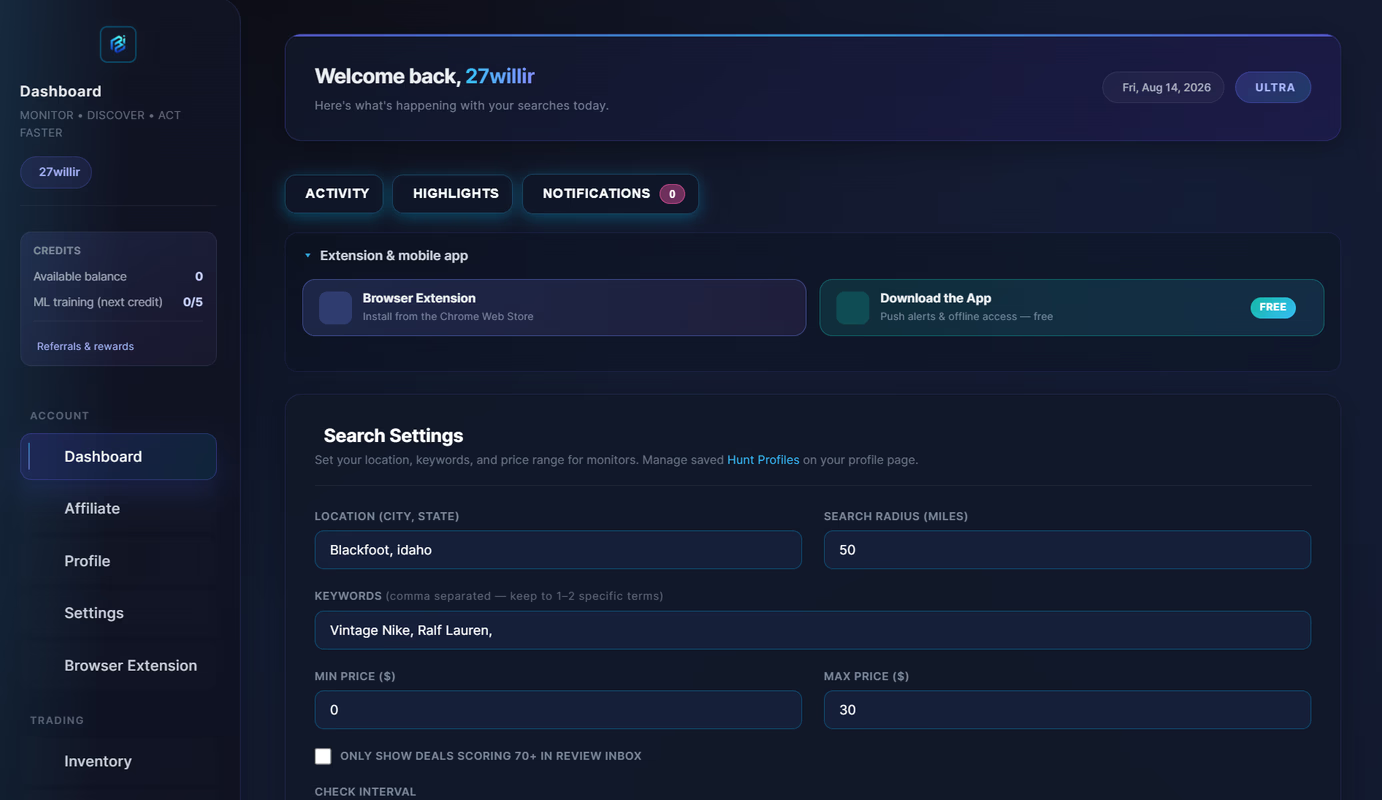
- SuperBot 5, September 2025. This version added an actual user dashboard, along with AI powered filtering, pattern recognition, and a basic deal scoring system. This was the point where a personal automation script started feeling less like a hobby project and more like an actual product. Rhev officially launched the company this same month.
- October 2025. With something real now sitting behind it, Rhev named the company Botifex, a mashup that nods to bot driven automation paired with AI capability. He positioned it as a full deal discovery platform rather than just a scraping tool, which matters more than it might sound like, because it's the difference between a script that finds Corvettes and a product that's supposed to work for anyone hunting anything.
From that first prototype to a named, operating company took him under six months. For context, that's faster than a lot of funded startups move, and he did it without funding, without a team, and while still going to class.
What Botifex Actually Does
It's worth slowing down here, because the founder story is the part that gets shared and the product tends to get skipped over, and that's a mistake, because the product is genuinely the more interesting half.
Botifex solves a problem that anyone who's ever tried reselling seriously will recognize instantly: by the time you manually spot a good deal, somebody else has probably already messaged the seller. Marketplaces move fast, especially on anything with real resale value, and the reseller who checks a feed every twenty minutes is always going to lose to the one who gets notified the second a listing goes live.
Instead of manually checking Facebook Marketplace, eBay, Craigslist, OfferUp, Poshmark, and Mercari one at a time, Botifex watches all six at once and surfaces the listings worth acting on. You set keywords and a max price, and the platform does the rest of the legwork. Someone lists a MacBook Pro for 750 dollars when you know it typically resells for 1,200, and Botifex catches it and pings you, ideally before anyone else has even seen it.
Speed is really the core selling point. On the paid tiers, Botifex checks marketplaces roughly every five minutes. That sounds like a small number until you compare it to what most people are actually doing, which is manually refreshing every 20 minutes or more if they're lucky, or realistically forgetting to check for hours at a stretch because life gets in the way. A listing that goes up at 2:14pm and gets flagged by Botifex at 2:19pm gives a user a real window to act. A manual refresh at 2:20pm is already too late, and anyone who's lost a good flip to someone faster knows exactly how that feels.
But speed alone isn't the whole pitch, because a fast alert for a bad deal is still a bad deal. That's where the AI filtering comes in. Botifex doesn't just surface every listing that matches a keyword, it also tries to separate a listing that's actually underpriced from one that just looks cheap at first glance. If something is 50 dollars below the market average for that category and condition, the platform can flag that context so the user isn't just guessing based on a gut feeling.
That distinction matters a lot more than it sounds like on paper. A huge part of reselling is knowing the difference between "cheap" and "profitable," and those two things get confused constantly, especially by newer resellers. A listing might look like a steal at first glance and then fall apart once you factor in marketplace fees, shipping costs, and how long an item is realistically going to sit before it sells. Botifex tries to close that gap by attaching resale comps, sell through data, and estimated profit directly to the deals it surfaces, instead of leaving users to open five extra browser tabs and do the math by hand every single time a listing comes in.
There's also a practical tool that gets less attention but genuinely helps: a free flip profit calculator, essentially a spreadsheet where a user plugs in purchase cost, marketplace fees, and shipping, and gets a quick green, yellow, or red signal on whether the math actually works before they even message a seller. It's a small thing, but it's the kind of small thing that saves people from the classic beginner mistake of buying something that looked profitable and turned out not to be once all the real costs were added up.
Under the Hood: How the Platform Is Structured
Botifex is organized around a handful of core building blocks, and understanding them helps explain why the product has grown the way it has since October 2025.
Marketplace coverage. The platform currently watches six major marketplaces: Craigslist, eBay, Facebook Marketplace, OfferUp, Poshmark, and Mercari. That's a meaningfully wider net than most competing tools, many of which specialize in just one platform, usually Facebook Marketplace or eBay, and leave everything else to manual checking. Craigslist in particular is worth mentioning because it's one of the only major marketplaces in 2026 that still has no native alert system built in at all, which is part of why third party tools like Botifex exist in the first place.
Refresh speed. Free accounts get a slower refresh cycle, while Pro and Ultra tiers check every five minutes. This tiered approach makes sense from a product standpoint, since it gives new users a genuine feel for the platform before asking them to pay for the faster version, while reserving the real competitive advantage, speed, for paying customers who need it most.
Keyword and price filtering. Users aren't just searching broad categories, they can set specific keywords alongside a maximum price threshold. That combination, keyword plus price ceiling, is a lot more useful than keyword alone, because "vintage camera" returns thousands of irrelevant results, while "vintage camera under 100 dollars" returns something a person can actually act on.
AI deal scoring. This is the layer that was added with SuperBot 5 back in September 2025 and it's stayed central to the product ever since. Rather than treating every matching listing equally, the system tries to rank and score them based on how good a deal actually looks relative to typical pricing in that category.
Category tuning. Botifex lets users tune alerts around specific categories such as electronics and gaming, tools and equipment, furniture, auto parts, and collectibles, since each category has wildly different normal price ranges, typical keywords, and timing patterns. A good deal threshold for furniture looks nothing like a good deal threshold for auto parts, and building that logic into the product instead of leaving it to the user is a meaningful design choice.
SMS alerts. On the higher tiers, alerts come through as text messages rather than requiring someone to have the app open or refresh an inbox, which matters a lot for the speed advantage to actually translate into real world action.
Pricing and Access
Botifex follows a fairly standard freemium structure that will feel familiar if you've used other SaaS tools, though it's still worth breaking down because the free tier is more generous than a lot of comparable products offer.
New users get a 7 day trial of full Pro features with no credit card required. That means unlimited keywords, access to all six marketplaces, the 5 minute refresh cycle, SMS alerts, and full analytics, all without paying anything upfront. After the trial period, accounts drop down to the free plan unless the user chooses to upgrade to Basic, Pro, or Ultra.
The paid tiers scale mostly around refresh speed, marketplace access, and proxy limits, with Ultra unlocking unlimited proxy data and first access to new features as they roll out. All plans can be cancelled at any time, and the general pitch, which shows up throughout Botifex's own marketing, is pretty straightforward: one successful flip a month is usually enough to cover the cost of the subscription. Missing a single good deal because you weren't fast enough often costs more than a month of Pro would have.
That framing is smart, honestly, because it reframes the tool from an expense into something closer to insurance against missed opportunities, and for anyone who resells with any regularity, that argument tends to land.
The onboarding itself is pretty low friction too, at least based on how it's described. After checkout, or after just picking the free plan, a new user lands on a signup form asking for name, phone number, zip code, email, and a password, and from there they're dropped straight into the dashboard. The zip code and phone number aren't just formalities either, they get used to tune which listings are geographically relevant and to make sure SMS alerts actually reach the right device the moment something worth acting on shows up. For a tool that's selling speed as its main advantage, cutting down the friction of getting started matters more than it might seem, since every extra step between signing up and getting your first alert is a chance for a potential user to lose interest and never come back.
What Makes Rhev Williams Different
Rhev represents a slightly different kind of tech founder, one defined less by pedigree and more by persistence and a willingness to just start before everything is figured out. A few things really stand out about how he got here.
He started from essentially nothing. No outside investment, no co-founder, no technical team backing him up. Just a Raspberry Pi, an internet connection, and a stubborn willingness to keep figuring things out one problem at a time. That's a very different starting point than most founders you read about, who often have some combination of savings, connections, or at least a co-founder to split the workload with.
He built the thing for himself first. Botifex wasn't dreamed up in a boardroom based on market research or a spreadsheet full of total addressable market calculations. It came out of Rhev personally wanting to find deals faster, and that kind of authenticity tends to show up in the finished product. Founders who build for themselves first usually end up solving real, specific problems rather than problems that only exist on paper.
He moved fast, and he moved fast on his own schedule. Going from a single purpose Corvette scanner in May to a named, operating company by October, all in under six months, is a pace a lot of funded startups with full teams would be proud of. There's something to be said for the fact that he didn't wait for permission, funding, or a perfect plan before starting to build.
And he came at all of this from outside the tech bubble entirely. Growing up on a farm in small town Idaho gives Rhev a perspective that most Silicon Valley founders simply don't have access to. There's no nearby network of engineers to bounce ideas off of, no local meetup full of other founders working through the same problems, no easy access to mentors who've already built something similar. What he had instead was resourcefulness, and the experience of building something entirely without a safety net underneath him.
It's worth pausing on that last point a bit longer, because it's easy to gloss over. Most founder profiles you read about involve someone who moved to a city, or already had a network, or at the very least had a friend who knew somebody who knew somebody in venture capital. Rhev had none of that geographic advantage. What he had was a farm, a Raspberry Pi that probably cost less than most people spend on a night out, and a genuine reason to keep going even when the early versions of the tool were clunky and limited to one category on one platform. There's a version of this story where he stops after SuperBot 1, satisfied with just finding himself a Corvette, and that would have been a perfectly reasonable place to stop. He didn't, and that's really the whole difference between a fun personal project and an actual company.
The Product's Place in a Crowded Market
It's fair to ask where Botifex actually fits, since deal alert tools aren't a brand new category. Resellers have had access to saved searches and notification tools for years, and most major marketplaces at least attempt to offer something in this space themselves.
The gap Botifex is aiming at is coverage plus intelligence, rather than just coverage alone. A lot of existing tools are either abandoned projects that haven't been updated in years, or they only work on a single platform, which forces resellers to stitch together multiple tools just to get the coverage they actually need. Poshmark and Mercari, for example, technically offer their own saved search notifications, but in practice those systems tend to fall short of what a serious reseller actually needs, since they're often built around social activity notifications like follows and comments rather than genuinely alerting users the moment new inventory matching their search hits the platform.
Craigslist doesn't even attempt native alerts at all, which is exactly the kind of gap that third party tools like Botifex were built to fill in the first place.
By combining coverage across six platforms with AI scoring and profit context in one place, Botifex is trying to be the single tool a reseller needs instead of one piece of a larger, messier stack. Whether that fully holds up depends a lot on how the AI scoring performs in practice across different categories, since electronics pricing behaves very differently than furniture or collectibles pricing does, but the ambition behind the product is clear enough even from the outside.
There's also a maintenance problem in this category that doesn't get talked about enough. A lot of scraping and alert tools get built by a solo developer, generate some early buzz, and then quietly stop getting updated once marketplaces change their site structure or add anti bot measures. The tool doesn't announce it's broken, it just slowly starts missing more and more listings until users notice their alerts have gone quiet. Active development, meaning someone is actually still shipping fixes and keeping pace with how marketplaces evolve, ends up being one of the more underrated factors in whether a tool is worth paying for at all. Given that Rhev is still the one actively building and expanding Botifex, that ongoing attention is arguably as important to the product's value as any individual feature.
There's also the question of who each type of tool actually serves best. A casual reseller who lists a handful of items a month probably doesn't need six marketplace coverage and AI scoring, a single saved search on one platform is probably fine. But someone treating reselling as a real side income, or a full business, runs into the exact bottleneck Botifex is built around: too many platforms to check manually, too much time lost to research, and too much competition from other resellers using the same basic tools. That's the segment Botifex seems to be building for, and it tracks with Rhev's own background, since he wasn't building this for a hypothetical market, he was building it because he was that reseller himself.
Early Traction and What Comes Next
Under Rhev's leadership, Botifex has grown into a company now valued in the six figures, which is a genuinely remarkable outcome for any founder, let alone someone who built version one on a single board computer while still attending high school. The company has also picked up some visibility along the way, including a feature on Product Hunt, which tends to be a meaningful signal in early stage software circles even if it's not a guarantee of long term success on its own.
User feedback that's circulated publicly points to the same core value proposition showing up again and again: speed translating directly into real outcomes. One user mentioned increasing their successful purchases threefold after switching to the platform's faster alert tiers, and another described finding a 4,000 dollar camera deal within two minutes of it going live. Anecdotes like that obviously aren't a substitute for hard data at scale, but they do line up with the core pitch of the product, which is that being first to a listing is often the entire difference between winning a deal and missing it.
Looking forward, the natural next steps for a platform like this would be expanding marketplace integrations even further, refining the AI scoring so it adapts more precisely to each category rather than applying one general model across very different types of goods, and continuing to build out the analytics side so users can actually track their performance and margins over time rather than just chasing one deal after another without a bigger picture in view.
There's also an obvious opportunity in going deeper on categories rather than just wider on platforms. Right now the tuning options cover things like electronics, tools, furniture, auto parts, and collectibles, and each of those is honestly its own little world with its own pricing quirks. A serious camera reseller and a serious furniture flipper are looking for completely different signals even though they're both technically using the same app. Building out more specialized scoring within each category, instead of one general purpose model trying to cover everything reasonably well, seems like a logical direction for a product still this early in its life.
None of that is guaranteed, of course. Plenty of tools in this space have started strong and then stalled once the harder, less glamorous work of maintaining six marketplace integrations against constantly shifting site structures set in. But Botifex has a few things working in its favor that a lot of competitors don't, mainly a founder who is still hands on with the product, still building it because he uses it, and still moving at the same pace that got the company from a single Corvette scanner to a real business in under six months.
A Name to Watch
Rhev Williams is still early in what looks like a genuinely interesting career, and it's worth remembering just how unusual the starting point actually was. He took an idea that began with a dream car and a class assignment and turned it into a real company with real, measurable value, and he did it while still in high school, from a part of the country that almost nobody associates with startups or software.
As Botifex keeps expanding its marketplace coverage and pushing further into AI driven deal intelligence, Rhev is positioning himself as one of the more compelling young founders currently working in the reselling and e-commerce space. He didn't have the traditional advantages a lot of founders lean on, but he had curiosity, a specific problem he actually wanted solved, and enough stubbornness to keep rebuilding the thing five separate times until it actually worked the way he needed it to.
Keep an eye on him. It genuinely feels like the best part of this story is still ahead. Whatever comes next for Botifex, whether that's more marketplaces, sharper AI, or some feature nobody's thought to ask for yet, it's a safe bet Rhev will be the one still up late building it, the same way he was back when the whole thing was just a Raspberry Pi and a Corvette he wanted.