Paycheck Calculator: Easily Estimate Your Take-Home Pay After Taxes
Getting a new job offer or negotiating a salary often starts with one big number: your annual salary. But the amount written in an offer letter is not the same as the amount that eventually reaches your bank account.
Federal income tax, state taxes, Social Security, Medicare, and other payroll deductions can reduce gross income significantly. This is why understanding your estimated take-home pay can be useful when evaluating a job, planning a household budget, or comparing salaries in different locations.
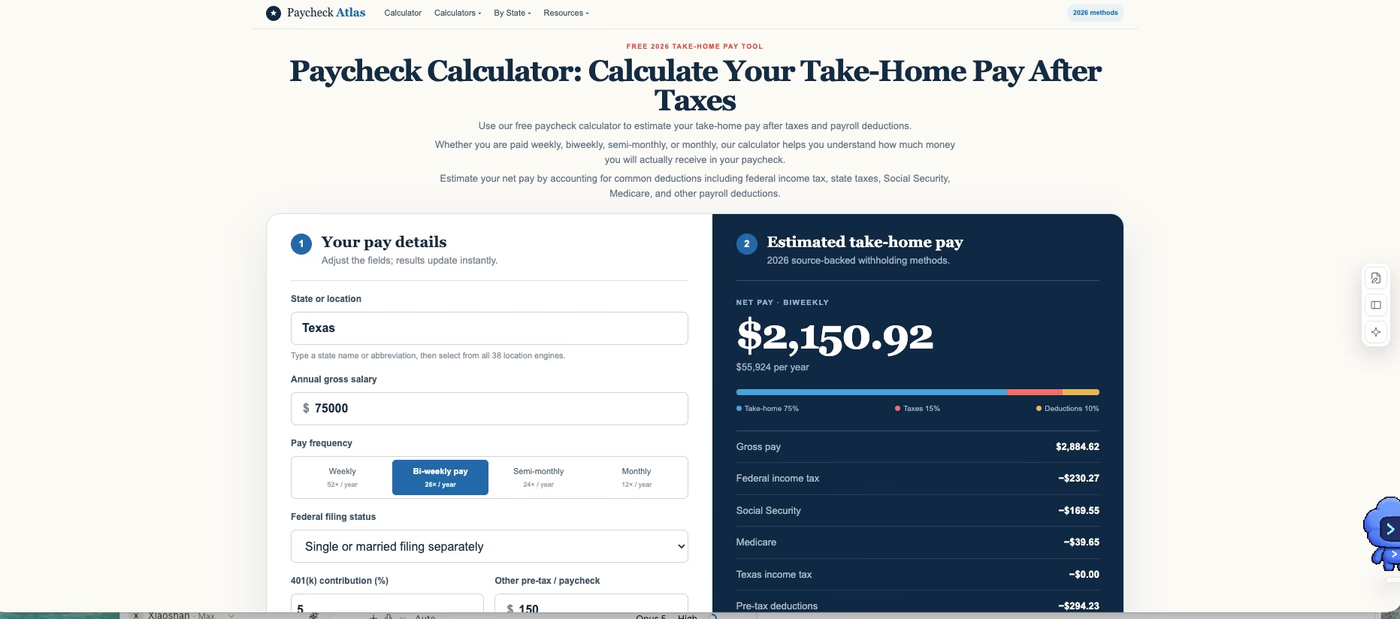
Paycheck Calculator is a free online tool designed to make this process easier. It helps users estimate how much of their gross income may remain after common taxes and payroll deductions.
Instead of manually working through tax rates and formulas, users can enter their information into the calculator and quickly get an estimate of their paycheck.
What Is a Paycheck Calculator?
A paycheck calculator is an online tool that estimates the difference between gross pay and net pay.
Gross pay represents your earnings before taxes and deductions. Net pay, commonly called take-home pay, is the amount remaining after applicable deductions have been taken from your paycheck.
For example, imagine that someone earns $75,000 per year. Dividing $75,000 by 12 gives $6,250 per month, but this does not mean the employee will receive $6,250 in their bank account every month.
A portion of those earnings may go toward federal income tax, Social Security, Medicare, state taxes, and other deductions.
A paycheck calculator helps turn a gross salary into a more realistic estimate of spendable income.
This can make salary numbers much easier to understand.
Why Gross Salary Doesn't Tell the Whole Story
When comparing jobs, people often focus primarily on annual salary.
A position paying $80,000 sounds better than one paying $70,000. However, salary alone does not provide a complete picture of someone's financial situation.
Location can matter. Payroll deductions can matter. Pay frequency can matter. Benefits and retirement contributions can also affect the amount deposited into an employee's account.
Even two workers earning exactly the same annual salary may receive different net pay.
That is why calculating estimated take-home pay can be valuable before making financial decisions based solely on gross salary.
How Paycheck Calculator Can Help
Paycheck Calculator is designed to simplify paycheck estimation.
Rather than requiring users to manually research tax brackets and perform several calculations, the tool provides a convenient place to estimate paycheck amounts based on the information entered.
It can be useful for many everyday financial questions, including:
- How much will I take home after taxes?
- What does a $60,000 salary look like per paycheck?
- How much could be deducted from my salary?
- What is my estimated take-home pay?
- How much money might I receive on a biweekly schedule?
- How does location affect my paycheck?
- How much additional take-home pay could I receive after a raise?
- What might my monthly income look like after common payroll taxes?
These are practical questions that often arise when starting a new job or reviewing personal finances.
Understanding Federal Income Tax
Federal income tax is one of the major factors affecting many U.S. paychecks.
The United States uses a progressive federal income tax system. This means income can fall into different tax brackets rather than an employee's entire salary simply being taxed at one flat percentage.
This distinction can sometimes cause confusion.
Someone whose income reaches a higher tax bracket does not necessarily pay that higher rate on every dollar earned. Instead, different portions of taxable income can be subject to different rates.
Because of this structure, simply multiplying an annual salary by a single tax percentage may not provide a useful estimate of take-home pay.
Using a paycheck calculator can make the estimation process more convenient.
Social Security and Medicare
Federal income tax is not the only deduction employees may see on their paychecks.
Payroll taxes associated with Social Security and Medicare are another important consideration for many workers.
These deductions are separate from federal income tax and can further reduce the difference between gross and net income.
When people estimate their paycheck mentally, these taxes are easy to overlook. As a result, the amount they expect to receive can be higher than what eventually appears in their bank account.
A more complete paycheck estimate should therefore consider more than federal income tax alone.
State Taxes Can Make a Difference
Where you live or work can also affect your estimated take-home pay.
State tax systems vary across the United States. Some states impose individual income taxes, while others do not impose a broad individual state income tax on wages.
Among states that do collect individual income taxes, tax structures and rates can also differ.
This makes state paycheck calculators particularly useful.
For example, someone considering jobs in California, Texas, New York, Florida, Pennsylvania, or Michigan may want to understand how location could affect estimated take-home income.
A salary that looks identical on two job offers may not necessarily produce the same paycheck in two different states.
Paycheck Calculator provides state-focused resources that can help users explore these differences without manually researching every calculation from scratch.
Pay Frequency Matters Too
Another factor that can make salary confusing is pay frequency.
Employers may pay workers weekly, biweekly, semimonthly, or monthly.
For example, a worker earning $52,000 annually might initially think of that as approximately $1,000 per week before taxes. But their actual paycheck depends on their employer's payroll schedule as well as taxes and deductions.
Understanding pay frequency is particularly important when creating a monthly budget.
Rent, mortgages, utilities, subscriptions, loan payments, and other expenses typically operate on their own schedules. Knowing approximately how much money will arrive in each paycheck makes it easier to plan around those expenses.
Useful When Comparing Job Offers
One of the most practical applications of a paycheck calculator is evaluating job offers.
Imagine receiving two offers:
Company A offers a higher gross salary but requires you to relocate to another state.
Company B offers slightly less but allows you to remain where you currently live.
Simply comparing annual salaries may not provide enough information to understand the financial difference between the opportunities.
Estimating take-home pay can provide another useful data point.
Of course, compensation decisions should also consider health insurance, retirement benefits, bonuses, equity, commuting costs, housing expenses, and other factors. But estimated net income is an important piece of the overall picture.
Helpful When Negotiating a Raise
A salary increase sounds straightforward, but employees may naturally wonder how much additional money they could actually see in each paycheck.
Suppose your salary increases from $65,000 to $70,000.
The difference is $5,000 annually in gross income, but that does not mean you will simply receive an additional $5,000 in spendable cash over the year.
Taxes and deductions can affect the increase.
Running the old and new salaries through a paycheck calculator can provide an estimate of how the raise might translate into take-home pay.
That can make salary negotiations and financial planning more concrete.
Plan a More Realistic Monthly Budget
Budgets work best when they are based on money you can actually spend.
Building a household budget around gross salary can create an unrealistic picture of available income.
Instead, starting with estimated net income can make budgeting more practical.
Once you understand approximately how much money reaches your bank account, you can allocate it toward categories such as housing, groceries, transportation, debt payments, savings, entertainment, and emergency funds.
This is particularly useful for people starting their first full-time job.
A salary number may look large when viewed annually. Breaking it down into estimated take-home pay per paycheck makes the number much easier to relate to everyday expenses.
Useful When Moving to Another State
Relocating for work involves much more than comparing salaries.
Housing costs, transportation, insurance, utilities, and taxes may all change.
If you are considering moving from one state to another, a state paycheck calculator can help you estimate one part of that financial transition.
For example, someone considering a job in another state can compare their estimated paycheck before and after moving.
The calculation alone should not determine whether relocation makes financial sense, but it provides useful information that can be combined with cost-of-living research.
Who Can Use Paycheck Calculator?
Paycheck Calculator is not designed only for accountants or financial professionals.
It can be useful for ordinary workers who simply want a clearer understanding of their income.
Job seekers can use it when evaluating an offer. Employees can use it when considering a raise. Recent graduates can estimate the paycheck associated with their first full-time salary. Families can use estimated net income when creating a household budget.
People considering relocation can compare paycheck estimates across states.
Even someone who is simply curious about where their salary goes may find a paycheck calculation helpful.
A Faster Alternative to Manual Calculations
It is possible to estimate a paycheck manually, but doing so can require multiple steps.
You may need to understand applicable tax rules, payroll taxes, state requirements, pay periods, and other variables.
For many users, that is more work than necessary when they simply want a quick estimate.
An online paycheck calculator turns those calculations into a much simpler process.
Enter the relevant information, review the estimated result, and adjust the inputs if you want to compare different scenarios.
For example, you can compare different salaries when negotiating a job offer or explore how a potential raise might affect your paycheck.
Free and Easy to Access
Another advantage of an online calculator is accessibility.
Paycheck Calculator is available through a web browser, making it convenient to use when researching jobs, planning a budget, or checking salary information.
There is no need to build complicated spreadsheets just to get a basic paycheck estimate.
The goal is to make payroll information easier for everyday users to understand.
Why Knowing Your Take-Home Pay Matters
Financial planning becomes easier when you understand the difference between what you earn and what you can actually spend.
Gross salary is useful for comparing compensation, but take-home pay is often more relevant for everyday life.
Your rent is paid with net income. Your groceries are purchased with net income. Savings, transportation, entertainment, and most other household expenses also come from the money remaining after deductions.
That makes estimated take-home pay one of the most practical salary numbers to understand.
Try Paycheck Calculator
Whether you are starting a new job, negotiating a raise, comparing opportunities, planning a move, or simply trying to understand your current income, Paycheck Calculator provides an easy way to estimate your take-home pay.
Instead of trying to calculate everything manually, you can use the online calculator to explore different salary and paycheck scenarios.
Understanding your paycheck does not need to be complicated.
Use Paycheck Calculator to estimate salary after taxes, explore state-specific paycheck information, and get a clearer picture of how gross income may translate into take-home pay.
For anyone trying to make more informed decisions about salary and everyday finances, it is a simple tool worth bookmarking.
Disclaimer: Paycheck calculations are estimates provided for general informational purposes. Actual payroll withholding and take-home pay may vary based on individual circumstances, deductions, benefits, tax elections, and applicable tax rules. The information should not be considered tax, legal, accounting, or financial advice.