
Preparing for an important job interview has traditionally meant spending hours researching a company, reviewing a resume, practicing common questions, preparing behavioral stories, and trying to anticipate what an interviewer might ask.
That preparation is still important. But modern AI is creating a new category of tools that can help candidates not only prepare before an interview, but also work with relevant context while the interview is happening.
InterviewAce is built around this idea.
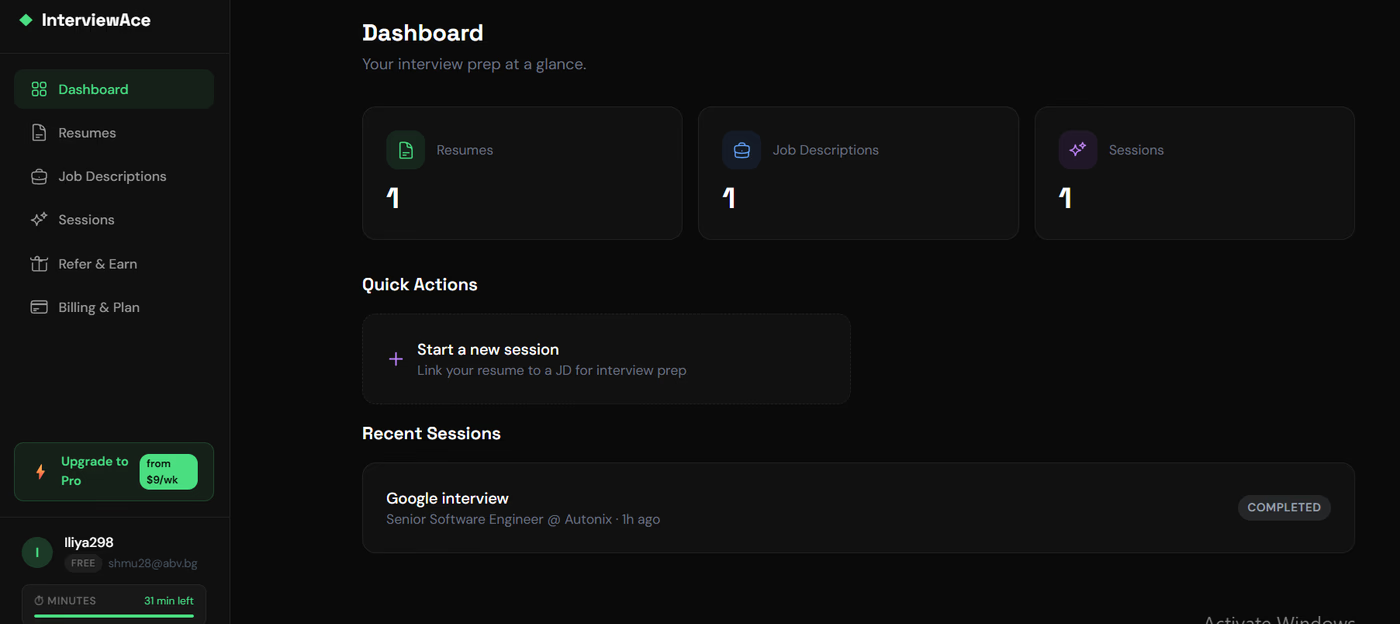
InterviewAce combines interview preparation with a real-time AI co-pilot designed to help candidates prepare more effectively and access useful context during live interviews.
Rather than treating interview preparation and the interview itself as two completely separate experiences, InterviewAce brings them together into a single workflow.
From Preparation to the Live Interview
A common problem with traditional interview preparation is that much of the information candidates carefully prepare beforehand is difficult to recall under pressure.
A candidate might spend hours reviewing their career history and preparing examples, only to struggle to remember the most relevant project when an interviewer asks an unexpected behavioral question.
The same thing can happen with technical interviews.
Candidates may know how they solved a particular problem at work, understand the architecture they worked with, and remember the outcome of a project, but recalling the exact details while simultaneously listening, thinking, and communicating can be challenging.
InterviewAce approaches this problem by combining preparation with real-time assistance.
The objective isn't simply to generate generic answers. The idea is to provide candidates with contextual support that can help them connect an interviewer's question with information that is relevant to their own experience.
That makes InterviewAce particularly useful for candidates who want an AI-powered interview co-pilot rather than another collection of static interview questions.
Preparing With AI Before the Interview
AI can also play an important role before the actual interview begins.
Candidates can use AI to generate practice questions, simulate different interview scenarios, analyze job descriptions, improve answers, and identify areas where their preparation needs more work.
InterviewAce has published a detailed guide covering how to use AI tools effectively for interview preparation, including the difference between practice-oriented AI tools and live interview co-pilots:
https://interviewace.online/blog/how-to-use-ai-tools-practice-job-interviews
This distinction is important.
Practice tools help candidates build confidence before the interview. Live co-pilot technology addresses a different problem: providing contextual assistance when the actual conversation is taking place.
InterviewAce is designed to support both sides of that workflow.
Practice mode can help candidates develop their answers and become more comfortable with common interview situations, while the live AI co-pilot is designed to provide real-time, context-aware assistance during an interview.
Research Still Matters
AI doesn't eliminate the need for traditional interview preparation.
Understanding the company, its products, market, competitors, strategy, and role requirements remains one of the most valuable things a candidate can do before an interview.
InterviewAce's guide on researching a company before an interview provides a practical framework for doing that research efficiently:
https://interviewace.online/blog/how-to-research-a-company-before-interview
Good research helps candidates move beyond generic answers.
Instead of simply saying that they are excited about a company, candidates can connect their own experience to specific products, initiatives, challenges, or opportunities within the organization.
That company-specific context can then become part of the candidate's broader preparation.
What Is an Interview Co-Pilot?
The term "AI co-pilot" has become increasingly common across software development, productivity, research, and other professional workflows.
The basic concept is straightforward: instead of replacing the person doing the work, an AI co-pilot provides information, suggestions, context, or assistance while the person remains in control.
InterviewAce applies this concept to interviews.
An interview co-pilot can potentially help a candidate work with information they have already prepared, including their professional background, projects, accomplishments, skills, and other relevant context.
This distinction matters.
An interview assistant that simply generates an answer to every question can produce responses that sound generic or disconnected from the candidate.
A contextual co-pilot, by contrast, can focus on helping the candidate identify relevant experiences and information.
For behavioral interviews, that could mean recognizing that a question about handling conflict relates to a particular project or management situation in the candidate's background.
For technical discussions, it could mean helping the candidate recall a relevant architecture decision, implementation detail, performance improvement, or engineering trade-off.
The candidate still has to understand the question and communicate the answer. The AI is there to provide context and support.
Real-Time Context During Behavioral Interviews
Behavioral interviews can be difficult because they require candidates to recall specific situations quickly.
Someone may have dozens of examples from previous roles, but only one or two may be particularly relevant to a specific question.
InterviewAce explores how real-time background prompts can help candidates work with that context during behavioral interviews.
The concept is covered in the InterviewAce News section through its article on real-time background prompts:
The goal is not to replace preparation.
Instead, preparation creates the underlying knowledge and examples, while real-time assistance can help candidates retrieve and connect that information when needed.
This distinction is important because effective interview technology should ultimately help candidates communicate their own experience rather than inventing an entirely artificial professional identity.
Structuring Better Answers With Resume Grounding
Another area explored by InterviewAce is the relationship between live behavioral answers and custom resume grounding.
The News section examines how candidates can structure live behavioral interview answers using their own resume context:
Resume grounding can be particularly useful when a candidate has a long or complex professional history.
For example, a senior engineer might have worked across multiple teams, technologies, products, and organizations. A product leader might have launched numerous products or managed different areas of a business.
When an interviewer asks a broad question, the challenge isn't necessarily a lack of experience. It can be choosing the most relevant experience quickly.
Contextual AI can potentially help narrow that gap by connecting the question with the candidate's existing information.
The candidate remains responsible for the final response, but the system can act as a layer of contextual support.
Preparing the Questions You Will Ask
Interview preparation isn't only about answering questions.
Near the end of an interview, candidates are usually given an opportunity to ask questions themselves. This is another part of the conversation where preparation can make a significant difference.
InterviewAce has published a guide covering strong questions to ask an interviewer, including questions about the role, expectations, team, challenges, and next steps:
https://interviewace.online/blog/questions-to-ask-your-interviewer
Having several thoughtful questions prepared can help turn the final part of an interview into a genuine two-way conversation.
It also gives candidates another opportunity to demonstrate that they understand the role and have taken the time to research the organization.
Managing Interview Pressure
Even candidates who are well prepared can struggle with nerves.
Interview anxiety can make it harder to recall information, structure an answer, communicate clearly, or think through an unexpected question.
InterviewAce has also published a practical guide to managing interview anxiety:
https://interviewace.online/blog/interview-anxiety-proven-techniques
Preparation is one of the most effective ways to reduce uncertainty, but candidates can also benefit from developing routines that help them stay focused and composed.
This is another area where having structured preparation and contextual support can complement each other.
Video Interviews and Real-Time Guidance
Video interviews have become a normal part of the modern hiring process.
They create additional challenges for candidates because the interview involves more than simply answering questions.
Candidates need to listen carefully, communicate clearly, maintain a natural conversation, understand what the interviewer is asking, and remember relevant examples — often while dealing with the additional pressure of being on camera.
This creates an interesting environment for real-time technology.
InterviewAce has explored the architecture behind a lower-cost preparation and real-time guidance stack for video interviews:
The broader trend is significant.
AI infrastructure is becoming more accessible, allowing developers and companies to experiment with real-time systems that previously would have required substantially more resources.
That opens the door to new categories of specialized AI applications, including tools focused specifically on professional communication and interviews.
Cost, Privacy, and Grounding
AI interview technology also raises important questions.
A useful system isn't defined only by how impressive its AI model is.
Candidates need to consider factors such as cost, privacy, latency, reliability, and grounding.
InterviewAce examines these issues in its coverage of evaluating live interview co-pilots:
https://interviewace.online/news/evaluating-live-interview-co-pilots-cost-privacy-and-grounding
Grounding is especially important.
When an AI system provides assistance in a professional setting, generic information may not be enough. Context can determine whether a suggestion is useful or irrelevant.
For an interview candidate, the relevant context may include their resume, previous roles, projects, skills, accomplishments, and preparation material.
Privacy is also an important consideration because career information can be highly personal.
As AI becomes more deeply integrated into professional workflows, candidates need to understand what information is being processed and how these systems are designed to handle it.
After the Interview
Interview preparation doesn't necessarily end when the call ends.
Following up after an interview can be another opportunity to reinforce your interest and leave a strong final impression.
InterviewAce's guide to writing a post-interview thank-you email covers what candidates should include, how quickly they should follow up, and how to avoid sending a generic message:
https://interviewace.online/blog/post-interview-thank-you-email
A strong interview process therefore extends from preparation, through the conversation itself, and into the follow-up afterward.
InterviewAce's broader content library is designed to support candidates across these different stages.
The InterviewAce Blog and News Sections
InterviewAce has also expanded beyond its traditional educational content with a dedicated News section.
The InterviewAce News section is available at:
https://interviewace.online/news
It is powered by Stork Wire from Stork AI, enabling InterviewAce to maintain a dedicated news destination directly on its own domain.
The News Desk is available here:
https://interviewace.online/news/desk
The new section focuses on developments around AI, interviews, hiring technology, real-time co-pilots, contextual systems, and related industry trends.
This is separate from the existing InterviewAce Blog:
https://interviewace.online/blog/
The Blog continues to focus on evergreen educational resources, interview preparation guides, career content, and practical advice.
News serves a different purpose by following current developments and emerging technology.
Together, the two sections provide candidates with both practical interview resources and ongoing coverage of the technology changing the interview process.
A More Contextual Approach to Interview Preparation
The best interview preparation has always been personal.
A candidate's strongest answers generally come from their actual experiences, decisions, accomplishments, failures, and lessons learned.
AI can add value when it helps candidates work with that information more effectively.
That is the idea behind InterviewAce.
By combining preparation with real-time assistance, InterviewAce aims to make the interview process more contextual, personalized, and practical.
For candidates preparing for their next opportunity, the platform provides a modern alternative to relying exclusively on static question lists and generic preparation materials.
As AI continues to evolve, the distinction between "preparing for an interview" and "being supported during an interview" may become increasingly blurred.
InterviewAce is building around that changing reality — providing an AI-powered preparation platform and real-time interview co-pilot for candidates navigating the modern hiring process.