Publishing a video to one social network is easy. Publishing that same video across several social platforms while keeping titles, descriptions, scheduling, and account management organized is where the process becomes time-consuming.
For creators, businesses, agencies, real estate professionals, and marketing teams, social media distribution can quickly turn into a repetitive workflow. A single video may need to be uploaded to YouTube, Facebook, Instagram, TikTok, LinkedIn, Pinterest, and other platforms. Each network has its own publishing process, requirements, and account interface.
The result is that producing the video may take less time than distributing it.
A multi-platform video publishing workflow can reduce much of this repetitive work while helping creators maintain a more consistent presence across their social channels.
Why Posting Videos Manually Becomes Difficult
Manual publishing works reasonably well when you manage one or two accounts. The problems become more noticeable as the number of platforms increases.
Consider a business that wants to distribute three videos each week across six social networks. That can mean as many as 18 separate publishing actions every week.
For each one, someone may need to sign into the appropriate account, upload the video, enter a title or caption, add a description, select publishing options, choose a thumbnail when supported, schedule the content, and verify that the post was successfully published.
Even when each task takes only a few minutes, the time adds up. There is also a greater chance of forgetting a network, publishing the wrong version of a video, or accidentally scheduling content for the wrong date.
Create the Video Once and Build a Distribution Workflow
A more scalable strategy separates content creation from content distribution.
Instead of treating every social network as an independent publishing project, creators can establish one central workflow. The process becomes simple: create the video, prepare the metadata, choose the destinations, schedule the content, and monitor the results.
The original video becomes a reusable content asset rather than something that has to be manually managed from scratch for every network.
This approach is particularly valuable for businesses already investing significant time or money into video production.
If a company creates a product demonstration, property tour, tutorial, interview, announcement, educational video, or other useful content, distributing it to additional networks can increase the potential value of that content without requiring another production.
Use a Multi-Platform Publishing Tool
Social media management platforms can centralize much of the publishing process.
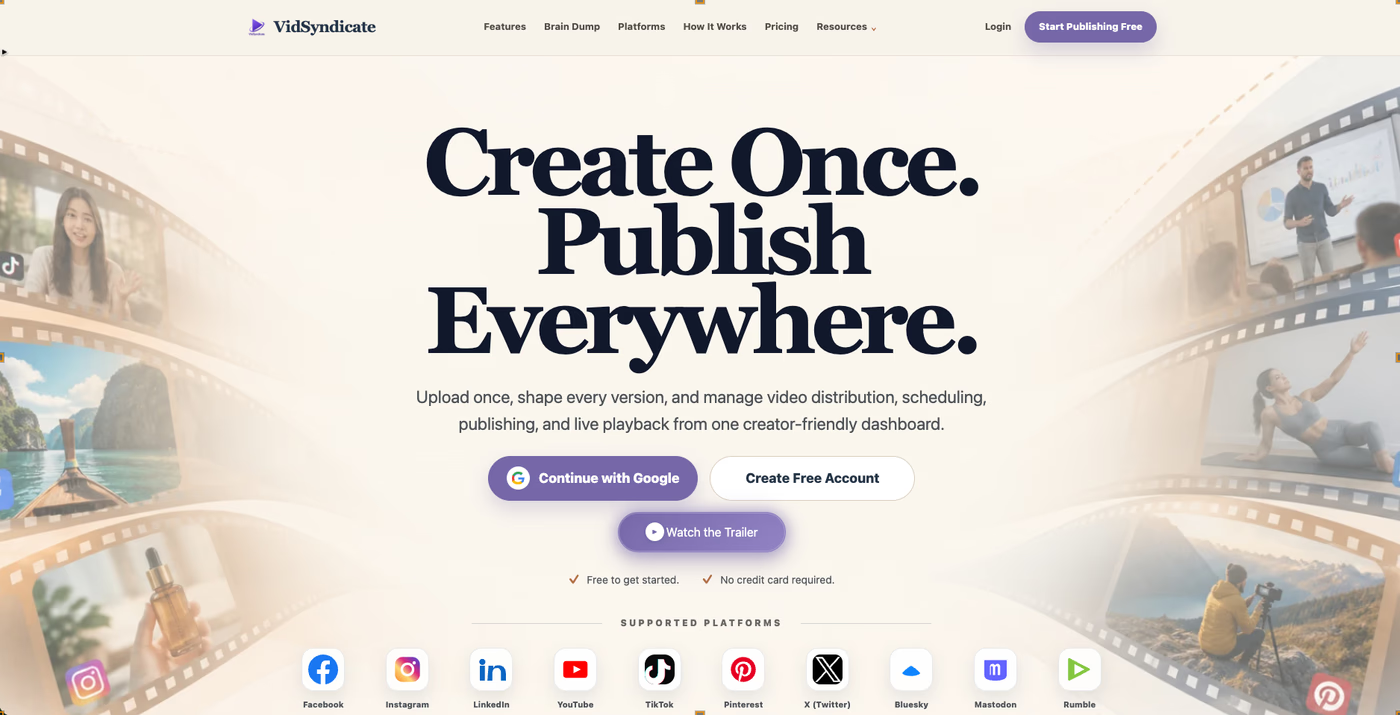
VidSyndicate is a social media publishing and video distribution platform designed to help creators, businesses, and teams manage content across multiple social networks from a centralized workflow.
Rather than repeatedly downloading, uploading, and organizing the same content for different destinations, a multi-platform publishing system allows creators to manage more of the distribution process from one place.
This type of workflow is particularly useful for organizations where video is a regular part of their marketing strategy.
The objective isn't automation simply for the sake of automation. The real benefit is reducing repetitive publishing work so more time can be spent creating content, interacting with audiences, and determining what performs well.
Don't Publish Identical Metadata Everywhere
Cross-platform publishing does not necessarily mean every post should be identical.
The video itself may work across several networks, but the accompanying text can often be improved for each destination.
A YouTube video might benefit from a descriptive title and detailed description. A short-form social post may perform better with a concise caption. A LinkedIn post might need additional professional context, while another network may place greater importance on hashtags or shorter text.
A good multi-platform workflow therefore provides a common starting point while still allowing content to be adapted to individual networks.
Think of it as creating once and customizing where necessary.
Scheduling Is Just as Important as Publishing
Another challenge with manual distribution is timing.
Uploading everything immediately may be convenient, but it isn't always the best publishing strategy. Some organizations want content distributed throughout the day or week rather than appearing everywhere simultaneously.
A centralized social media calendar makes this easier.
Instead of maintaining separate reminders or logging into individual networks at different times, upcoming content can be organized around a publishing schedule.
This becomes increasingly valuable as the amount of content grows.
A creator publishing one video each month may be able to manage everything manually. A business publishing several times each week across multiple platforms benefits much more from having a central calendar and repeatable workflow.
Multi-Platform Publishing Helps Small Teams Compete
Large companies often have dedicated social media employees or entire marketing departments. Small businesses rarely have that luxury.
The person responsible for social media may also be handling sales, customer service, operations, photography, video production, or other parts of the business.
Automation can help close some of that resource gap.
A small company doesn't necessarily need someone spending hours uploading the same video to several websites. Software can handle portions of the repetitive distribution process while the business remains responsible for the creative and strategic decisions.
This is one reason multi-platform publishing can be particularly useful for real estate agents, local businesses, independent creators, small agencies, consultants, and other organizations with limited marketing resources.
More Distribution Can Increase the Value of Every Video
Creating quality video takes effort.
There may be planning, recording, editing, graphics, captions, music, thumbnails, and approvals involved before a video is ready to publish.
Publishing that finished video to only one network limits its potential distribution.
Audiences are fragmented across social platforms. Someone who regularly watches YouTube may rarely use Instagram. Another person may primarily discover content through Facebook, TikTok, LinkedIn, Pinterest, or another network.
Multi-platform distribution allows businesses to meet audiences where they already spend their time.
It also reduces dependence on any single social platform.
Algorithms change. Audience behavior changes. Networks gain and lose popularity. Building an audience across multiple destinations gives creators more ways to reach people when those changes occur.
Keep a Central Record of Published Content
Organization becomes another important consideration as a video library grows.
Without a centralized workflow, teams can eventually lose track of basic information.
Was this video already published to Facebook? Did it get uploaded to YouTube? Was the Instagram version scheduled? Which accounts received the latest product video?
These questions are easy to answer when there are ten videos. They become harder when there are hundreds.
A centralized content system creates a record of what was created, where it was intended to go, and how it fits into the publishing calendar.
That visibility becomes increasingly valuable as a business scales its content strategy.
Automation Should Still Leave Humans in Control
Social media automation works best when it eliminates repetitive tasks without eliminating human judgment.
Not every video belongs on every network. Some posts need different messaging. Certain announcements may need to be published immediately. Other content should be reviewed before it goes live.
The goal should therefore be controlled automation.
Creators decide what to publish, where it should appear, how it should be presented, and when it should go live. The software handles as much of the repetitive execution as possible.
That balance makes automation useful without turning social media into an impersonal publishing machine.
Build a Repeatable Social Media Workflow
A practical multi-platform workflow doesn't have to be complicated.
Start by identifying the social networks that actually matter to your audience. Connect the accounts you actively maintain. Create a repeatable process for preparing videos and their metadata. Use a central calendar to organize upcoming content. Customize posts when individual networks require different messaging.
Then automate the portions of the workflow that don't require a human decision.
A platform such as VidSyndicate can help centralize this process by giving creators and businesses a place to manage social media publishing and video distribution rather than repeating the same workflow across numerous websites.
As the number of social networks continues to grow, centralized publishing becomes less about convenience and more about making a multi-channel content strategy manageable.
Make Every Video Work Harder
The most expensive part of video marketing is often creating worthwhile content in the first place.
Once a video has been produced, distributing it shouldn't require rebuilding the publishing process for every social network.
A centralized multi-platform publishing strategy allows one piece of content to reach audiences across several destinations while reducing repetitive administrative work.
For individual creators, that means more time creating.
For small businesses, it means making better use of limited marketing resources.
For teams and agencies, it means developing a publishing workflow that can continue working as the number of videos, accounts, clients, and social platforms grows.
The objective isn't to publish everywhere simply because you can. It's to make it practical to distribute good content everywhere it makes sense.