
If you sell physical products in the European Union, a new kind of document is heading your way: the Digital Product Passport (DPP).


Under the EU Ecodesign for Sustainable Products Regulation (ESPR), more products will need a digital record that travels with them from factory to consumer. That record answers questions regulators, retailers and buyers will start asking: where did the materials come from, what is the environmental impact, how durable and repairable is the product, and how can it be recycled?


For a small or mid-sized brand, the reaction is understandable. Where do you even start? A DPP is not a single PDF. It is structured product data, a public page consumers can reach, a way to keep that data accurate as a product changes, and proof that the record has not been tampered with.


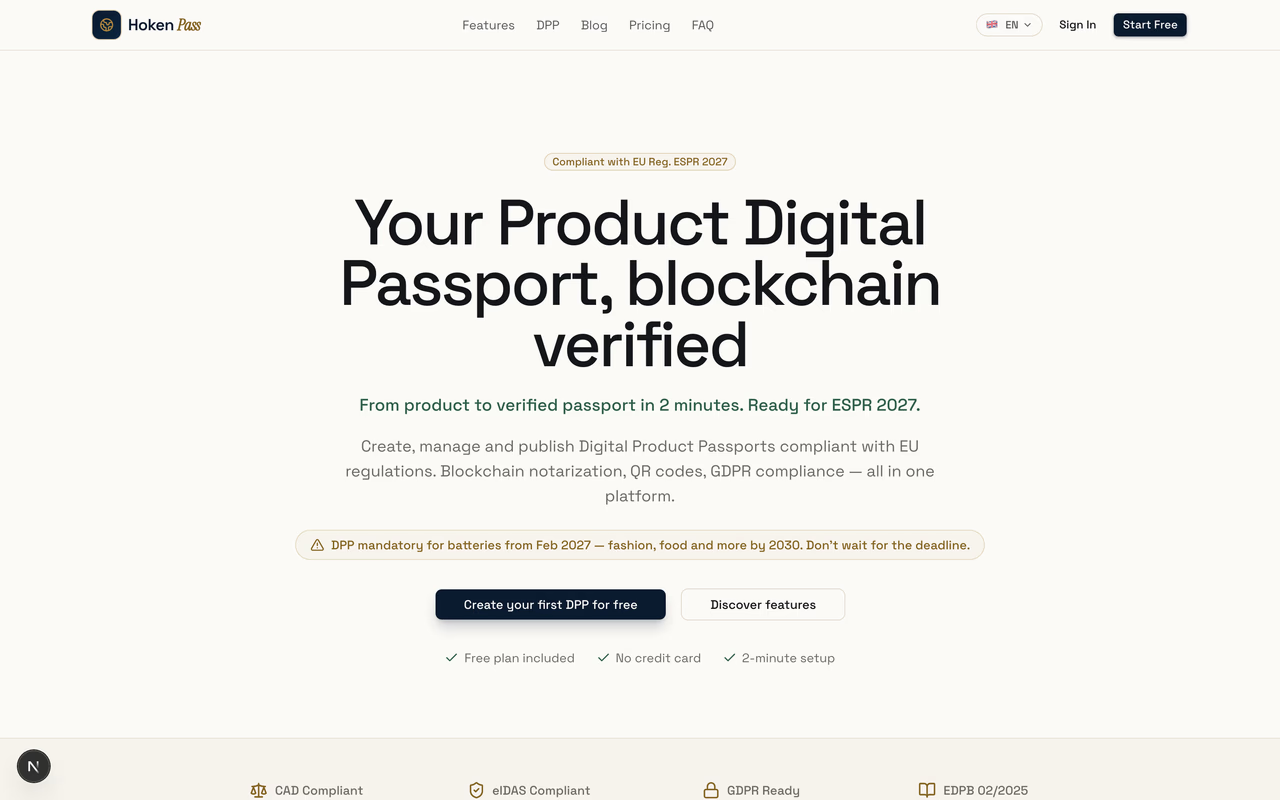
Hoken Pass is a platform built to handle all of that in one place. It lets a business create, manage and publish Digital Product Passports without building a compliance system from scratch.


How it works


Hoken Pass is organized around category-specific templates. A fashion brand, a battery manufacturer, an automotive supplier, a food and beverage producer and an electronics maker all face different data requirements, so the platform ships separate templates for each. You add the fields that matter for your category: material origin, environmental impact, durability, repairability, recyclability.


Once the data is in place, each passport becomes a customizable public page. You apply your brand colors, add your logo, and generate a QR code and digital links that let a consumer scan a product and open its passport on their phone. That is the consumer-facing half of the story, and it matters for marketing as much as compliance.


The record is not static. Product information changes, so Hoken Pass keeps version history and lets you edit while you are still working on a draft. You can give different team members different levels of access with role-based controls, and apply section-level privacy so the right people see the right parts of a passport.


Blockchain verification


Compliance is only half the value. The other half is trust.


Hoken Pass offers blockchain notarization of passports on the EOS blockchain. The platform takes the contents of a passport and notarizes them as a SHA-256 hash, producing a cryptographic fingerprint of the record at a point in time. Because that fingerprint lives on a distributed ledger, nobody can quietly edit a passport after the fact without leaving a trace.


This matters for two audiences. For regulators and auditors, it is evidence that the data has not been altered. For consumers, it is a concrete, verifiable signal that the brand stands behind what it publishes.


The combination is what makes the product relevant beyond a paperwork exercise: a passport that doubles as a trust signal in the marketplace.


Positioned for ESPR


Hoken Pass is built around the requirements of the Ecodesign for Sustainable Products Regulation. It is designed for the world where ESPR applies, rather than bolted on later.


That positioning is practical. Regulations like ESPR are not abstract policy; they change procurement conversations, retail onboarding and consumer expectations. A brand that can point to a live, verifiable passport has an answer ready when a buyer or regulator asks for one, instead of scrambling to produce a document.


Who it is for


If that sounds relevant, the platform is aimed at a fairly clear group:


- Brands and businesses that sell physical products into the EU
- Teams in fashion, automotive, batteries, food and beverage, and electronics
- Companies that want a centralized workflow for creating and updating product information
- Businesses that want the assurance of a tamper-evident, blockchain-notarized record


The paid plans add the blockchain notarization, exports and additional management features. There is also a freemium entry point, which is useful if you want to explore the workflow and see how a passport feels before committing.


Why it matters for your customers


One of the quieter effects of the DPP is what it does to the relationship between a brand and the person who buys the product. A passport stops being purely a compliance item the moment it is easy for a consumer to open.


With a Hoken Pass QR code on a label or a digital link in a listing, a customer can see where a product came from and how it is meant to be repaired or recycled. That turns compliance data into something shoppers can actually use, and for categories like fashion or electronics, it can become part of the story the brand tells.


There is also a practical edge for retailers and B2B buyers. As ESPR timelines tighten, retailers will increasingly ask suppliers for product data before agreeing to stock a line. Having a live, verifiable passport ready when that question arrives keeps a product in the running, instead of slowing a deal down while someone assembles spreadsheets.


Keeping it simple to run


The day-to-day operation is designed to avoid overhead. Because everything lives in one place, there is no loose collection of documents or a separate tool for every task.


Drafts work the way a product team expects: you build a passport, review it, and only then publish it. When something changes, you update the record and the new version is tracked. Because access is role-based, a compliance lead, a marketing owner and a warehouse manager can each work on the parts that concern them without stepping on each other.


That matters for a small team, where the person handling compliance is often the same person handling marketing, sales or operations. The fewer systems involved, the more likely the data stays current.


Where to go from here


The practical starting point is smaller than most brands expect. You do not need to model your entire catalog on day one. You can create a passport for a flagship product, publish it, and let the workflow prove itself before rolling it out more broadly.


Hoken Pass comes with a freemium tier, which is a low-risk way to test the process with a real product and a real public page. Paid plans add the blockchain notarization, exports and the management features that a full rollout needs.


Why now


The interesting timing is that most sellers are not yet feeling pressure, which means the brands that move first have room to set the standard. A product with a clear, verifiable passport is easier to defend in a retail conversation, easier to trust as a consumer, and easier to verify as an auditor.


If your products go into the EU, the question is less whether you will need Digital Product Passports and more when you will need them, and how much of the work you want to do by hand. Hoken Pass is an attempt to make the when earlier and the work lighter.
Articles
SaaS Tools
Hoken Pass: How EU Businesses Can Build Compliant Digital Product Passports Fast
A single platform for creating, managing and publishing blockchain-verified Digital Product Passports for products sold in the EU, built around the Ecodesign for Sustainable Products Regulation (ESPR).
about Hoken Pass
Sep 2, 20266 min read
Read more about
Hoken Pass
Visit their tool page to learn more about their tool.
More tool articles
Related articles
Why More Traffic Won’t Fix a Broken E-commerce Funnel
More traffic is often the default answer to slow e-commerce growth, but it can amplify the wrong problem. Learn how to identify whether acquisition, conversion, retention or revenue is actually limiting growth — and what to fix before increasing spend.
BlueWalnut GeniusSep 10, 2026
Why That Black Box Didn't Redact Anything (And How to Actually Remove Sensitive Text From a PDF)
Drawing a black box over text in a PDF hides it from your eyes, not from copy and paste. Here's why so many redactions fail (a few very publicly), what else hides inside a PDF besides the visible text, and a simple two-minute check to make sure confidential details are really gone before you hit send.
mousePDFSep 10, 2026
Why Modern Software Architecture Demands More Than Flat Whiteboards: The Story Behind Lynara
Modern tech stacks span multi-cloud infrastructure, event streams, microservices, and client interfaces—yet teams still document them with flat 2D drawings. Learn why generic diagramming tools fail complex software architectures, and how Lynara introduces an interactive, multi-layer visual framework built specifically for software architects and engineering teams.
LynaraSep 3, 2026