
Artificial intelligence is very good at suggesting possibilities.
Ask an AI what to cook for dinner and it can produce dozens of ideas in seconds. Ask for a shopping list and it can create one just as quickly.
But there is a problem with that approach: most kitchens are not empty.
There may already be vegetables in the refrigerator, rice in a cupboard, half a block of cheese, herbs that need to be used, eggs bought a few days ago and several ingredients that someone buys almost every week.
If an AI ignores all of that and starts from a blank page, it may be intelligent, but it is missing the most important context.
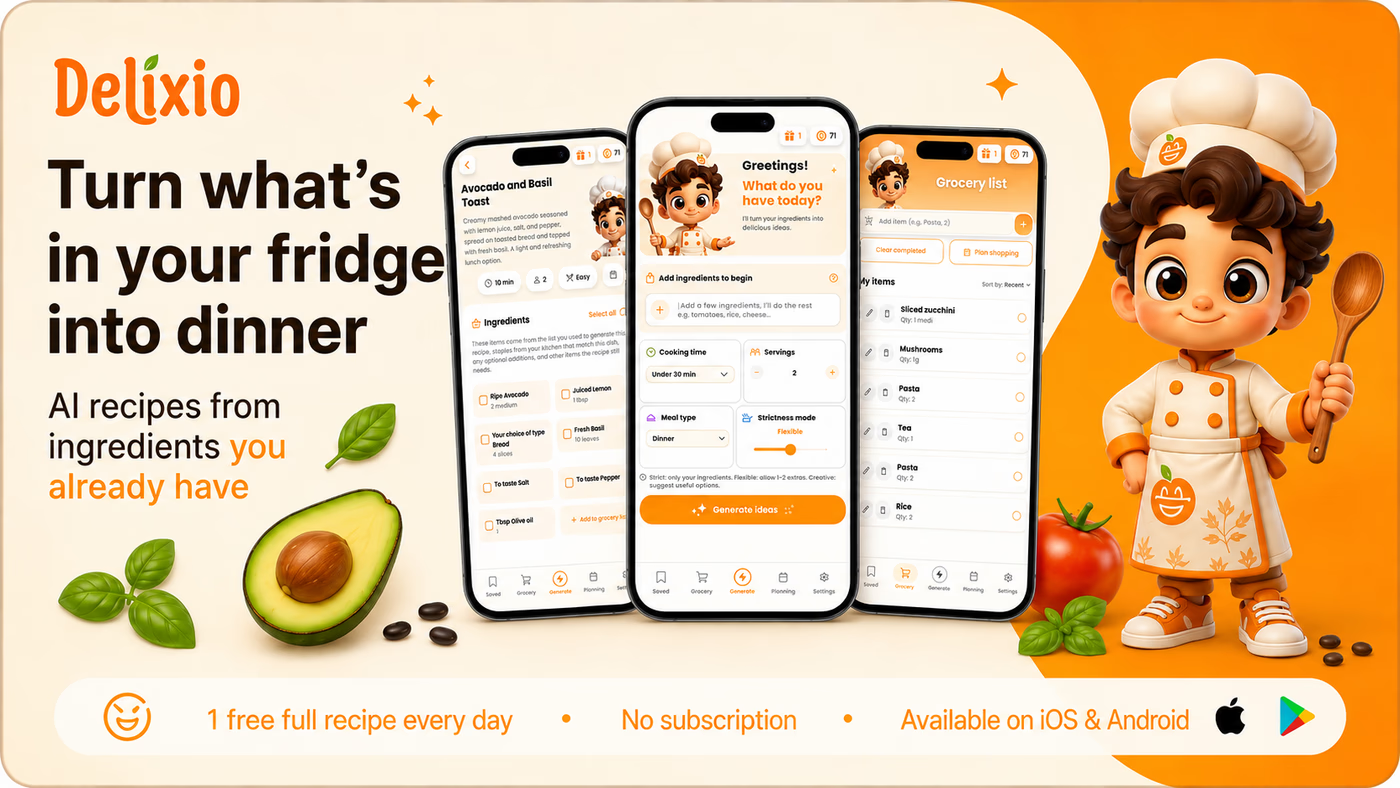
That is one of the ideas behind My Kitchen and Use First in Delixio: before helping someone decide what else they need, start by remembering what they already have.
A kitchen is not a blank prompt
Traditional recipe search usually begins with a dish: someone decides they want lasagna, curry or tacos, finds a recipe and then buys the ingredients required to make it.
But ingredient-first cooking reverses that process, because instead of asking:
“What ingredients do I need for this recipe?”
it begins with:
“What can these ingredients become?”
That difference is especially relevant for AI.
Generative systems are good at handling combinations that would be impractical to cover with a fixed recipe catalog. The contents of a real refrigerator are messy and unpredictable. Four people can have completely different collections of ingredients at the same moment.
The challenge is therefore giving the AI enough useful context to generate the right ones.
Remembering what is already there
This is the purpose of My Kitchen.
Rather than asking users to reconstruct their kitchen context every time they want to cook, Delixio provides a place for ingredients they have available.
The concept is deliberately simple: if olive oil, garlic, rice, eggs or other ingredients are regularly present in the kitchen, that information is useful cooking context. If something more temporary is available - a zucchini, some spinach or half a pack of feta - that matters too.
The important shift is from a disposable prompt toward persistent context.
A generic AI conversation might begin every evening with:
I have eggs, spinach, feta, onion and rice. What can I cook?
Then the next day the user has to explain the situation again.
A cooking product should be able to do better than that. The application should gradually understand the environment in which those cooking decisions are being made.
Not every ingredient has the same priority
Knowing what is available solves only part of the problem.
Sometimes an ingredient matters more than the others, perhaps there is an aubergine you specifically want to use. Some fresh herbs have been sitting in the refrigerator. A package has already been opened. Or you simply decided that tonight is the night to do something with those mushrooms.
That is what Use First is for: it adds priority to availability.
This is an important distinction because ingredient-based cooking should not mean forcing every available ingredient into the same recipe. If a kitchen contains fifteen ingredients, the best meal is not necessarily the one that uses all fifteen.
Instead, the system can start from a smaller question:
Which ingredients matter most right now?
That produces a much more realistic cooking problem.
Priority is different from urgency
There is also a useful design boundary here.
Marking something as Use First does not need to mean that an application is making a food-safety judgment or claiming an ingredient is about to expire.
The user is simply expressing preference:
I would like to use this before the other things I have.
That keeps the feature practical.
Software does not need to invent urgency to be useful. It can simply preserve the user's intention and make it easier to act on later.
The distinction matters because good AI products should be careful about what they actually know.
An AI might know that a user wants to prioritize a tomato. That does not automatically mean it knows whether that tomato is safe to eat, when it was purchased or exactly how long it will remain fresh.
Useful context does not have to pretend to be perfect knowledge.
Better context can be more valuable than a better prompt
A lot of discussion around generative AI focuses on prompting.
Users are encouraged to write increasingly detailed instructions so the model can produce better results.
That works, but it also transfers work back to the user.
For everyday consumer products, another approach is possible: let the product accumulate the relevant context through normal use.
In cooking, that context might include the ingredients someone has, the ingredients they want to prioritize, recipes they previously saved and meals they intend to make later.
The user should not need to write a carefully engineered paragraph every time they want dinner.
The intelligence can sit behind a much simpler interaction.
Here is what I have. What can I make?
That is enough.
From inventory to inspiration
The purpose of My Kitchen is not to turn cooking into warehouse management.
Most people do not want to scan every jar, count every onion or maintain a perfectly synchronized digital replica of their refrigerator.
Nor should they have to.
There is a useful middle ground between knowing nothing about the kitchen and demanding a complete inventory.
Even partial context can be valuable.
If Delixio knows about the ingredients that matter for the next meal, it already has a better starting point than a system generating recipes without any knowledge of the user's situation.
And because Delixio's recipe workflow begins with ingredients, that information has an immediate purpose.
The kitchen is not being catalogued for its own sake.
It is being turned into possibilities.
Shopping should fill gaps, not replace the kitchen
There is another consequence of starting with what someone already has.
Shopping changes too.
Many meal-planning systems effectively work in this order:
choose recipes → create shopping list → buy everything → cook
There is nothing inherently wrong with that model, but it assumes the plan is more important than the existing kitchen.
Ingredient-first cooking suggests another sequence:
look at what is available → choose what to cook → identify what is missing → buy only the gaps
That is a different relationship between recipe generation and a Grocery List.
The grocery tool becomes a bridge between what is already available and what is needed to complete a meal.
It does not have to be the beginning of the process.
This is particularly useful for the wonderfully ordinary situation in which someone already has 80% of a meal but does not yet know what that meal is.
Cooking is a stateful problem
This points toward a broader product-design idea.
Cooking is stateful.
What made sense yesterday may not make sense today because ingredients have changed. A recipe that was interesting last week may already have been cooked. Something previously unimportant may now be the ingredient someone most wants to use.
An AI recipe generator that treats every request as an isolated conversation loses that state.
A cooking application has the opportunity to preserve it.
My Kitchen provides one piece of that memory.
Use First provides another.
Saved Recipes preserve ideas worth returning to.
Planning preserves future intentions.
Grocery tools preserve what still needs to be obtained.
The individual features are not particularly exotic. Their value comes from being connected to the same cooking problem.
AI does not need to generate everything
There is a tendency to make AI the answer to every part of an AI-powered product.
That is not always necessary.
AI may be excellent at the moment where ingredients need to be transformed into a coherent recipe idea.
But remembering that the user has garlic at home does not require generative AI.
Neither does remembering that they want to use spinach first.
Saving a recipe, scheduling it or putting something on a grocery list are ordinary product interactions.
And that is a good thing.
A useful AI application is not necessarily the one that uses a model for the largest number of tasks.
It is the one that uses intelligence where intelligence adds value and conventional software where conventional software works better.
The refrigerator is part of the interface
For cooking applications, the physical world matters.
There is food in cupboards. There are leftovers. There are things somebody bought with good intentions and forgot about. There are ingredients that are always available and others that appear for only a few days.
That physical context should influence the digital experience.
This is why the idea of My Kitchen is more than an ingredient list.
It represents an attempt to bring the state of the real kitchen into the decision about what to cook.
And Use First adds a small but meaningful human instruction to that state:
these are the things I care about using right now.
From there, AI can do what it is particularly good at: finding possibilities among combinations that a conventional interface could never enumerate.
From “what should I buy?” to “what can I do with this?”
Many digital food experiences are optimized around discovery.
More recipes. More inspiration. More things to save. More ingredients to purchase.
But abundance is rarely the problem when someone is standing in front of an open refrigerator wondering what to make.
The problem is turning what is already there into a decision, that is the philosophy behind ingredient-first cooking.
The most useful answer may not begin with another shopping list, but it may begin with the tomato, spinach, feta, rice and eggs already sitting in the kitchen.
AI can provide the creativity, the product should provide the memory, and the user should remain the one deciding what matters most.
Delixio is an AI-powered cooking app for iPhone and Android built around ingredients you already have. Features including My Kitchen and Use First help users keep useful ingredient context, while recipe generation, Saved Recipes, Grocery Lists and meal planning connect that context to everyday cooking decisions.
Learn more at delixioapp.com.