
Every department has someone everyone depends on.
They know how a critical process works, where important information is stored, which steps need to happen, and what to do when something goes wrong.
They may be the person who manages software renewals, coordinates employee onboarding, handles monthly financial reporting, maintains critical equipment, or oversees an important compliance process.
Over time, they become the person everyone turns to when questions arise.
But what happens when that person isn't available?
For many organizations, the answer is surprisingly simple: the work waits.
Sometimes the delay is minor. Other times, an important deadline passes, a required process is missed, or another employee spends hours trying to reconstruct something that was previously handled without a second thought.
This is one of the most overlooked risks in department operations. It isn't necessarily a technology problem or even a staffing problem.
It's an ownership, knowledge, and operational continuity problem.
The Hidden Risk of Depending on One Person
Consider an IT department with several experienced employees.
One person manages software licensing and renewals. Another handles server maintenance. Someone else coordinates new employee onboarding and access provisioning.
Each employee knows their responsibilities and performs them consistently.
From a manager's perspective, the department appears to be operating effectively. Deadlines are met, systems are maintained, and employees receive the services they need.
But what happens when one of those employees leaves unexpectedly?
The department may discover that nobody else knows the complete process.
Perhaps the renewal dates were maintained in a personal spreadsheet. The maintenance procedure was never fully documented. The onboarding checklist exists, but the steps have changed since it was last updated.
Suddenly, basic questions become difficult to answer:
- Who is responsible for this process now?
- Is someone else prepared to handle it?
- Where are the instructions and supporting information?
- What deadlines are approaching?
- Which activities have already been completed?
- Are there outstanding issues that require attention?
- What other responsibilities did this employee manage?
The problem isn't necessarily that employees were careless or that management failed to assign responsibilities.
The problem is that important operational knowledge and accountability became concentrated in individual people.
This is commonly called key-person dependency or a single point of failure.
And it isn't limited to IT.
Accounting departments may depend on one person for monthly reconciliations. Human Resources may rely on one employee for benefits administration. Facilities departments may have a single employee who understands maintenance schedules and vendor relationships.
Almost every department has responsibilities that become difficult to manage when the person who normally handles them is unavailable.
Why Key-Person Dependencies Are Easy to Overlook
One reason these dependencies persist is that they rarely cause problems while everything is working.
Experienced employees develop routines. They remember deadlines, know which systems to access, and understand the exceptions that aren't written down.
Managers become comfortable because the work consistently gets done.
In many cases, the better an employee performs, the less visible the underlying process becomes.
A task that gets completed every month without intervention may never attract management attention.
That can create a false sense of security.
A department might have excellent employees and still have poor operational resilience.
The distinction matters.
Reliable employees are valuable. Reliable processes allow a department to continue operating when those employees aren't available.
Organizations need both.
Assigning a Responsibility Isn't the Same as Providing Coverage
Many organizations maintain lists identifying who owns different responsibilities.
That's a good starting point.
But assigning someone as the owner doesn't necessarily mean the department is prepared for that person's absence.
For important responsibilities, managers should understand several related elements.
Primary Ownership
Every responsibility should have a clearly identified person accountable for ensuring it is handled.
That doesn't mean the primary owner must personally perform every related task.
It means someone is responsible for making sure the work happens and that problems receive appropriate attention.
Without clear primary ownership, work can fall into the familiar trap where everyone assumes someone else is handling it.
Backup Ownership
A backup owner provides continuity when the primary owner is unavailable.
But assigning a backup name isn't enough.
The backup needs to understand the responsibility, have access to necessary systems and information, and know when to step in.
For some responsibilities, a brief written procedure may be sufficient.
For others, meaningful coverage requires training, experience, and periodic participation.
A backup who has never performed the process and cannot access the necessary systems may provide little practical protection.
Supporting Information
Important responsibilities often depend on instructions, documents, contacts, and other resources.
Those resources need to be available to authorized employees, not scattered across personal folders, email messages, or undocumented conversations.
A department should be able to identify where the information needed to perform a responsibility is maintained.
Associated Operational Work
A responsibility is often broader than any individual task.
For example, someone may own the responsibility of maintaining an organization's user access controls.
That responsibility might involve recurring access reviews, account audits, permission changes, and follow-up activities.
Knowing who owns the responsibility is important.
Knowing what work must be performed to fulfill it is equally important.
When ownership and associated work are disconnected, managers can see who is responsible without necessarily seeing whether the required activities are being completed.
The Difference Between Responsibilities and Tasks
This distinction is important because organizations often manage responsibilities as though they were simply another task list.
A task represents something that needs to be done.
A responsibility represents an ongoing area of accountability.
Consider the responsibility of managing employee onboarding.
That responsibility may involve creating user accounts, assigning equipment, coordinating system access, and verifying that onboarding requirements are completed.
Individual onboarding activities come and go as employees join the organization.
But the responsibility itself continues.
Similarly, a department may be responsible for maintaining system backups.
The associated work could include daily backup monitoring, weekly verification, monthly restore testing, and periodic reviews of retention policies.
Completing one task doesn't mean the responsibility has ended.
Tasks are activities. Responsibilities establish continuing accountability for those activities.
This distinction becomes especially important when employees change roles or leave an organization.
A manager needs to understand not only which open tasks must be reassigned, but also which ongoing responsibilities need new ownership and coverage.
Why Spreadsheets and Shared Documents Often Fall Short
Spreadsheets are useful tools, and many departments use them successfully to organize information.
The problem arises when spreadsheets become the primary system for managing ongoing responsibilities and operational work.
Imagine a department with the following arrangement:
- A spreadsheet lists department responsibilities and their owners.
- Another spreadsheet tracks recurring work.
- A shared folder contains procedures and reference documents.
- Calendar reminders track deadlines.
- Email conversations contain important decisions and exceptions.
- Individual employees maintain personal notes about how work gets done.
Each source may contain useful information.
But the relationships between them are difficult to maintain.
When a responsibility changes ownership, does someone update every related spreadsheet and document?
When a recurring task changes, does the responsibility record reflect it?
When a backup employee needs to take over, can they quickly identify the work associated with that responsibility?
And when a manager wants to understand whether a department is operating effectively, can they obtain a reliable answer without contacting several people?
These challenges become more significant as organizations grow.
More employees, departments, responsibilities, and recurring activities create more opportunities for information to become disconnected.
The issue isn't that spreadsheets are inherently bad.
It's that disconnected tools make it harder to maintain a complete picture of department operations.
What Happens When an Employee Leaves Unexpectedly?
Consider a practical scenario.
An employee responsible for several important operational processes resigns with little notice.
The manager begins transferring responsibilities to other team members.
The obvious tasks are relatively easy to identify. Open assignments can be reviewed, and immediate deadlines can be reassigned.
But the less visible work presents a bigger challenge.
- Who performs the quarterly access review?
- When is the next equipment inspection due?
- Which recurring reports are required by management?
- What vendor relationships does the employee maintain?
- Which procedures depend on knowledge that was never documented?
The department may spend days or weeks discovering activities that previously happened automatically.
Some responsibilities may not be discovered until something goes wrong.
This is why operational continuity should be addressed before an employee leaves.
The goal isn't to predict every staffing change.
It's to ensure that important responsibilities remain identifiable, understandable, and manageable regardless of who currently holds them.
Five Practical Ways to Reduce Key-Person Dependency
Organizations don't need to redesign every department overnight.
A practical approach can begin with a few straightforward improvements.
1. Identify Critical Responsibilities
Start by asking department managers which responsibilities would create significant disruption if their current owners became unavailable.
Focus on activities involving operational deadlines, security, compliance, financial impact, customer service, or essential internal processes.
Not every responsibility carries the same risk.
Some work can wait several days without consequences. Other work may require immediate coverage.
Prioritizing critical responsibilities helps organizations concentrate their efforts where continuity matters most.
2. Establish Clear Primary and Backup Ownership
For each critical responsibility, identify the primary owner and determine whether backup coverage is necessary.
Avoid assigning backups simply to fill an empty field.
Consider whether the backup has the necessary skills, permissions, and availability.
For particularly important responsibilities, managers may want the backup to periodically perform the process or participate in reviews.
That helps confirm that coverage exists in practice, not just on paper.
3. Connect Responsibilities to Their Work
Identify the recurring and one-time activities associated with each responsibility.
This creates a clearer picture of what fulfilling the responsibility actually requires.
For example, a responsibility involving system maintenance might include weekly checks, monthly updates, quarterly reviews, and annual planning activities.
Connecting those activities to the responsibility makes it easier to understand the operational impact when ownership changes.
It also helps managers identify work that is overdue, blocked, or approaching its deadline.
4. Keep Supporting Information Accessible
Document the information necessary to perform critical responsibilities.
This may include procedures, reference documents, system locations, vendor contacts, or escalation instructions.
Sensitive credentials should remain in approved secure systems rather than being copied into general documentation.
The objective is to make essential knowledge available to the right people while maintaining appropriate security controls.
Documentation also needs periodic review.
An outdated procedure can create almost as much confusion as having no procedure at all.
5. Review Responsibilities and Coverage Regularly
Ownership and coverage aren't one-time decisions.
Employees change positions. Departments reorganize. Processes evolve. New systems are introduced, and old activities become unnecessary.
A responsibility that had adequate coverage six months ago may no longer have it.
Managers should periodically review primary owners, backup owners, supporting resources, and associated work.
These reviews can reveal gaps before they turn into operational problems.
Visibility Is Just as Important as Documentation
Even a well-documented responsibility can become a problem if managers have no visibility into the work being performed.
Consider a department with dozens of recurring operational activities.
Each activity may have an assigned owner and a documented procedure.
But if managers cannot easily identify which activities are overdue, blocked, or approaching their deadlines, problems can remain hidden until someone reports them.
This is where operational visibility becomes important.
Managers need to understand both the structure of their department and its current operating condition.
That includes questions such as:
- Which responsibilities have primary owners?
- Which critical responsibilities lack backup coverage?
- What recurring work is currently assigned?
- Which activities are overdue or blocked?
- Which departments or operational areas need attention?
These are different questions, but they are closely connected.
A department can have well-defined responsibilities and still struggle with execution.
Likewise, a department can complete its tasks consistently while remaining vulnerable because important responsibilities depend on a single person.
Effective operational management requires attention to both ownership and execution.
How DeptOps Helps Departments Organize Responsibilities
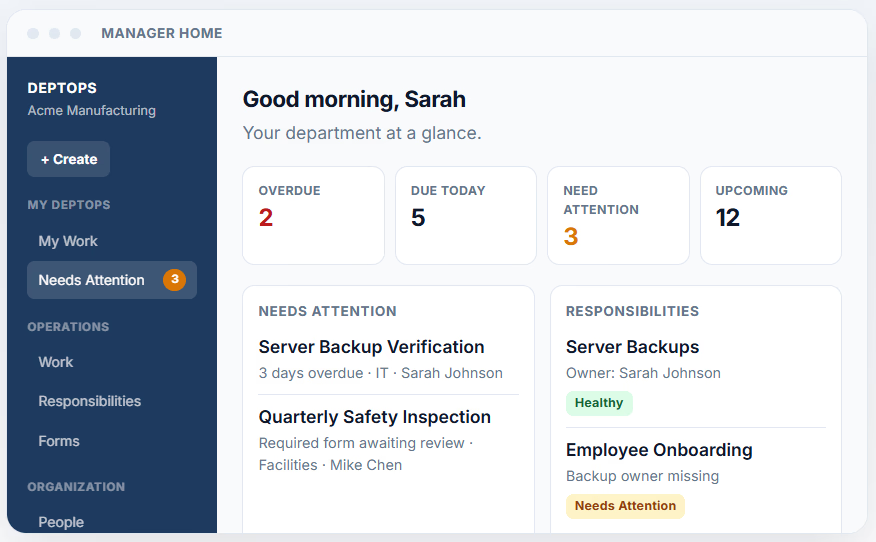
DeptOps was created to provide a dedicated place for managing department responsibilities and the work that keeps departments running.
Rather than treating responsibility ownership, recurring work, and operational visibility as unrelated activities, DeptOps brings them together in one platform.
Responsibility Management
Departments can define responsibilities and assign primary and backup owners.
This helps managers establish accountability and identify responsibilities where coverage may need attention.
Supporting information and resources can be associated with responsibilities, helping employees understand what is involved.
Assigned Work
DeptOps supports both one-time and recurring Assigned Work.
Departments can organize operational activities with assignments, deadlines, and completion tracking.
Recurring work is particularly important because many critical department activities must happen repeatedly, not just once.
Connecting work to responsibilities helps establish the relationship between ongoing accountability and the activities required to fulfill it.
Needs Attention
Operational issues shouldn't depend entirely on someone noticing them in a spreadsheet or remembering to raise them during a meeting.
DeptOps provides visibility into work that requires attention, including overdue and blocked activities.
This helps managers focus on issues that may affect department operations.
Operations Map and Org Health
DeptOps also provides broader visibility into department operations through its Operations Map and Org Health capabilities.
Department health indicators help distinguish areas that are healthy, need attention, are critical, or have not been evaluated.
These indicators provide a structured view of operational conditions rather than requiring managers to piece together information from disconnected sources.
They are not a substitute for management judgment, but they can help identify where further investigation is needed.
Software Alone Doesn't Eliminate Key-Person Risk
It's important to recognize that no software platform can guarantee business continuity.
A system can identify responsibility owners, associate backup owners, organize work, and improve visibility.
But it cannot automatically ensure that a backup employee knows how to perform a complicated process.
It cannot replace training, good documentation, appropriate system access, or management oversight.
Those remain organizational responsibilities.
The value of a dedicated operations platform is that it provides a consistent structure for managing these elements.
It makes ownership easier to identify, work easier to track, and gaps easier to recognize.
That structure can support better continuity planning, but the organization still needs to act on the information.
Business Continuity Isn't Just About Major Disasters
When organizations discuss business continuity, the conversation often focuses on major disruptions.
Cyberattacks. Power outages. Natural disasters. System failures.
Those risks deserve attention.
But many operational disruptions begin with ordinary events.
- An employee takes a two-week vacation.
- Someone calls in sick unexpectedly.
- A longtime employee retires.
- A department reorganizes.
- A position remains vacant for several weeks.
These events are normal parts of operating an organization.
The question is whether important responsibilities can continue when they happen.
Departments that depend heavily on undocumented individual knowledge are more vulnerable to disruption.
Departments with clearly defined ownership, appropriate backup coverage, accessible procedures, and visible operational work are generally better positioned to adapt.
A Simple Question Every Department Manager Should Ask
Think about the employees in your department.
Now imagine that one of your most experienced team members is unexpectedly unavailable for the next 30 days.
- Would you know every important responsibility they manage?
- Would you know which recurring activities need to continue?
- Could you identify upcoming deadlines?
- Would someone else have the knowledge and access needed to perform the work?
- Could you quickly determine which responsibilities and tasks require reassignment?
If answering those questions would require searching through spreadsheets, emails, shared folders, and individual notes, your department may have more key-person dependency than you realize.
That doesn't mean your employees are doing anything wrong.
It means there may be an opportunity to organize responsibilities and operational work more effectively.
The Goal Is Continuity, Not Replacing People
Experienced employees are among an organization's most valuable resources.
Their knowledge, judgment, and relationships often make the difference between a department that struggles and one that operates smoothly.
Reducing key-person dependency isn't about making those employees less important.
It's about ensuring their expertise contributes to a department that can function reliably over time.
Clear responsibility ownership establishes accountability.
Backup coverage provides a path for continuity.
Accessible procedures help preserve institutional knowledge.
Connected recurring work makes ongoing obligations visible.
And operational oversight helps managers identify problems before they become larger disruptions.
The strongest departments aren't those where one person knows how to do everything. They're the ones where important work can continue even when that person isn't available.
That's the philosophy behind DeptOps: a place for everything, and everything in its place.
Learn more about organizing department responsibilities, primary and backup ownership, recurring work, and operational visibility at DeptOps.com.