
A Place for Everything and Everything in Its Place
DeptOps wasn't born from a software idea. It came from years of trying to keep a department organized, accountable, and running smoothly.
When I was an IT Director, one of my ongoing challenges was keeping track of everything my department was responsible for.
Not just the projects or the urgent issues. Those usually had a way of getting attention.
I'm talking about the everyday responsibilities that keep a department functioning. The things that need to happen every day, every week, every month, and every year.
Who was responsible for what? Who was the backup if that person was unavailable? What work needed to be completed regularly? And how could I be confident that nothing important was falling through the cracks?
Like many managers, I relied on spreadsheets, lists, and various ways of organizing that information.
They worked, to a point.
But as responsibilities grew and people changed roles, keeping everything organized and up to date became a challenge of its own.
The Visibility Problem
One of my goals as an IT Director was to have better visibility into my department's operations.
And frankly, it was an area where I always felt I was falling behind.
I wanted to be able to look at my department and quickly understand what we were responsible for, who owned each responsibility, who provided backup coverage, and whether the associated work was getting done.
That sounds simple enough.
But the information was often spread across spreadsheets, documents, task lists, and people's knowledge.
You might have one spreadsheet showing responsibilities, another tracking recurring activities, and separate documentation explaining how certain processes worked.
The information existed. The problem was keeping it connected, current, and easy to understand.
I didn't want to spend my time hunting for information or asking people to confirm things I felt should already be visible.
I wanted a better way to manage the department.
A Place for Everything and Everything in Its Place
One of my favorite sayings has always been:
"A place for everything and everything in its place."
That philosophy has been a driving force behind how I approach organizing complicated departments.
To me, organization isn't just about keeping things neat. It's about creating a structure that makes information useful.
When something needs to be done, there should be a clear place for it.
When someone is responsible for an important function, that ownership should be documented.
When a backup is needed, it should be obvious who that person is.
When work needs to happen repeatedly, there should be a reliable way to schedule and track it.
And when a manager wants to understand how things are going, the information should be available without having to piece it together from five different places.
The challenge is that most departments don't have one system designed specifically around those needs.
We Have Software for Almost Everything Else
Think about the software organizations use.
There are platforms for managing projects, tracking support tickets, handling customer relationships, maintaining documents, and managing finances.
Each serves an important purpose.
But what about managing the department itself?
Not just its projects or incoming requests, but its ongoing responsibilities and the recurring work required to keep everything operating.
That's the gap I kept running into.
A spreadsheet could document who was responsible for something, but it wasn't particularly good at connecting that responsibility to scheduled work, backup ownership, procedures, and operational status.
A project management tool could track tasks, but the permanent responsibilities of a department aren't necessarily projects.
And a document management system could store procedures, but it couldn't tell me whether the work those procedures supported was actually getting completed.
Each tool solved part of the problem.
None gave me the overall picture I wanted.
Turning That Frustration Into DeptOps
Those experiences eventually became the foundation for DeptOps.
I wanted to create the kind of system I would have appreciated having when I was responsible for running an IT department.
A dedicated place to organize departments, people, responsibilities, ownership, backup coverage, and operational work.
A system where recurring work could be scheduled and tracked rather than repeatedly managed through reminders and spreadsheets.
A place where procedures and forms could be connected to the activities they support.
And, importantly, a way for managers to see what needs attention without constantly asking for updates.
That's why visibility is such an important part of DeptOps.
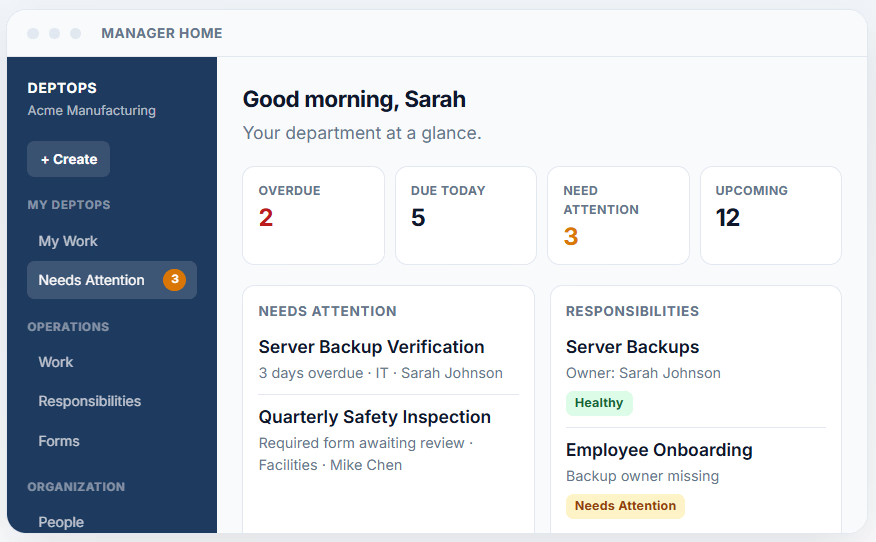
Features like Needs Attention, the Operations Map, and Org Health are built around the idea that managers should be able to understand what's happening across their operations, identify gaps, and focus on problems before they become bigger issues.
DeptOps isn't intended to replace every specialized tool a department uses.
It's intended to provide a central place for managing the operational responsibilities and work that often fall between those tools.
Built From a Manager's Perspective
One thing that has influenced how I think about DeptOps is remembering what it was like to be the person responsible for the department.
As a manager, I didn't need another complicated system that created more administrative work.
I needed answers.
- Who owns this?
- Who's the backup?
- What needs to get done?
- What's overdue?
- What isn't covered?
- Where do I need to focus my attention?
Those are straightforward questions, and I believe department management software should make them easier to answer.
Of course, software alone doesn't make a department well organized. People still need to establish responsibilities, maintain accurate information, and follow through on their work.
But the right system can make those practices much easier to maintain.
The Goal Hasn't Changed
Looking back, the idea behind DeptOps is really the same goal I had as an IT Director.
- I wanted to be better organized.
- I wanted better visibility.
- I wanted clear accountability.
And I wanted confidence that the everyday work keeping the department running wasn't being overlooked.
I don't believe managing a department should require constantly reconstructing its operations from spreadsheets, lists, emails, and memory.
There should be a better way.
That's why I built DeptOps.
And that old saying still captures the philosophy behind it:
A place for everything and everything in its place.
DeptOps - Departments, managed.