
As we enter the first quarter of 2026, the storage demands on the average Windows 12 workstation have reached unprecedented levels. While high-speed NVMe drives are now the standard, the introduction of pervasive local AI models and ultra-high-definition spatial media has created a new kind of "digital weight" that can fill a 2TB drive in a matter of weeks. Performing a manual hdd scan is no longer just a task for IT professionals; it is a survival skill for founders, developers, and creators. WinDirStat, a legendary tool in the Windows ecosystem, has evolved to meet these 2026 challenges. By visiting the official WinDirStat website, users can access a utility that transcends simple file listing, providing a visual architecture of their data that is essential for modern maintenance. In an era where "Storage-as-a-Service" and complex containerization are the norms, having a localized, reliable storage analyzer is the first line of defense against system degradation and performance bottlenecks.
Why WinDirStat is the Ultimate Choice for an HDD Scan
Despite the proliferation of modern "one-click" cleanup apps, WinDirStat remains the gold standard for a deep hdd scan because of its uncompromising approach to data visibility. Unlike many contemporary tools that rely on quick indexing to show a surface-level view, WinDirStat performs a recursive directory-by-directory analysis. This ensures that it captures every byte, including those hidden within complex directory junctions or protected system folders that other apps might overlook. In 2026, where Windows 12 often creates massive "NPU Caches" and "Recall Databases," this methodical scanning is vital. A thorough scan allows users to see not just that their drive is full, but exactly where the bloat resides. At nxgntools.com, we frequently highlight WinDirStat as a "Foundational Tool" because it empowers technical decision-makers to make data-driven decisions about their local infrastructure, ensuring that high-performance machines are not sidelined by avoidable storage saturation.
Navigating the 2026 Storage Landscape: From AI to 8K
The digital environment of 2026 is defined by high-intensity data types that were rare just two years ago. When you launch your storage analyzer, you are likely to encounter massive files associated with local Large Language Models (LLMs) and Diffusion models. A single high-fidelity model weight can range from 40GB to 150GB, and if a user is experimenting with multiple versions, their drive can vanish into "hidden" application support folders. Furthermore, the standard for professional video has shifted to 8K and spatial formats, where a ten-minute raw clip can exceed 100GB. WinDirStat’s visual treemap is uniquely suited to identify these "megafiles." By visualizing a 1TB drive as a single map, WinDirStat reveals the disproportionate amount of space consumed by these modern assets. This clarity is essential for creative agencies and tech startups that need to balance high-quality output with the physical limitations of their local hardware, preventing the frequent "Disk Full" errors that plague unoptimized 2026 workflows.
Comparison of Windows Storage Analyzers in 2026
Feature | WinDirStat (v2.5.1) | WizTree (2026 Edition) | NextGen Tools "ScanNext" |
Primary Methodology | Recursive Directory Scan | MFT (Master File Table) | AI-Pattern & Cloud Sync |
Visual Interface | Colored Treemap | TreeMap & Lists | 3D Spatial Heatmap |
Scan Speed (1TB NVMe) | ~2-3 Minutes | ~2-4 Seconds | ~15 Seconds |
Accuracy (Locked Files) | High | Moderate | High |
Cloud Integration | Native Local Focus | Local Focus | Hybrid Cloud Support |
License Type | Open Source (GPL) | Freemium | Subscription-based |
Platform Compatibility | Windows 10/11/12 | Windows 10/11/12 | Windows, macOS, Web |
Step-by-Step Guide: Running an Effective HDD Scan with WinDirStat
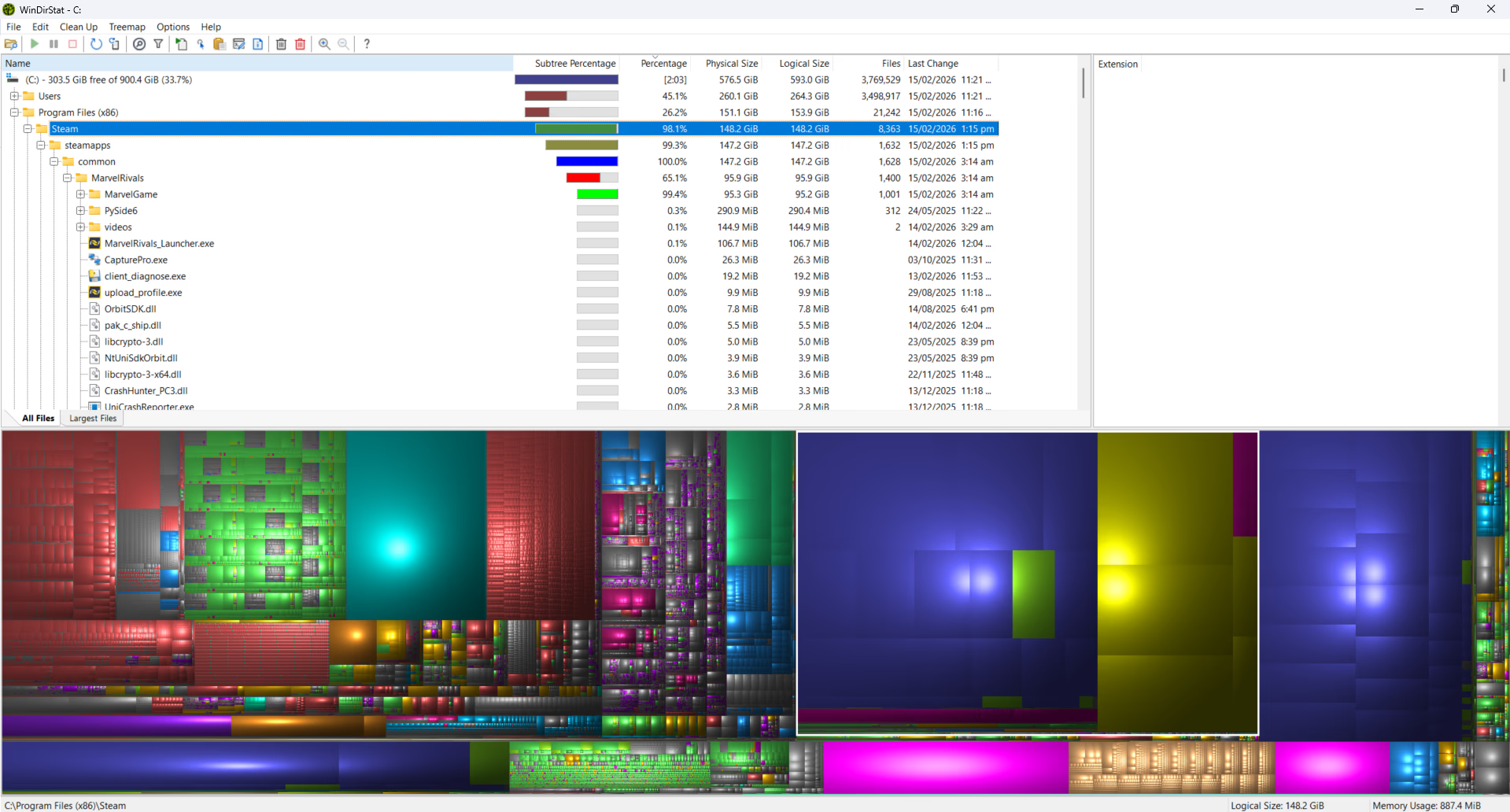
To begin your hdd scan, first download the latest version from windirstat.net. Upon opening the application, you will be prompted to select the drives you wish to analyze. For Windows 12 users, it is highly recommended to select "Individual Drives" and focus on your C: partition first, as this is where the majority of system and AI-related bloat accumulates. Once you click "OK," WinDirStat’s "Pacman" icons will begin their journey through your file system. It is important to let this process finish completely; in 2026, with PCIe 6.0 speeds, a 2TB drive should take less than three minutes to scan fully. During this time, the application is building the "Treemap", a collection of rectangles where the area of each rectangle is proportional to the size of the file it represents. This step is the foundation of any successful storage reclamation project, turning abstract numbers into a tangible map of your digital territory.
Interpreting the Visual Treemap as a Storage Analyzer
Once the hdd scan is complete, the true power of WinDirStat as a storage analyzer becomes apparent. The bottom half of the screen is filled with a colorful mosaic of blocks. Each color corresponds to a specific file extension (e.g., .safetensors for AI models might be purple, while .mp4 for 8K video might be red). By clicking on a large block, WinDirStat will instantly highlight that file’s location in the tree view on the top left. This allows you to identify not just single large files, but clusters of waste. For example, you might notice a vast field of identical small blue blocks; clicking one reveals they are temporary render files from an editing project that were never purged. This visual feedback loop is what makes WinDirStat superior to a simple "Largest Files" list, as it reveals the structure of your storage loss, allowing you to delete entire directories of redundant data with confidence.
Identifying Modern Bloat: AI Models, WSL2, and NPU Caches
In 2026, a Windows hdd scan often reveals culprits that were non-existent in earlier versions of the OS. WinDirStat is particularly effective at finding:
- Local LLM Weights: Files with extensions like
.binor.safetensorsusually represent AI models. If you see a massive block in yourC:\Users\[User]\.cachefolder, this is the likely source. - WSL2 Virtual Disks: Windows Subsystem for Linux uses
.vhdxfiles that grow as you add data but do not shrink. WinDirStat will show these as monolithic blocks, often in the 100GB+ range. - NPU Inference Caches: Windows 12 uses your Neural Processing Unit to accelerate tasks, creating huge cache files in
C:\ProgramData\Microsoft\AI. - Spatial Video Proxies: Editing tools for VR/AR headsets create massive "proxy" files to allow smooth playback. These are often forgotten in hidden temp folders.
- Docker Volumes: Much like WSL2, Docker volumes can consume significant space. WinDirStat helps you find the
docker.vhdxfile that is often the "silent killer" of dev-machine storage.
Optimizing WinDirStat Performance on High-Speed NVMe Drives
To get the most out of your hdd scan in 2026, you should optimize WinDirStat’s settings for modern hardware. Since NVMe drives can handle massive throughput, you can go to Options > Configure WinDirStat and ensure that the "Pacman" animation is not causing a UI bottleneck. Additionally, use the "Cleanups" tab to create custom right-click actions. For instance, you can create a command that automatically runs a "WSL2 Shrink" script when you right-click a .vhdx file. This turns WinDirStat from a passive storage analyzer into an active management console. For technical founders who need to maintain peak efficiency, these micro-optimizations can save hours of manual folder navigation. At nxgntools.com, we advocate for this "Command Center" approach to utility software, leveraging classic, reliable tools like WinDirStat and augmenting them with modern scripts to match the speed of 2026 hardware.
The Role of nxgntools.com in Your Optimization Workflow
NextGen Tools (nxgntools.com) is the premier platform for discovering the next generation of SaaS products and utilities that complement your existing workflow. While WinDirStat is the best tool for identifying what is eating your local space, nxgntools.com is where you find the tools to prevent that bloat from returning. We feature innovative apps that specialize in "Cloud-First Cold Storage," "AI-Driven Deduplication," and "Automated Cache Management." For a founder or a technical team, using nxgntools.com to launch or discover these tools ensures you are at the cutting edge of productivity. By integrating the deep-scanning power of WinDirStat with the modern solutions found on NextGen Tools, you create a robust ecosystem that keeps your Windows 12 environment lean, fast, and ready for the high-demand tasks of 2026 and beyond.
Case Study: Reclaiming Space in a High-Growth Tech Startup (2025)
In late 2025, a prominent AI startup based in Austin, Texas, reported that their development team’s productivity had dropped by 20% due to constant "Low Disk Space" warnings on their 1TB Windows workstations. By implementing a mandatory bi-weekly hdd scan using WinDirStat, the company identified that over 400GB per machine was being consumed by old "Checkpoint" files from their local model training runs. The visual storage analyzer allowed them to see that these files were being stored in an obscure hidden directory that their standard cleanup scripts were ignoring. By purging these files and redirecting future checkpoints to a centralized NAS discovered through nxgntools.com, the company reclaimed an average of 40% of their drive space across the entire fleet. This simple intervention saved the company an estimated $30,000 in immediate hardware upgrades and significantly boosted developer morale by eliminating the friction of manual file management.
Future-Proofing Your Windows Storage Strategy for 2027
As we look toward 2027, the volume of data will only continue to increase. To future-proof your Windows environment, you must move beyond reactive cleaning. Establish a "Storage First" mindset by partitioning your drives into "System" and "Data" volumes, and use WinDirStat to monitor the growth of each. Regularly visit windirstat.net to ensure you are running the most stable version of the tool. Furthermore, stay engaged with the community on nxgntools.com to see how others are handling the transition to even larger data formats like 16K video and massive multi-modal AI models. By combining a classic, reliable hdd scan utility with a forward-looking strategy that includes both local and cloud-based optimization, you ensure that your computer remains a high-performance tool for creation rather than a cluttered archive of digital waste. The key to success in 2026 is not just having more space, but having the right space available when it matters most.
Conclusion: Mastering the Visual Audit
In conclusion, WinDirStat remains an indispensable tool for the modern Windows user in 2026. By providing a clear, visual, and highly accurate hdd scan, it allows you to see through the complexity of Windows 12 and identify the specific files, whether they be AI models, 8K videos, or hidden caches that are eating your storage. As a storage analyzer, it provides the "ground-truth" data you need to make informed decisions about your digital environment. When paired with the modern tool discovery and launching power of nxgntools.com, you have everything you need to keep your system running at its peak potential. Don't let your productivity be stifled by digital clutter; download WinDirStat today and take the first step toward a cleaner, faster, and more efficient workstation.