
There is a strange problem with how we learn today.
We have access to more information than any generation before us, yet actually turning that information into something useful still takes an unreasonable amount of work.
A lecture can be two hours long. A research paper can take an afternoon to unpack. A folder of PDFs can slowly become a graveyard of files we swear we will read later. Notes get scattered between documents, screenshots, recordings, browser tabs, and whatever app happened to be open at the time.
The information is technically there.
The problem is what happens next.
That is the problem I started building Abstruck to solve.
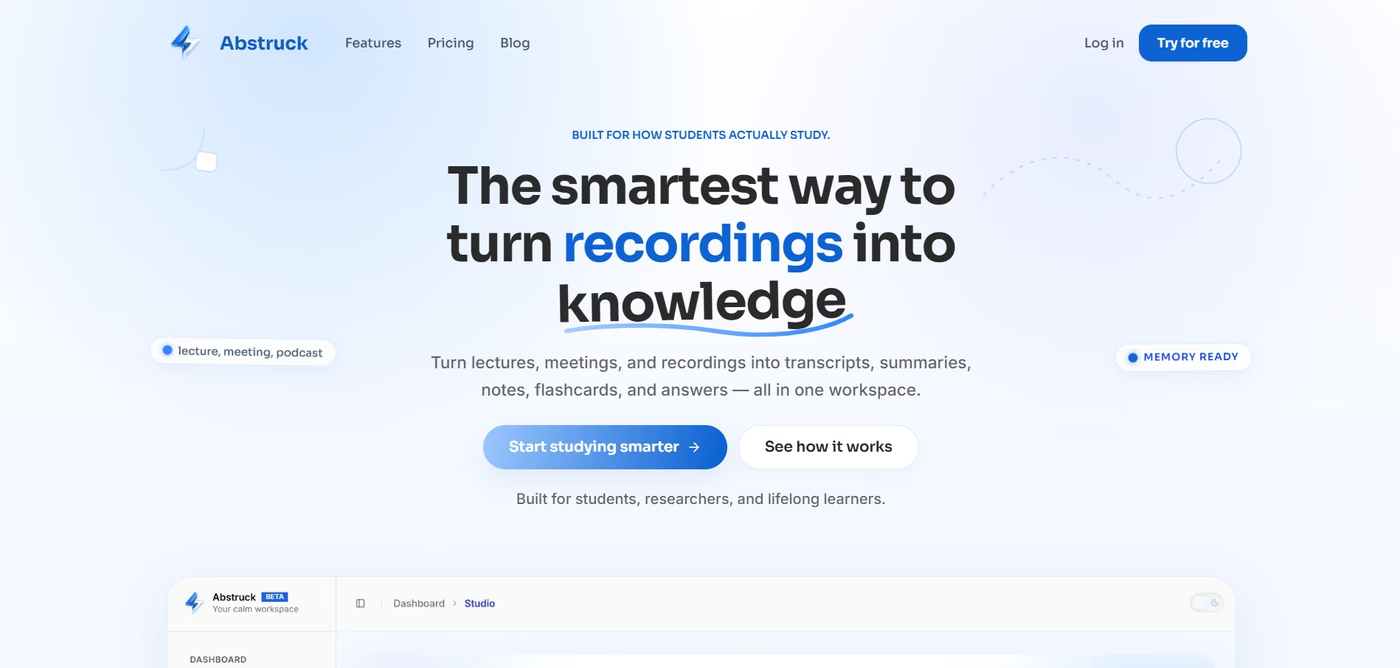
Abstruck is an AI-native learning and knowledge workspace designed to help students and learners turn the information they already have into knowledge they can actually understand, organize, remember, retrieve, and use.
The idea sounds simple:
Bring in information. Understand it. Turn it into something useful.
But getting that workflow right has become one of the most interesting problems I have worked on.
Information Is Everywhere. Understanding Is Still Manual.
Think about a typical week as a student.
You might have:
- lecture recordings
- presentation slides
- PDFs
- reading materials
- research papers
- meeting recordings
- handwritten notes
- links your professor sent
- documents shared by classmates
Each source contains useful information, but each one demands a separate process.
You listen.
You pause.
You rewind.
You highlight.
You summarize.
You reorganize.
You make reviewers.
You create flashcards.
You search through old notes when you forget something.
A lot of modern AI tools help with one piece of this process. Some summarize documents. Some transcribe recordings. Some generate flashcards. Some let you chat with files.
Those capabilities are useful, but I became more interested in the larger question:
Why are we still treating all of those steps as separate tasks?
The real value is not the transcript.
It is not the summary.
It is not even the flashcard.
The value is the transformation from raw information into usable knowledge.
That became the core idea behind Abstruck.
What Abstruck Actually Does
Abstruck takes learning material such as recordings, lectures, and documents and helps transform them into structured learning resources.
Depending on the source and workflow, that can include:
- searchable transcripts
- concise summaries
- organized notes
- study materials
- flashcards
- source-grounded questions and answers
- knowledge that can be revisited later
Instead of thinking of Abstruck as an isolated AI note-taking app or lecture transcription tool, I think of it more as a workspace between the information you consume and the knowledge you ultimately want to keep.
You bring the source.
Abstruck helps process it.
Then you work with the result.
That distinction matters because students rarely need information in only one format.
A transcript might help when you need to find exactly what a lecturer said.
A summary helps when you need the main ideas quickly.
Structured notes help when you are reviewing.
Flashcards help when you need to actively recall concepts.
Source-grounded AI helps when you need to ask a specific question without manually searching through the entire material again.
They are different outputs, but they belong to the same learning process.
I Did Not Want to Build Another Generic AI Wrapper
When you build anything around AI today, there is an obvious question:
Does this really need to exist?
There are already excellent products in the learning space.
NotebookLM exists.
Quizlet exists.
Mindgrasp exists.
StudyFetch exists.
Knowt exists.
And there will be many more.
Pretending otherwise would be dishonest.
So my goal with Abstruck was never to claim that nobody had thought about AI-assisted learning before.
The question I care about is different:
Can the experience of working with learning information still be made significantly better?
I believe it can.
There is still room for tools that feel more cohesive, more intuitive, more useful across different learning materials, and more accessible to the people actually doing the studying.
That is where I want Abstruck to compete.
Not by having the longest feature checklist.
Not by adding AI to everything possible.
But by making the path from “I have this information” to “I understand and can use this information” feel increasingly effortless.
Building as a Student Changes the Product
One thing that shapes Abstruck heavily is that I am not building it from a hypothetical idea of what students might need.
I am a student myself.
I deal with the same long lectures, documents, deadlines, scattered materials, and study workflows that the product is supposed to improve.
That creates a useful constraint.
If something technically works but feels annoying to use, I notice.
If a feature saves only a few clicks but adds another layer of complexity, I question whether it belongs.
If the AI generates something impressive-looking but not genuinely useful for studying, that matters more to me than whether it looks good in a demo.
Building from the Philippines also affects how I think about accessibility.
There are powerful educational AI products being built globally, but I want students here to be part of that shift rather than merely watching it happen elsewhere.
Abstruck is being built as a global product, but making modern learning technology more useful and accessible to Filipino students is personally important to me.
AI Should Reduce Learning Friction, Not Replace Learning
There is another principle I keep coming back to while building Abstruck:
AI should help you work with information, not remove you from the learning process entirely.
A tool that simply gives you an answer can be useful.
But learning requires more than getting answers.
You need context.
You need connections between ideas.
You need retrieval.
You need repetition.
You sometimes need to return to the original source and verify what was actually said.
That is why source-grounded workflows matter.
If you ask Abstruck something about your material, the useful version of that experience is not an AI confidently improvising.
It is AI helping you understand the information you actually provided.
The distinction becomes increasingly important as AI-generated content becomes easier to produce.
Trust matters.
Sources matter.
And knowing where information came from matters.
The Future of Studying Is Probably Not Another Folder of Notes
For years, digital studying mostly replicated physical studying.
Documents replaced paper.
Typing replaced handwriting.
Cloud folders replaced binders.
But the underlying workflow remained surprisingly similar.
You still manually organize information into static files.
AI creates an opportunity to rethink that.
Imagine learning materials becoming more dynamic.
A lecture does not have to remain a video you replay from the beginning.
It can become searchable.
A PDF does not have to remain a document you vaguely remember reading.
Its ideas can become part of a usable knowledge workspace.
Notes do not have to be the final destination.
They can become the foundation for questions, flashcards, retrieval, review, and deeper exploration.
That is the direction I find far more interesting than simply generating prettier summaries.
The long-term opportunity is to make knowledge active.
Why “Abstruck”?
The name came from the idea of taking something abstract and making it usable.
Information often begins that way.
A lecture is just a stream of words.
A research paper is a dense collection of arguments.
A recording is an hour of audio.
A folder contains documents but not necessarily understanding.
Abstruck is about taking that abstract information and helping transform it into something structured enough to work with.
There is also the idea of something happening in a struck — quickly, almost like a strike of lightning.
The name became a compact representation of what I wanted the product to feel like:
abstract information transformed into usable knowledge with dramatically less friction.
Building the Product Is an Ongoing Process
I do not think Abstruck is finished.
Software like this probably should not ever feel completely finished.
Learning workflows are too varied, AI capabilities are moving too quickly, and there are too many interesting problems left to solve.
But I also do not want the product to become a collection of features added simply because they are technically possible.
The standard I am trying to keep is straightforward:
Does this meaningfully improve how someone turns information into knowledge?
If the answer is yes, it is worth exploring.
If the answer is no, it probably does not belong.
That principle gives Abstruck room to grow beyond recordings or individual documents without losing the reason it exists.
What I Want Abstruck to Become
I want Abstruck to become a place where the information that matters to you stops feeling fragmented.
A lecture.
A document.
A recording.
A set of notes.
Eventually, whatever sources are important to your work or learning.
Instead of each source disappearing into a different application, the goal is to make them easier to understand together and easier to turn into something useful.
For students, that might mean going from a lecture to organized study material in minutes.
For researchers, it might mean navigating large collections of source material more effectively.
For anyone dealing with information-heavy work, it could mean spending less time processing information manually and more time actually thinking with it.
That is the larger vision.
But the starting point remains simple:
Take what you already have and make it more useful.
Building Something I Would Actually Want to Use
There are easier products I could have chosen to build.
There are probably easier markets too.
But education and learning technology are interesting precisely because the problem is difficult.
People learn differently.
Information comes in countless formats.
Accuracy matters.
Trust matters.
Good UX matters.
And adding AI does not automatically make any of those things better.
That makes the problem worth working on.
Abstruck started because I wanted a better way to work with the information I was already consuming as a student.
It is gradually becoming something larger: an attempt to build a modern learning workspace around a very basic idea.
We already have enough information.
What we need are better ways to turn it into knowledge.
That is what I am building with Abstruck.
Explore Abstruck: https://www.abstruck.space/