
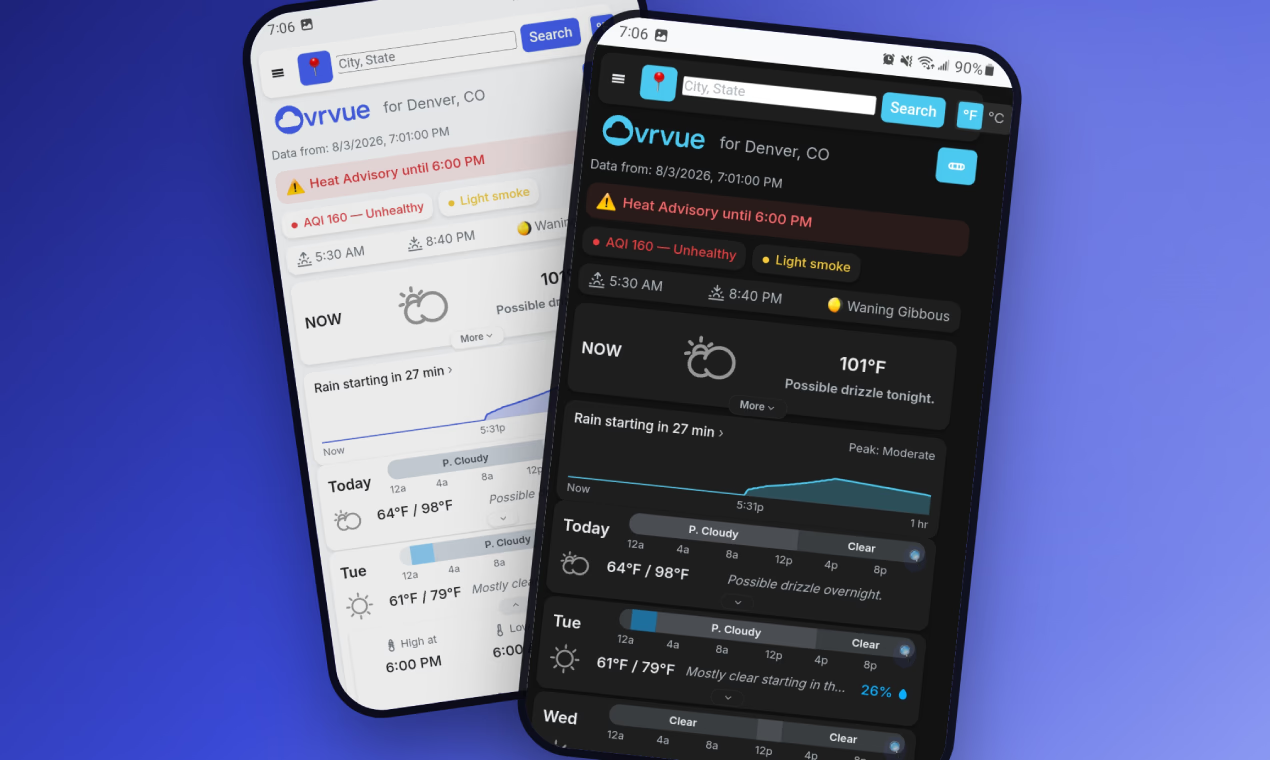
When “Nothing” Is the Wrong Answer
One of the most comforting conventions in software is the empty state.
No messages.
No alerts.
No transactions.
No results.
Nothing happening can be a perfectly useful answer. In fact, good interfaces often work hard to distinguish genuine absence from clutter. If there is nothing worth showing, perhaps the correct design is to show nothing at all.
But there is a dangerous edge case hiding inside that principle.
Sometimes nothing is also what failure looks like.
A blank inbox can mean you have no new mail. It can also mean synchronization failed.
An empty analytics chart can mean there were no events. It can also mean the tracking pipeline broke.
A weather map with no precipitation can mean the sky is clear.
It can also mean the radar never loaded.
Those two states may be visually identical.
They are not informationally equivalent.
The latest Ovrvue.app Product Definition Document makes this distinction explicit in one of its design principles: “Degradation must not be able to lie.” The document explains the problem through radar. Geography with no precipitation drawn on it looks like clear weather, not missing weather data, so the app must identify the failure rather than silently falling back to an empty image.
That is a narrow implementation detail with a much broader implication.
Graceful degradation is usually celebrated as the art of failing quietly.
Sometimes quiet failure is the most misleading failure of all.
We Have Been Trained to Prefer Invisible Failure
Software design generally treats disruption as something to minimize.
If one component fails, the rest of the application should keep working. If an image cannot load, the page should remain usable. If an optional API is unavailable, the product should avoid collapsing around it.
This is good engineering.
A weather app should not lose the entire forecast because radar failed. Ovrvue follows exactly that principle. Its PDD states that derived values return null instead of placeholders, and that a failed radar lookup should cost the user the radar, not the forecast.
That is ordinary graceful degradation.
The harder problem comes afterward.
How should the broken piece disappear?
The simplest implementation is often to render whatever remains. If radar imagery fails but the map still renders, perhaps the interface can simply show the geography.
Technically, the app has degraded gracefully. Nothing crashed. The user can still navigate the forecast.
Semantically, however, the application may now be making a false claim.
A radar map showing roads, coastlines or geographic outlines with no precipitation painted over them does not look broken.
It looks clear.
The interface has converted uncertainty into confidence.
Failure Has Meaning Because Interfaces Have Meaning
Every visual state communicates something whether the designer intended it to or not.
A disabled button says this action is unavailable.
A spinner says work is still happening.
A blank panel says there is currently nothing to display.
A red badge says something deserves attention.
The meaning comes partly from convention and partly from context.
Weather radar has an especially strong convention: color means precipitation. Green, yellow and red areas indicate increasingly substantial echoes. A map without those colors therefore reads naturally as the absence of precipitation.
That makes “no pixels arrived” a dangerous technical fallback.
The user does not see a failed network request.
They see blue sky.
This is why Ovrvue’s latest radar system treats silent failure differently from ordinary optional-data failure. The PDD explicitly distinguishes safe absence from deceptive absence: if a missing feature genuinely reads as missing, it can disappear; if missing data would look like a valid result, the failure needs to be named.
This is a useful test far beyond weather:
If the data vanished, would the remaining interface accidentally make a claim?
If the answer is yes, graceful degradation needs another step.
Ovrvue’s Radar Rebuild Made This Problem Harder
Earlier versions of Ovrvue.app used U.S. National Weather Service RIDGE-II station radar. In the latest PDD, radar has been rebuilt around a global default using RainViewer imagery, with NWS retained as an optional higher-resolution source where available in the United States.
The change solved one obvious limitation.
Radar no longer had to disappear outside the U.S.
But removing that limitation introduced new responsibility.
The default radar view is now centered directly on the user’s coordinates rather than around a weather station. Ovrvue draws its own geographic context using Natural Earth coastlines, lakes and major rivers stored in a static geo.json asset. RainViewer supplies precipitation imagery over that geography. A crosshair marks the user’s exact location, and recent frames loop with timestamps so movement can be understood over time.
This makes the map more useful.
It also makes the map more convincing.
A properly drawn coastline, lakes, rivers and location marker create a complete-looking visual surface even before radar imagery arrives.
That is exactly why failure handling matters.
The better the base map looks, the easier it is for missing precipitation data to masquerade as a legitimate clear-sky result.
Visual polish can increase the cost of ambiguity.
A Partial Success Can Be More Dangerous Than a Total Failure
Total failures are easy to understand.
The screen is blank.
An error appears.
Something obviously did not work.
Partial failures are much harder because they preserve enough structure to look intentional.
Suppose the geographic asset loads correctly but the radar manifest fails.
The user still sees a map.
Suppose RainViewer’s manifest arrives but frame images fail.
The user may still see geography, a pin and controls.
Suppose one asynchronous render finishes after the user has switched radar sources and paints into a view that no longer corresponds to the requested state.
The software is still alive.
That is what makes these bugs deceptive.
Ovrvue’s PDD records several defensive choices around the rebuilt radar: failed geometry fetches are not cached, because caching a failure would convert a transient problem into a persistent one; asynchronous rendering races are handled when the modal is rebuilt; and missing precipitation imagery is not allowed to silently appear as a successful empty radar view.
These decisions all point toward the same idea.
Correctness is not only about whether the code received the right values.
It is about whether the user can distinguish a real answer from a failed attempt to produce one.
“No Data” and “Zero” Are Different Things
This distinction appears constantly in data-heavy software.
No sales data is not zero sales.
No heart-rate reading is not a heart rate of zero.
No location result is not evidence that a place does not exist.
No precipitation response is not clear weather.
Yet software often collapses missing information into the nearest displayable default.
Zero is convenient.
An empty array is convenient.
A blank string is convenient.
A hidden component is convenient.
These values make code paths simpler because they allow the rendering system to continue without forcing every absence to become an explicit state.
Ovrvue takes the opposite position in several parts of its architecture. Its PDD says derived values generally return null rather than placeholders, and conditional components do not render at all when their information does not exist. It avoids -- placeholders, meaningless 0.0 in accumulation values and “Good” air-quality tiles that contribute little when conditions are normal.
That philosophy works because those absences are usually unambiguous.
If the UV tile does not appear, the app is not claiming UV equals zero.
The radar case is different because the container itself has meaning.
Once the map remains visible, removing the precipitation layer changes the message.
This is why error handling cannot be standardized purely at the component level.
The same null can be safe in one visual context and deceptive in another.
Graceful Degradation Is a Semantic Problem
Engineers often describe graceful degradation in technical terms.
Can the app still run?
Does the page remain interactive?
Can unaffected features continue?
Those are necessary questions.
They are not sufficient.
There is also a semantic version of graceful degradation:
Does the reduced experience still mean what the user thinks it means?
Ovrvue’s architecture provides several useful examples.
If National Weather Service station radar cannot resolve, the global RainViewer view can still function. That is real degradation because the user loses a higher-resolution optional source while retaining valid radar.
If radar itself fails, the forecast remains. Also valid.
If weather data is temporarily unavailable but a previously fetched forecast exists, the installed app can show that older forecast with its age identified instead of passing it off as current.
Again, valid degradation.
In all of these cases, the reduced product is still truthful about what it is presenting.
That is the actual standard.
Not “does something remain on screen?”
“Can what remains still be interpreted correctly?”
The Same Problem Appears in Loading Indicators
The PDD contains another bug that initially seems unrelated.
Ovrvue’s pull-to-refresh feature once showed a spinner for a fixed one-second period even though the actual refresh operation might take longer, especially when the phone needed a fresh GPS fix. The spinner would stop before the work completed. To the user, it looked like refresh had failed even though the application was still working.
The eventual design rule was simple: a progress indicator must be bound to the work it claims to represent.
This and the radar problem are really the same bug.
In one case, the interface displayed absence before it knew whether data was absent.
In the other, the interface displayed completion before the work was complete.
Both systems were mechanically functioning.
Both presentation layers lied about the state of that functioning.
Ovrvue’s PDD groups these kinds of failures under another principle: “A signal must survive its container.” A correct calculation or process is not enough if the visual structure that presents it clips, transforms or misrepresents the result.
The container participates in correctness.
That is easy to forget.
Reliability Is Not the Same As Looking Calm
There is understandable pressure to make software feel composed.
Errors are ugly.
Warnings interrupt the design.
A vanished component may be cleaner than an explanation.
This can create an aesthetic bias toward hiding failure.
The product continues looking polished even when part of it is uncertain.
But calm interfaces are not necessarily trustworthy interfaces.
Imagine two weather maps.
The first shows an explicit message that radar imagery is currently unavailable.
The second displays a beautiful precipitation-free map because its image requests failed.
The second interface is visually cleaner.
The first is better software.
Trust often requires making uncertainty visible at exactly the moments when design instinct would prefer to smooth it away.
That does not mean every failed request deserves a giant red error banner.
Error communication can still be proportional.
A small label may be enough.
A component can disappear when disappearance is unambiguous.
The important thing is that the fallback state should never impersonate the successful state.
Better Fallbacks Preserve the Difference Between Known and Unknown
A useful way to think about fallback design is to separate three states that software often compresses into two.
There is yes.
There is no.
And there is we do not currently know.
For precipitation:
Rain is present.
Rain is absent.
Radar data is unavailable.
For analytics:
Traffic occurred.
No traffic occurred.
The analytics pipeline has not reported.
For synchronization:
Changes exist.
No changes exist.
The server has not been reached.
That third state complicates interfaces.
It also protects meaning.
Ovrvue’s latest radar implementation is particularly instructive because the application is intentionally minimalist. Its entire product philosophy favors conditional surfacing and removing things that are not useful.
Yet minimalism does not win when hiding something would change the meaning of what remains.
That is an important boundary.
“Show less” is not the same as “say less than is necessary to remain truthful.”
The Most Dangerous Error Is a Plausible Answer
Obvious failures are irritating.
Plausible failures are dangerous.
A crash tells you not to trust the result.
A loading error tells you the information never arrived.
A map that quietly shows clear conditions tells you something specific about the world.
That specificity is what makes silent degradation risky.
As software increasingly sits between users and complex data sources, more applications will face this problem. Interfaces assemble outputs from APIs, models, sensors, caches and third-party services. Individual pieces will inevitably fail independently.
The goal cannot be to prevent every failure.
The goal is to prevent failure from becoming an answer.
Ovrvue’s radar rebuild happens to expose this problem through weather, where the distinction is easy to understand. A missing rain layer cannot be allowed to become “no rain.”
But the principle is much larger than radar.
A system is not gracefully degraded merely because it still renders.
It is gracefully degraded when the remaining interface preserves the boundary between what the software knows and what it failed to learn.
Sometimes nothing really is the right answer.
And sometimes the most honest thing software can show is that it does not have one.
Ovrvue.app is a personal weather app built around actionable conditions, progressive disclosure and explicit failure states that avoid turning missing weather data into misleading certainty.
Learn more: https://ovrvue.app