
Why E-commerce Dashboards Don’t Tell You What to Fix
Running an e-commerce business today means having access to more data than ever.
Google Analytics tells you what visitors are doing. Google Ads and Meta show campaign performance. Your e-commerce platform provides orders and revenue. Email platforms measure retention and engagement. SEO tools track visibility. Page-speed tools tell you whether your website is technically healthy.
And almost all of them come with dashboards.
Yet there is a strange paradox: the more data we collect, the harder it can become to decide what to do next.
The problem is no longer getting the numbers. The problem is understanding which numbers matter right now — and turning them into action.
A dashboard describes. A business has to decide.
Imagine opening your analytics on Monday morning.
Conversion has fallen slightly. Google Ads ROAS is still reasonable. Meta performance is weaker. Traffic is up. Returning customer revenue is down. Mobile performance could be better.
What should you work on?
Every observation may be correct, but simply putting them together on a dashboard doesn't answer the question.
- Should you increase Google Ads because it is performing relatively well?
- Reduce Meta spend?
- Work on conversion?
- Improve mobile performance?
- Focus on retention?
The traditional analytics approach often leaves that decision to the person looking at the dashboard. The software provides the measurements; the human has to work out how everything relates.
That is becoming the real bottleneck.
Your webshop is a connected system
One reason dashboards struggle with this is that they naturally divide a business into separate metrics and channels.
The business itself doesn't work that way.
Think of an e-commerce business as a connected system:
Acquisition → Conversion → Retention → Revenue → Capacity to scale
Each part influences the others.
Suppose acquisition is performing well but conversion has deteriorated. Increasing advertising spend may generate more visitors, but those additional visitors enter the same underperforming funnel.
You have successfully scaled the wrong part of the system.
Or imagine conversion is excellent but acquisition has slowed significantly. Spending weeks making another small improvement to checkout may have little effect because insufficient qualified traffic is entering the funnel.
Neither conversion nor acquisition can therefore be judged properly in isolation.
The important question isn't simply: “Is this KPI good or bad?”
It is: “What is currently constraining the performance of the whole system?”
Find the constraint before optimizing
This changes how you approach optimization.
Most businesses can identify dozens of things that could be improved. There is almost always another campaign to optimize, landing page to change, technical issue to solve or email flow to improve.
But they don't all deserve attention at the same time.
If conversion is currently the main constraint, fixing it may also make existing acquisition spend more productive.
If acquisition is the constraint, increasing conversion from an already healthy level may have less impact than bringing more qualified visitors into the store.
If retention is deteriorating, acquiring customers faster may mask rather than solve the underlying problem.
The objective therefore isn't to produce the longest possible list of recommendations.
It is to identify where improvement creates the most leverage now.
Sometimes the best growth decision is HOLD
This way of thinking leads to something dashboards rarely do: making an explicit decision.
- Sometimes that decision can be SCALE.
- But sometimes it should be HOLD.
That distinction matters.
Consider a channel that appears to be performing reasonably well. The obvious recommendation might be to increase its budget.
But what if there isn't enough evidence yet that additional spend will remain efficient? What if conversion elsewhere in the funnel is weakening? What if another channel is already beyond its efficient range?
Looking at the channel alone can produce a perfectly rational recommendation that is wrong for the business as a whole.
HOLD doesn't mean do nothing.
It means: don't scale this part of the system yet. First address the condition that prevents scaling from being efficient.
That is a much more useful decision than another green or red KPI.
From insight to priority
There is a second problem with conventional analytics: even good insights can become overwhelming.
A sophisticated analysis might discover 25 issues.
Technically, that is valuable.
Operationally, it can be useless.
A webshop owner or marketing team doesn't have unlimited time and resources. They need to know:
What should we do first?
That means recommendations need context and priority.
One action might have high expected impact because it addresses the current constraint directly. Another might be worthwhile but less urgent. A third could be postponed because solving it won't materially change current performance.
This is where analytics starts becoming decision support.
Instead of:
Data → dashboard → human interpretation
the process becomes:
Data → relationships → constraint → decision → prioritized actions
AI can play an interesting role here, but only when it is grounded in the actual business data.
Where AI becomes useful
Much of the discussion around AI in e-commerce has focused on generating content: product descriptions, advertisements, emails and images.
Those applications are useful, but there is another opportunity.
AI can help interpret the increasingly complex collection of signals an e-commerce business already produces.
The goal isn't to ask a general-purpose AI, “How can I improve my webshop?”
Without business context, the answer will inevitably be generic.
Instead, AI can help reason across actual signals from acquisition, conversion, retention, advertising, website performance and other sources.
It can then help answer much more useful questions:
- What appears to be holding growth back?
- Which issue should we investigate first?
- Is increasing advertising spend justified?
- Where is budget being wasted?
- Which action is likely to have the greatest impact?
- Why is this recommendation more important than another one?
That moves AI away from being merely a content generator and toward becoming a sparring partner for decision-making.
How we approached this with BlueWalnut Genius
This is the thinking behind BlueWalnut Genius.
Rather than building another place to look at e-commerce KPIs, we wanted Genius to help answer the question that comes after looking at the numbers:
What should we actually do?
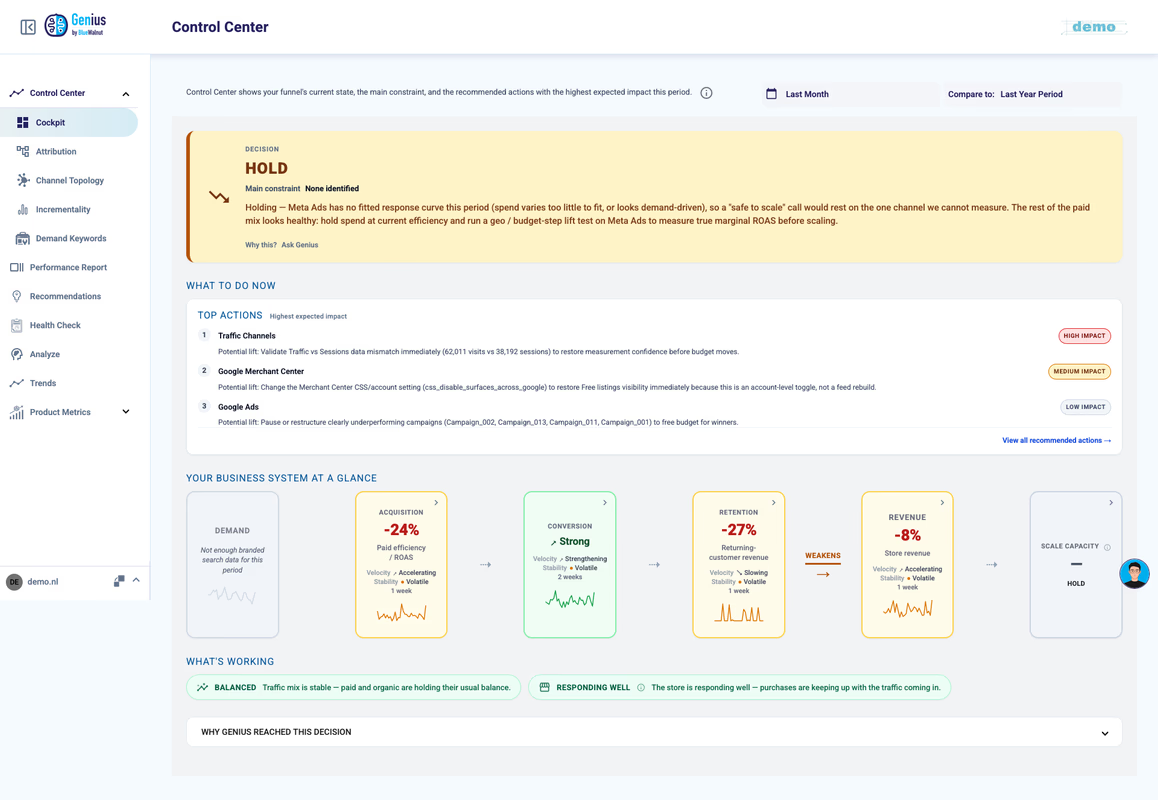
The BlueWalnut Genius Control Center analyzes acquisition, conversion, retention and revenue as parts of one connected system. It identifies the current constraint, makes the resulting decision explicit, and ranks actions according to their expected impact.
For example, instead of simply showing that one advertising channel is outperforming another, Genius can consider that signal in the context of conversion and the rest of the business before recommending whether to scale, hold or change direction.
The Control Center then connects to deeper analysis.
Recommendations turn findings into concrete actions. The Health Check examines technical, conversion, measurement, UX and other issues that may be limiting performance. And Genius Chat lets users investigate the reasoning in natural language — for example, by simply asking:
“What should we fix first, and why?”
The aim isn't to remove human judgment.
Quite the opposite.
It is to give the person making the decision a better starting point.
You can read more about how this works in our article about BlueWalnut Genius Control Center.
The next generation of e-commerce analytics
Dashboards aren't going away, nor should they.
We still need measurements. We still need charts. And sometimes we need to examine an individual KPI in detail.
But measurement shouldn't be the end product.
The next step for e-commerce analytics is moving from telling businesses what happened toward helping them understand:
- Why does it matter?
- What is holding us back?
- What should we do first?
- What should we not do yet?
That requires looking beyond individual KPIs and understanding the webshop as a system.
Because ultimately, an e-commerce team doesn't need another 20 charts on Monday morning.
It needs to know where to focus.
BlueWalnut Genius was built around exactly that idea:
Stop drowning in dashboards. Genius tells you what to fix.