Ask a plumber, an electrician or a decorator what the worst part of their week is, and very few will say the work itself. They will say the paperwork. The invoice that still needs writing at nine o'clock at night. The carrier bag of receipts in the footwell. The nagging feeling that the tax bill in January is going to be bigger than they think. VanBooks was built to take that part of the week away, for the people who do their admin from the driver's seat of a van.
Who VanBooks is for
VanBooks is bookkeeping software for UK sole traders and tradespeople: plumbers, electricians, builders, carpenters, decorators, plasterers, roofers, tilers, kitchen fitters, heating engineers, cleaners, gardeners, landscapers and handymen. Most of them work alone or with a mate, spend their days on site, and do their books in whatever time is left over. They are not accountants, and they do not want to become one.
Most accounting software is designed for an office. It assumes you are sitting at a desk with a keyboard, that you know what a "nominal code" is, and that you have an afternoon to set it up. Tradespeople have a phone, a van and about five minutes between jobs. VanBooks is designed around that.
Say what you did
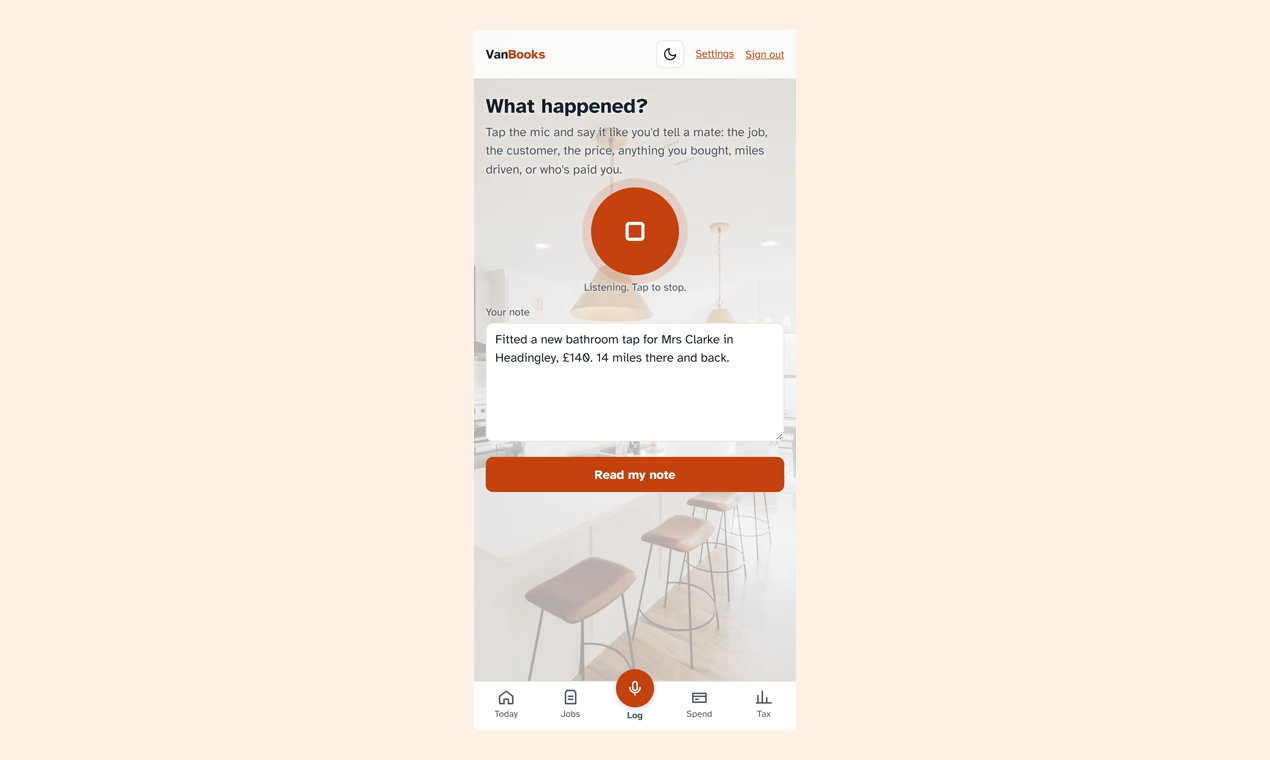
The idea at the heart of VanBooks is simple: you talk, it writes. Tap the microphone and say what happened, the way you would tell a mate:
"Fitted a new tap for Mrs Patel, ninety-five quid. Valve from Screwfix, eighteen pounds. Drove there and back from the yard."
VanBooks turns that into three things: an invoice to Mrs Patel for £95, a cost of £18 for the valve, and a journey for the mileage. You check them, change anything that is not right, and save. What used to be ten minutes of typing at the end of the day takes a few seconds in the van before you drive to the next job.
Everything VanBooks drafts is shown to you before it is saved. You stay in control of what goes on an invoice and what goes in your books; the app just does the typing.
Getting paid faster
An invoice only matters if it gets paid. VanBooks sends invoices and quotes by WhatsApp, text message or email, because that is how most tradespeople's customers actually like to be contacted. Customers can open the invoice on their phone without downloading anything.
Quotes can be accepted online, and you can ask for a deposit before you start a bigger job. When a customer pays late, VanBooks chases them for you with polite automatic reminders, so you do not have to have the awkward conversation yourself. When the money comes in, you record the payment and the invoice is marked as paid.
For regular work, such as a monthly clean or a maintenance contract, repeat invoices go out on schedule without you having to remember them.
Receipts, costs and mileage
Every pound you spend on the job and do not record is a pound you pay tax on when you did not need to. VanBooks makes recording costs as easy as possible. You can say what you bought, or take a photo of the receipt and VanBooks reads it for you: the shop, the date, the amount and the VAT.
Mileage is worked out from postcodes, so you do not need to note odometer readings. For self-employed people using HMRC's simplified expenses, the approved rate for a car or van is 45p a mile for the first 10,000 business miles in a tax year and 25p a mile after that. Logging every journey properly adds up quickly over a year, and it is one of the most commonly missed allowances among tradespeople.
Costs are kept in the categories HMRC uses on the Self Assessment form, so at the end of the year your figures are already sorted the way they need to be.
Knowing what to put aside for tax
One of the hardest parts of being self-employed is that nobody takes tax off your pay for you. Many tradespeople find out in January that they owe more than they have saved, sometimes with a payment on account for the following year on top.
VanBooks shows, after every payment you receive, roughly how much of it to put aside for Income Tax and National Insurance, based on your profit so far that year. It is an estimate rather than tax advice, but it turns a once-a-year shock into a small, regular habit: money comes in, you move the suggested amount to a savings pot, and January is no longer frightening.
Built for the construction trades: CIS and VAT
Tradespeople working for builders and contractors often come under the Construction Industry Scheme (CIS), where the contractor deducts tax from payments, usually 20% for registered subcontractors or 30% for those who are not registered. Those deductions count towards your tax bill, so they need recording properly. VanBooks handles CIS deductions on invoices and keeps track of what has already been taken off.
For VAT-registered tradespeople, VanBooks supports the standard rate, the Flat Rate Scheme and the construction VAT domestic reverse charge, which applies to many building services supplied between VAT-registered businesses in the construction industry. Getting the reverse charge wrong is easy and expensive; VanBooks puts the right wording on the invoice for you.
Ready for Making Tax Digital
Making Tax Digital for Income Tax is the biggest change to how self-employed people deal with HMRC in a generation. Instead of one Self Assessment return a year, sole traders with qualifying income will keep digital records and send HMRC quarterly updates from compatible software.
HMRC is bringing it in in stages, based on qualifying income from self-employment and property:
- from April 2026, for those with qualifying income over £50,000
- from April 2027, for those over £30,000
- from April 2028, for those over £20,000
VanBooks keeps your records digitally, in HMRC's categories, from the first job you log. Sending updates to HMRC directly from VanBooks is coming soon. Starting now means that when your turn comes, your records are already in the right shape, rather than needing a year of receipts typed in at the last minute.
Knowing which jobs make money
Because VanBooks links costs and mileage to the jobs they belong to, it can show you what each job actually made. That quote you thought was generous might turn out to have barely covered materials and fuel. Seeing job profitability laid out helps tradespeople price their next quote with confidence instead of guesswork.
Free tools, even without an account
Alongside the app, the VanBooks website has free tools anyone can use without signing up: a free invoice template, a self-employed tax calculator, a CIS calculator, a VAT calculator, a mileage allowance calculator and a quick check of whether Making Tax Digital applies to you. There are also plain-English guides on topics like what tradespeople can claim as expenses, how much tax to put aside, payments on account and the trading allowance, and pages written for each trade.
Where it works
VanBooks works on the web and as an app on iPhone and iPad (App Store), Android (Google Play) and Windows (Microsoft Store). Your records are the same wherever you open them, so you can log a job on your phone in the van and look over the month's figures on a laptop at home.
Pricing
VanBooks has one plan. The first month is free, with no card needed to start, and after that it is £9 a month. There are no tiers to choose between and no features held back for a more expensive plan.
Who makes VanBooks
VanBooks is made in the UK by Charter Enterprise, a small independent business registered with the Information Commissioner's Office. It started from one simple idea: the paperwork should fit around the job, not the other way round. It is not a cut-down version of an accounting package built for offices; it was designed from the start for people whose office is a van.
Getting started
If you are a tradesperson or sole trader in the UK and your books live in a carrier bag, a spreadsheet or the back of your head, VanBooks is worth a try. Sign up at vanbooks.uk, say what you did on your last job, and see the invoice appear. The first month is free, so the only thing to lose is the Sunday evening you would otherwise have spent on paperwork.
VanBooks helps you keep records. Tax estimates are a guide, not advice. If you are unsure about your tax position, check with an accountant.