
India’s hotel billing stack is entering a more demanding phase. The change is being driven by two forces at once: tighter GST operating requirements and a hospitality market that increasingly expects digital, connected workflows from booking through checkout.
The biggest regulatory development came in September 2025, when GST on hotel accommodation priced at ₹7,500 or less per unit per day was reduced from 12% to 5% without input tax credit (ITC). Accommodation above that threshold remains under the 18% category, making accurate room-value classification much more important at the point of billing.
For hotel operators, the implication is straightforward: room tariff, tax treatment, guest folios and final invoices can no longer be managed reliably through disconnected spreadsheets, paper registers or a single aging desktop terminal.
The pressure is also commercial. Recent 2026 reporting shows major OTAs charging commissions in the roughly 15%–21% range on some India-facing platforms, reinforcing the industry's push toward stronger direct-booking and property-owned digital workflows.
The question is no longer whether hotels should digitize billing. It is whether their current system can handle the complexity of a modern property.
What Changed: Hotel Billing Now Requires More Intelligence
A modern hotel billing operation needs to connect tax, guest movement, room services, payments and inventory instead of treating each as a separate function.
1. Instant room-service-to-folio synchronization
Food, beverages, laundry or other in-stay services should be added directly to the guest's room account rather than re-entered manually at checkout.
This reduces missing charges and makes the final folio a consolidated record of the guest's stay. Raseed's hotel system specifically supports adding food, beverages and laundry charges to a guest account and pulling them into the final GST-ready invoice.
2. Tariff-aware GST billing
The 2025 GST change makes tariff configuration particularly important. Hotels charging up to ₹7,500 per accommodation unit per day must apply 5% GST without ITC, while the higher-value category remains at 18%.
That makes GST billing for hotels less about manually selecting a tax percentage and more about maintaining the right room, rate and service configuration.
3. Better e-invoice readiness
The GST e-invoicing framework currently covers eligible B2B transactions for taxpayers above the notified turnover threshold, which has been ₹5 crore or more since August 2023. In addition, from April 1, 2025, taxpayers with AATO of ₹10 crore or more must report e-invoices within 30 days of the invoice date.
Importantly, this is not a blanket mandate for every corporate hotel booking. Applicability depends on the supplier's eligibility and the transaction type.
4. Sequential, auditable invoicing
GST invoice rules require a consecutive serial number, unique for the financial year, while permitting one or multiple series. Hotels therefore need billing systems that maintain controlled invoice numbering rather than allowing ad hoc edits or duplicate invoice sequences.
These requirements make the billing database a compliance system as much as a payment tool.
Industry Impact: Why Cloud-Native Hotel Systems Are Winning
The traditional hotel desktop model was designed around a relatively simple workflow: reservation at the front desk, manual service entries, payment collection and invoice printing.
That workflow becomes fragile when occupancy rises.
A busy property may simultaneously handle walk-ins, OTA reservations, direct bookings, restaurant charges, housekeeping updates, UPI payments and guests checking out within the same 30-minute window. A standalone terminal can still produce an invoice, but it is poorly suited to being the single operational source of truth.
This is where a front desk billing software model starts to converge with PMS functionality.
The technology advantage is not simply “being online.” It is synchronization.
A connected system can allow front-desk staff to manage reservations and check-in/check-out while service charges are attached to the correct room. Managers can then use centralized reports to review occupancy and revenue rather than reconstructing the night's activity from several systems.
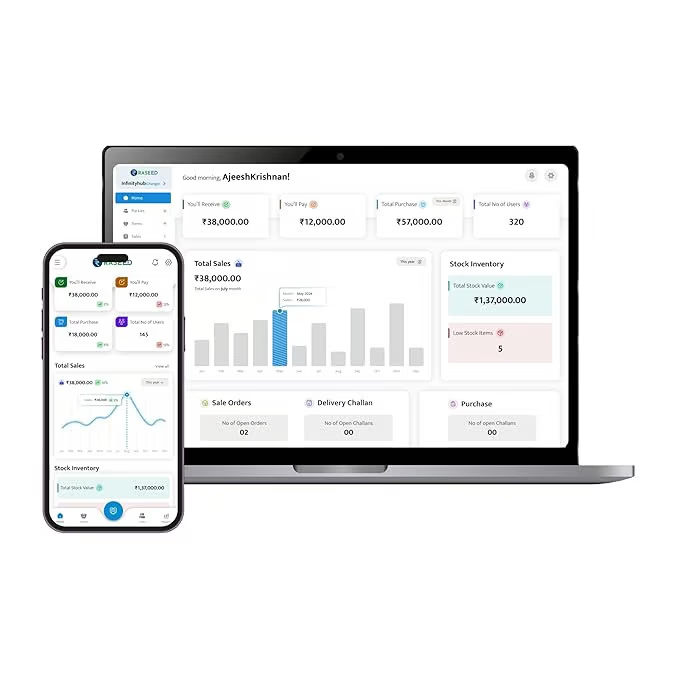
Raseed's current hotel platform reflects that broader direction. Its published hotel workflow includes room inventory, reservation management, guest check-in/check-out, in-stay service billing, real-time room-status updates, restaurant POS integration, housekeeping management, channel-manager connectivity, UPI/Razorpay payments, GST-focused workflows and real-time reporting.
That creates an important distinction in the hotel PMS alternative market: the competitive advantage is shifting from feature count to workflow continuity.
The same logic applies to OTA dependence. Recent industry reporting suggests properties are examining the economics of OTA distribution more closely, particularly as platform commissions reduce the net value of each booking. A stronger direct digital stack therefore matters not only for marketing, but also for what happens after the reservation reaches the property.
What Hotel Owners Should Do Next
1. Audit the guest journey end to end
Map every step from booking → check-in → room service → payment → checkout → night audit.
Look for manual re-entry, duplicate records, delayed postings and situations where staff have to move information from one application to another.
A good hotel check-in/check-out software workflow should shorten the guest journey rather than simply digitize the paperwork.
2. Consolidate guest charges
Room accommodation, restaurant orders and additional services should feed one guest account wherever the workflow permits.
This is especially important for staycation packages, extended stays and properties with several revenue centres. A consolidated folio makes staycation & room tariff tax billing easier to review and reduces the chance of forgotten service charges.
Raseed's hotel system is designed around this model, combining bookings, room billing, orders and reports in one workflow.
Explore Raseed hotel billing software
3. Treat audit and inventory data as operational assets
A modern system should support more than invoice generation. Managers should be able to review night audit reporting, payment records, occupancy trends and operational data while departments maintain visibility over rooms, amenities and related inventory.
Raseed's published platform includes room inventory and categories, room-status tracking, performance reporting and centralized payment/billing records.
The objective is simple: replace end-of-day reconciliation with continuous visibility.
Expert Verdict: Billing Is Becoming the Hotel's Data Hub
Over the next 12–18 months, hotel billing technology is likely to move further toward connected guest journeys rather than isolated billing modules.
Contactless mobile checkout, automated invoice delivery through WhatsApp, integrated payments, live room-status updates and increasingly automated tariff/tax validation are logical next steps. A 2026 India hospitality outlook also points to mobile-first bookings, AI-powered systems and digital concierge experiences becoming more prominent across the sector.
The winning architecture will therefore be one that connects reservation, room, service, payment, tax and reporting data in one operational flow.
For hotel owners, Hotel Billing Software is rapidly evolving from a back-office billing utility into the financial and operational backbone of the property.