
Organizations have software for nearly everything, why not Department Management?
Projects have project management platforms. Customer relationships have CRM systems. Support requests have ticketing systems. Documents have content management systems. Accounting has financial software.
But much of the work that keeps a department running every day still lives in spreadsheets, calendars, email reminders, shared documents, and individual memory.
DeptOps was created to address that gap.
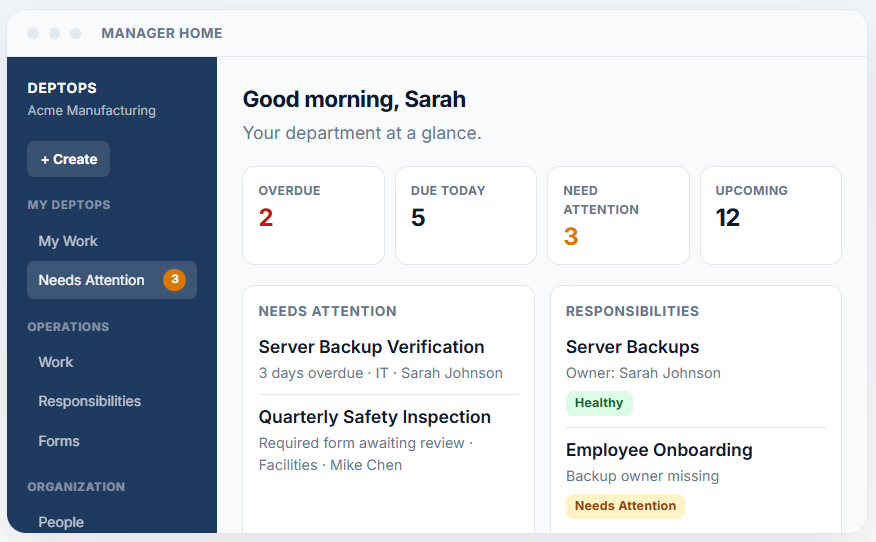
DeptOps is department operations management software designed to give organizations one place to manage department responsibilities, ownership, recurring operational work, assigned work, procedures, and the activities that need ongoing attention.
The idea behind the platform starts with a simple question:
If recurring work is responsible for keeping so much of an organization running, why does it so often have nowhere dedicated to live?
Recurring Work Is Different From Project Work
Projects typically have a defined beginning and end.
Launch a website. Migrate an accounting system. Open a new office. Implement a new benefits program.
Department operations are different.
Run payroll every two weeks. Review user access every quarter. Reconcile accounts every month. Review backups regularly. Renew certifications annually. Prepare department reports every Friday.
These activities are not projects that happen to repeat. They are ongoing operational responsibilities.
Completing one occurrence does not complete the responsibility. It simply means the organization successfully handled that occurrence. Then the cycle begins again.
Traditional project and task management software can track many of these activities, but recurring department work introduces additional questions.
- Who owns the responsibility?
- Who provides backup coverage?
- Which department is responsible?
- What needs to happen each time?
- When was it last completed?
- What is coming up next?
- Where are the ownership or coverage gaps?
DeptOps was designed around these questions.
Making Department Responsibilities Visible
One of the challenges with department operations is that important work often becomes invisible when everything is running correctly.
Finance closes the books. IT reviews systems and permissions. Human Resources handles recurring compliance activities. Operations performs routine inspections. Managers prepare reports and conduct regular reviews.
Problems often become visible only when something gets missed.
Then the questions begin.
- Who was responsible for this?
- Was someone supposed to remind us?
- When was it last completed?
- Who handles it when the normal owner is unavailable?
- Are there instructions somewhere?
DeptOps approaches this as a responsibility and ownership problem, not simply a task problem.
Organizations can document the responsibilities handled by their departments and assign primary and backup owners. Those responsibilities can then be connected to the operational work, procedures, and information needed to perform them.
The result is a clearer picture of not only what work exists, but who is accountable for keeping it moving.
Moving Beyond Calendars and Spreadsheets
Calendars are commonly used to manage recurring operational work because they answer an important question: When should something happen?
But department operations require more context.
A calendar reminder might indicate that a quarterly access review is due Tuesday. It does not necessarily show who owns the underlying responsibility, who provides backup coverage, whether the previous review was completed, or how that responsibility fits into the department's broader operations.
Spreadsheets provide more flexibility and are often the next step.
A department can create columns for responsibilities, owners, frequencies, due dates, and status. For smaller teams, that may work well for a time.
The challenge is that spreadsheets are passive.
Someone must maintain the dates, update ownership, identify overdue work, keep the information current, and make sure the spreadsheet still reflects how the department actually operates.
Over time, the spreadsheet used to manage operations can itself become another operational responsibility.
DeptOps provides a structured alternative for organizations that have outgrown that approach.
Connecting Responsibilities With the Work They Generate
A recurring task and an ongoing organizational responsibility are related, but they are not necessarily the same thing.
Consider a quarterly vendor access review.
The organization may want to know that a particular person owns the responsibility, another person provides backup coverage, a specific department is accountable for it, the review occurs quarterly, documented procedures explain how it should be performed, and each occurrence can be tracked.
The quarterly task is one piece of a larger operational structure.
DeptOps connects those pieces so organizations can manage both the responsibility and the work it generates.
Teams can use DeptOps to organize department responsibilities and ownership, primary and backup coverage, recurring and one-time assigned work, procedures and documentation, forms, operational calendars, and items requiring attention.
Managers gain visibility into the work that keeps their departments operating, while employees have a clearer understanding of what they own and what needs to be done.
Reducing Dependence on Tribal Knowledge
Another challenge with informal department management is that operational knowledge frequently becomes attached to individuals instead of the organization.
Ask how an important recurring process works and the answer may simply be:
"Tim handles that."
That identifies a person, but it does not document the operation.
If Sarah changes roles, takes an extended leave, or leaves the organization, the department may discover how much operational knowledge existed only in one person's head.
Clear responsibility ownership and backup coverage can help organizations identify these dependencies before they become problems.
By connecting responsibilities with owners, backups, work, procedures, and supporting information, DeptOps helps organizations create a more durable picture of how their departments actually operate.
A Different View of Department Operations
Organizations have spent decades improving how they manage projects.
DeptOps focuses instead on the work that may never become a project.
- The monthly review.
- The quarterly audit.
- The weekly report.
- The annual certification.
- The recurring checklist.
- The responsibilities that continue year after year.
Individually, these activities may not seem significant enough to require their own management platform. Collectively, they represent much of the work required to keep departments functioning.
DeptOps was built around the idea that this work deserves greater visibility.
Rather than asking only, "What tasks are due this week?", organizations can also ask:
What responsibilities keep this department running, who owns them, who provides backup, and is the work actually getting done?
That is the problem DeptOps is designed to help solve.
About DeptOps
DeptOps is a department operations management software platform designed to help organizations manage department responsibilities, ownership, recurring operational work, assigned work, procedures, forms, and operational visibility in one place.
Built for department managers, operations teams, IT departments, administrative teams, and small to midsize organizations, DeptOps provides an alternative to managing ongoing department operations through disconnected spreadsheets, calendars, documents, emails, and institutional knowledge.
For more information, visit DeptOps.com.