
Stop Running Your Department From Spreadsheets and Memory
Most departments do not have a work problem. They have a visibility problem.
The work is getting done, but much of what keeps a department running exists in spreadsheets, shared documents, email threads, calendars, task lists, and people's memories. Everyone knows a piece of the operation, but few people can see the whole picture.
Who owns each responsibility? Who is the backup? Which recurring tasks are due next week? What happens when someone is out? Which important activities are falling behind?
For many teams, answering those questions requires asking around.
That approach can work when a department is small. As responsibilities grow, employees change roles, and recurring work becomes more complicated, informal processes become increasingly difficult to manage.
This is the problem DeptOps was built to solve.
The Hidden Work That Keeps Departments Running
Every department has operational work that does not fit neatly into a traditional project.
An IT department may need to review user accounts, test backups, renew certificates, maintain documentation, check system health, and complete security reviews.
A finance department may have monthly reconciliations, reporting responsibilities, recurring reviews, compliance activities, and year-end procedures.
HR, operations, administration, facilities, and other departments have their own versions of the same challenge.
These activities are often recurring and operational rather than project-based. They may never appear on a project plan because they do not have a defined beginning and end.
They simply need to keep happening.
The problem is that organizations often manage this work using tools that were not designed for it.
Why Spreadsheets Eventually Become a Problem
Spreadsheets are flexible, inexpensive, and familiar. That makes them a natural starting point for tracking responsibilities and recurring work.
A department might create columns for the task, owner, frequency, due date, and status. For a while, that can work well.
But spreadsheets depend heavily on people remembering to maintain them.
Someone must update dates. Someone must change ownership when responsibilities move. Someone must notice when an item becomes overdue. Someone must know that a former employee was the only person responsible for an important process.
The spreadsheet contains information, but it does not actively help manage the operation.
As the department grows, teams often compensate by creating more spreadsheets, more tabs, more shared documents, and more calendar reminders.
Eventually, the system becomes harder to understand than the work itself.
Institutional Knowledge Is Not an Operations System
The other common approach is even simpler: people remember what needs to happen.
Experienced employees know their responsibilities. Managers know who handles which systems or processes. Team members remind each other about recurring activities.
- Until someone leaves.
- Or takes vacation.
- Or changes roles.
- Or simply forgets.
When operational knowledge exists primarily in people's heads, the organization develops key-person dependencies. A responsibility may technically belong to the department, but in practice only one employee knows that it exists or understands how it gets done.
This creates unnecessary risk.
A healthy department should be able to answer basic operational questions without relying on institutional memory.
Make Responsibility Ownership Visible
One of the simplest improvements a department can make is documenting its responsibilities and assigning clear ownership.
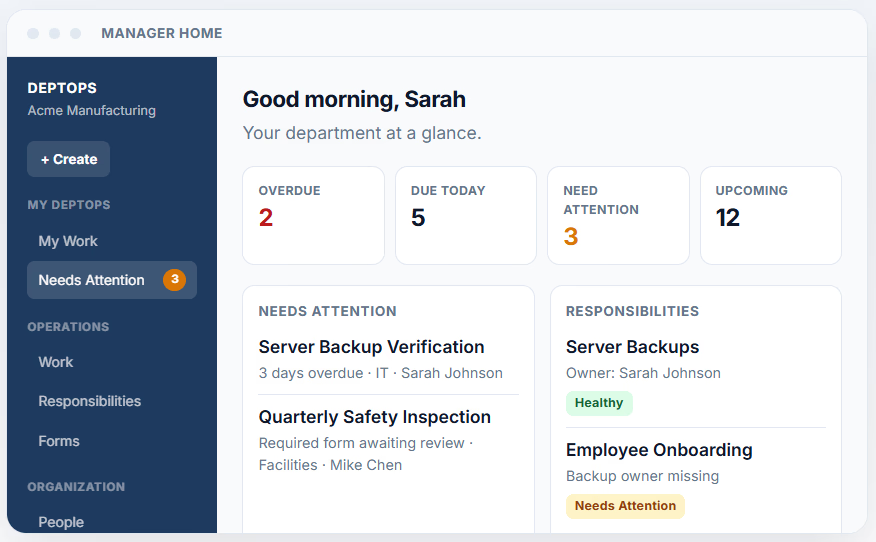
DeptOps allows teams to create responsibilities and identify primary and backup owners.
That distinction matters.
A primary owner establishes accountability. A backup owner helps prevent the responsibility from becoming dependent on one person.
Instead of asking:
"Who handles this?"
The answer is already documented.
This can be particularly useful for responsibilities that are important but do not generate daily activity. Tasks performed quarterly or annually are easy to forget precisely because employees do not interact with them frequently.
Clear ownership also helps managers identify gaps. If an important responsibility has no owner or backup, the problem becomes visible before it causes an operational failure.
Recurring Work Needs More Than a Checklist
Many departments have work that repeats on a predictable schedule.
- Daily.
- Weekly.
- Monthly.
- Quarterly.
- Annually.
Traditional task management tools can track individual tasks, but recurring operational work has a different lifecycle. Completing today's task does not eliminate the underlying responsibility. Another occurrence will eventually need to be completed.
DeptOps is designed around that reality.
Teams can define recurring work, assign it appropriately, and track upcoming occurrences without manually recreating the same tasks over and over.
This creates a repeatable operational rhythm.
Instead of relying on someone to remember that a quarterly review needs to happen, the work itself becomes part of the department's operating structure.
See What Needs Attention
Capturing responsibilities is useful, but managers also need to know where attention is required.
A long list of tasks does not necessarily provide that visibility.
Operational software should help separate normal activity from exceptions.
DeptOps provides a Needs Attention view so teams can focus on work that requires action rather than searching through every responsibility and assignment.
That changes the manager's question from:
"What is everybody working on?"
to:
"What needs my attention right now?"
That is a much more useful question for day-to-day department management.
Create an Operations Map
As departments grow, understanding how responsibilities fit together becomes increasingly difficult.
There may be dozens or hundreds of responsibilities distributed across teams and employees.
DeptOps provides an Operations Map that helps organizations see how department responsibilities and ownership are structured.
This gives managers a higher-level view of the department instead of forcing them to reconstruct the organization from individual tasks or spreadsheets.
The goal is not simply to collect more data.
The goal is to make the department easier to understand.
Give Employees a Clear View of Their Work
Operational visibility should not only benefit managers.
Employees also need a straightforward answer to:
"What am I responsible for?"
DeptOps brings assigned work together so team members can see the responsibilities and work that apply to them.
This reduces the need to search across spreadsheets, emails, documents, and separate tracking systems.
When ownership and expectations are visible, employees spend less time figuring out what they are supposed to do and managers spend less time reminding people.
Plan for Absences and Employee Turnover
Every organization eventually experiences employee turnover.
When an employee leaves, managers often discover responsibilities that were never formally documented.
The employee may have maintained a spreadsheet, performed a monthly review, managed a vendor relationship, or completed a recurring process that nobody else fully understood.
The organization discovers the dependency only after the person is gone.
Documenting responsibilities, assigning primary and backup owners, and tracking recurring work creates a basic layer of operational continuity.
It does not replace good documentation or employee training. It does make hidden dependencies easier to identify.
The same principle applies to vacations, extended absences, and internal role changes.
Departments become more resilient when responsibility belongs to the organization rather than existing only in one person's memory.
Department Operations Are Different From Project Management
Project management software is valuable when teams are managing projects with defined objectives, timelines, milestones, and completion dates.
But not everything a department does is a project.
- A monthly access review is not a project.
- A weekly operational check is not a project.
- Maintaining responsibility for a business process is not a project.
These activities may continue indefinitely.
Trying to force ongoing operational responsibilities into a project structure can create unnecessary complexity. Teams end up creating endless projects, recurring task templates, or elaborate boards simply to represent work that never really ends.
DeptOps focuses specifically on the ongoing work required to operate a department.
A Practical Alternative to Building a Bigger Spreadsheet
Replacing spreadsheets does not mean replacing simplicity with complexity.
That is an important distinction.
Many businesses do not need an enterprise-scale operations platform. They need something more structured than a spreadsheet without introducing an enormous implementation project.
DeptOps is designed to provide that middle ground.
Departments can organize responsibilities, establish ownership, manage recurring and assigned work, and monitor what needs attention from one system.
The objective is straightforward: provide enough structure to improve reliability without making the software itself another operational burden.
Who Can Use DeptOps?
DeptOps can support departments across many types of organizations because the underlying problem is not industry-specific.
Any department with recurring responsibilities can encounter the same challenges.
That can include:
- Information technology
- Finance and accounting
- Human resources
- Operations
- Administration
- Facilities
- Compliance
- Customer operations
- Internal business services
The individual responsibilities differ, but the management questions remain similar.
- What needs to happen?
- Who owns it?
- Who can back them up?
- When does it need to happen again?
- What currently needs attention?
Those are fundamental operational questions.
Start by Making the Invisible Visible
Improving department operations does not necessarily require redesigning every process.
A useful first step is simply documenting what already exists.
- List the recurring responsibilities that keep the department functioning.
- Identify who currently owns each one.
- Identify where no backup exists.
- Document recurring work that employees are expected to remember.
- Look for processes that depend heavily on one person.
This exercise alone can reveal operational gaps that have existed unnoticed for years.
Once that information is visible, it becomes much easier to improve it.
Build a Department That Does Not Depend on Memory
Spreadsheets are excellent tools.
So are calendars, email, documents, and task lists.
The problem occurs when those tools collectively become the operating system for an entire department.
Important recurring work should not depend on someone remembering to open the right spreadsheet. Managers should not have to ask around to determine who owns a responsibility. Employee turnover should not reveal critical processes nobody knew existed.
Department operations become easier to manage when responsibilities, ownership, backup coverage, recurring work, and attention items are visible in one place.
That is what DeptOps is designed to provide.
It gives departments a practical way to move operational work out of scattered spreadsheets and institutional memory and into a system built specifically for the work that keeps departments running.