
When you start collecting signups early, you are not just building a list. You are building momentum, proof, and a feedback loop that can make launch day feel inevitable instead of uncertain. The fastest way to turn that early interest into real users is to communicate consistently with a plan, not sporadically with “big updates” that arrive too late.
This guide gives you a simple, repeatable pre-launch email sequence for startups you can send to your VIP list. It is designed for founders who want to create hype without feeling salesy, learn what to build before committing to months of work, and show up on launch day with warm leads who already trust you.
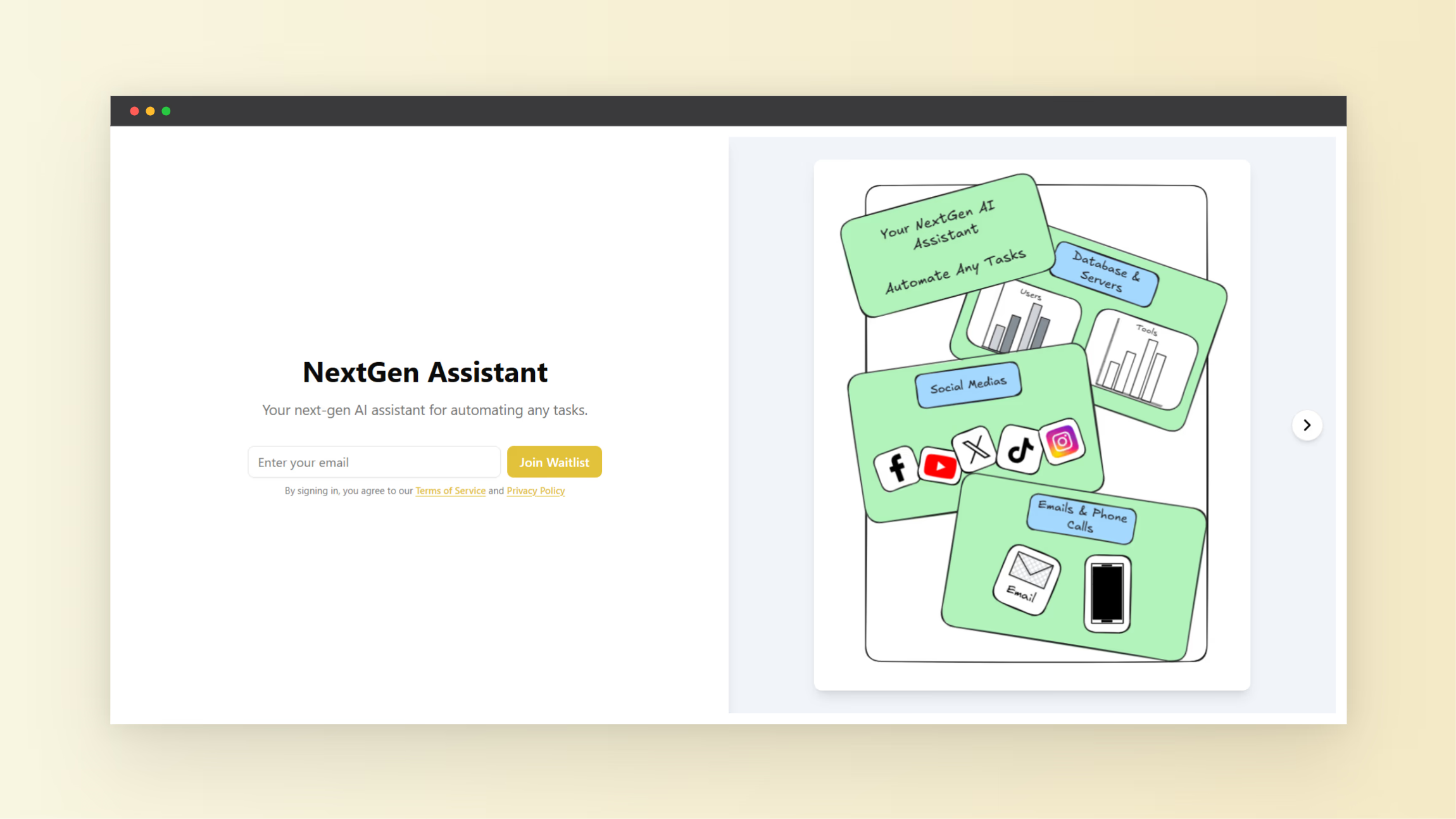
Tools like VIP List are built for this exact phase. With a “build hype before you build” mindset, you can capture interest early, organize signups, and run a structured sequence that turns curiosity into commitment. What matters most, though, is what you send and when you send it. Let’s map that out.
What makes a VIP list different from a normal newsletter
A VIP list is not a content newsletter and it is not a generic product announcement list. It is a relationship with a clear promise: early access, insider context, and a better outcome for joining early. That promise sets expectations, and expectations shape what your emails should deliver.
If you treat a VIP list like a newsletter, people lose the “why now” urgency. If you treat it like a sales list too early, you burn trust before you have earned it. A strong pre-launch email sequence for startups balances three things in the right order: clarity (what you are building), credibility (why you can deliver), and participation (how subscribers can help shape it).
Before you write a single email: set up your VIP list for the sequence
Your sequence will work best if your list is organized from day one. Even a simple setup gives you better targeting, which increases replies and conversions.
- Confirm the “VIP promise” on signup: Tell people what they will get (early access, discount, priority onboarding, behind-the-scenes updates) and how often you will email.
- Collect one extra data point: Ask one optional question at signup such as role, company size, or biggest challenge. This lets you tailor messaging without making the form heavy.
- Decide your main call to action (CTA): For pre-launch, your CTA is usually one of these: reply with feedback, join a demo, take a survey, or confirm interest for early access.
- Create one segmentation rule: At minimum, segment “high intent” (people who replied, booked, or clicked key links) versus “low intent” (silent subscribers). You will treat them differently close to launch.
With a tool like VIP List, the goal is to keep signups flowing while you run this sequence in the background. That way, every new subscriber gets the same clear story and your launch readiness improves every week.
The simple pre-launch email sequence for startups (7 emails you can copy)
This sequence is intentionally straightforward. You can run it over 14 to 21 days, or stretch it if your timeline is longer. The key is consistent momentum, not perfection.
Below, each email includes: timing, goal, suggested subject lines, and a copy framework you can adapt. Keep emails short, make the next step obvious, and write like a real person, not a brand committee.
Email 1 (Immediately): Welcome + set expectations
When to send: Right after signup
Goal: Confirm they are in the right place, restate the VIP promise, and start a two-way conversation.
Subject line ideas:
• You’re on the VIP list
• Welcome, here’s what happens next
• Quick question (so we build the right thing)
Framework:
Start by thanking them and re-stating what they signed up for. Then set frequency and what “VIP” means. Close with one question that is easy to answer in a reply.
Example copy:
Thanks for joining the VIP list. You’ll get early access before we open this up publicly, plus a small bonus for helping us shape the first version.
Between now and launch, I’ll send a few short updates (no spam). When it’s time, you’ll be the first to know and you’ll get priority onboarding.
Quick question so we build this right: what are you using today to solve this problem, and what do you wish it did better?
Email 2 (Day 2): The “why” story + credibility
When to send: 1 to 2 days after Email 1
Goal: Explain the problem you are solving and why you are equipped to solve it, without overselling.
Subject line ideas:
• Why we’re building this
• The moment we knew this needed to exist
• The problem we can’t unsee
Framework:
Tell a short origin story, describe the pain in concrete terms, and connect it to the outcome you are building. End with a question that invites validation.
Example copy:
We’re building this because we kept seeing the same pattern: people spend time and money trying to [current workaround], but the results are inconsistent and the process is frustrating.
After talking to [type of user], it became clear the real issue is [root cause]. So we’re creating a simpler way to [core promise].
Does that match your experience? If not, what’s the real pain for you?
Email 3 (Day 4): Show the plan (what you will ship first)
When to send: 2 days later
Goal: Reduce uncertainty by explaining what is included in v1 and what is not, which builds trust and prevents mismatched expectations.
Subject line ideas:
• What’s in v1 (and what’s not)
• The first version will do these 3 things
• Our v1 scope, in plain English
Framework:
List 3 to 5 outcomes, not features. Include one “not yet” item to show focus. Ask for prioritization feedback.
Example copy:
Here’s what the first version is designed to help you do:
1) [Outcome #1]
2) [Outcome #2]
3) [Outcome #3]
What we are intentionally not doing in v1: [popular request]. We want to nail the core workflow first.
If you could wave a magic wand, which of the three outcomes matters most to you right now?
Email 4 (Day 7): Proof and progress (even if small)
When to send: 3 days later
Goal: Demonstrate momentum. Progress creates confidence, and confidence creates conversions.
Subject line ideas:
• Small update, big milestone
• Here’s what we shipped this week
• Progress update (and a quick favor)
Framework:
Share 2 to 4 short bullets of progress. Include one screenshot description or “what changed” narrative. Ask for one small action: reply, vote, or quick survey.
Example copy:
Quick progress update from the past week:
• We finished [milestone]
• We tested [workflow] with [number] people
• We improved [pain point] based on feedback
One quick favor: if you had to pick, would you rather we prioritize [Option A] or [Option B] next? Just reply with A or B.
Email 5 (Day 10): Invite to participate (beta, demo, or interview)
When to send: 3 days later
Goal: Turn subscribers into collaborators. This increases retention and creates a sense of ownership.
Subject line ideas:
• Want to be a beta tester?
• Can I show you what we’re building?
• We’re opening a few early spots
Framework:
Explain who the beta is for, what they get, and what you need from them. Make the commitment clear and small.
Example copy:
We’re inviting a small group from the VIP list to try an early version before launch.
If you’re a good fit, you’ll get: early access, direct input on the roadmap, and priority support during onboarding.
What we need from you: one short call or a few notes after you try it.
Reply with “beta” and 1 sentence about your use case, and I’ll follow up with next steps.
Email 6 (Day 14): The offer (early access details + clear value)
When to send: 4 days later
Goal: Present the reason to buy or adopt early, without pressure. This is where your VIP promise becomes tangible.
Subject line ideas:
• VIP early access details
• Your early access perk (before we launch)
• Want in first? Here’s how it works
Framework:
State what early access includes, who it is for, and what they should do next. Add a simple scarcity element only if it is real (limited onboarding capacity, limited beta seats).
Example copy:
As a VIP subscriber, you’ll get early access before we open this publicly.
Early access includes:
• [Benefit #1]
• [Benefit #2]
• [Benefit #3]
We’re onboarding a limited number at first so we can support everyone properly. If you want one of the first spots, reply with “early access” and I’ll send the onboarding details.
Email 7 (48 hours before launch): Final reminder + what to expect on launch day
When to send: 1 to 2 days before launch
Goal: Create a clean, confident handoff into launch day so subscribers recognize your launch email and take action.
Subject line ideas:
• Launch is in 48 hours (VIP heads-up)
• Quick heads-up before we go live
• Last VIP reminder before launch
Framework:
Remind them what you are launching, the exact timing, and what they should do when the email arrives. Reduce friction by telling them what the next step looks like.
Example copy:
Quick VIP heads-up: we’re launching in 48 hours.
On launch day, you’ll get an email from me with: your early access instructions, the VIP perk, and the fastest way to get set up.
If you already know you want in, reply “ready” and I’ll prioritize your onboarding message.
What to send if your launch is longer than 2 to 3 weeks
If you have a longer runway, you do not need to invent a new email every week. You need a rhythm that keeps trust compounding while you keep learning. The easiest approach is to loop three types of emails between the core sequence above.
- Behind-the-scenes: share a decision you made, what you learned from users, or how you narrowed scope.
- Mini case studies: “We watched someone try to solve X, here is what got in the way, here is what we changed.”
- Progress plus question: one update plus one question, every time.
This keeps your pre-launch email sequence for startups alive without turning it into content marketing. It also keeps replies coming, which is often the strongest signal of future conversions.
How VIP List fits into your pre-launch workflow
A pre-launch phase is messy because you are building and marketing at the same time. You want a system that makes it easy to collect signups, keep the promise you made, and avoid dropping hot leads. That is where a VIP list tool like VIP List helps, because the entire strategy starts with capturing intent early and then nurturing it consistently.
Practically, think of VIP List as the “front door” that turns attention into a structured audience. Once people are on the list, your email sequence does the heavy lifting by creating clarity and momentum. When you combine the two, you get a repeatable loop: traffic becomes signups, signups become conversations, conversations become a sharper product, and a sharper product becomes a stronger launch.
Best practices that make this sequence convert
Small details make a big difference in a pre-launch email sequence for startups, especially because your list is still forming an opinion about you.
- Write for replies, not clicks: Replies create real relationships and highlight your best prospects.
- Keep each email to one idea: One purpose, one CTA, one next step.
- Use plain language: If an email sounds like a pitch deck, it will feel distant.
- Share constraints: Saying “we are focused on v1” or “we can onboard 20 people first” builds credibility because it sounds real.
- Personalize lightly: Use role or use case if you collected it, but do not overdo gimmicky personalization.
- Consistency beats volume: A simple sequence sent on schedule outperforms occasional “big news.”
Common mistakes to avoid
Many startup launches underperform because the list is treated like an announcement channel instead of a community in progress. Avoid these pitfalls to keep your VIP list engaged.
- Only emailing when you want something: Give context and progress before you ask for time or money.
- Vague updates: “We are working hard” does not build confidence. Share what changed and why it matters.
- Overpromising: Big promises create big doubt. Focus on the first clear outcome you can deliver.
- No segmentation: Your most engaged subscribers should get a more direct path to beta and onboarding.
- Waiting until the day before launch to talk pricing: If you plan to charge, introduce value and early access details before launch.
What to measure (so you know it’s working)
You do not need a complex analytics stack to evaluate a pre-launch email sequence for startups. You need a handful of signals that tell you whether interest is deepening.
- Reply rate: The strongest early indicator of future conversions.
- Activation intent: People who ask “when can I try it?” or “how much is it?” are your priority cohort.
- Early access confirmations: Count how many explicitly opt in when you present the early access offer.
- Drop-off points: If replies stop after Email 3, your scope or message may be unclear.
If your open rate is not perfect, do not panic. In pre-launch, the quality of conversations often matters more than vanity metrics, especially if you are still iterating on positioning.
Copy-and-paste checklist: your sequence in one view
If you want the simplest way to execute, use this checklist and fill in the brackets with your product specifics.
- Welcome: VIP promise + one question
- Why: origin story + “does this match you?”
- v1 scope: 3 outcomes + 1 “not yet” + prioritization
- Progress: 3 bullets + A/B reply
- Participation: beta invite + simple commitment
- Offer: early access details + reply to confirm
- Launch heads-up: what happens on launch day + “ready” reply
Run this once, learn from replies, and refine it. Your second launch will be easier because you will have a tested story, a clearer audience, and a list that trusts you.
Final thoughts: hype comes from consistency, not noise
“Build hype before you build” works when hype is earned through clarity and progress. A VIP list is your best early asset because it collects the people most likely to care, and a simple email sequence turns that attention into a relationship you can launch with.
Use this pre-launch email sequence for startups as your baseline. Keep it human, keep it focused, and keep asking questions. By the time you hit launch day, you will not be sending an announcement into the void. You will be opening the doors for people who already feel like they helped build what you are releasing.