
Writing better prompts is no longer only about knowing a few clever prompt engineering tricks. As AI tools become part of everyday work, the real challenge is learning how to communicate your intent clearly, give enough context, define the right output, and improve the prompt based on results. That is where AI prompt optimization becomes useful. Instead of guessing why a prompt works or fails, AI prompt optimization helps you analyze a prompt, identify weak areas, and turn it into a clearer instruction that produces more reliable responses.
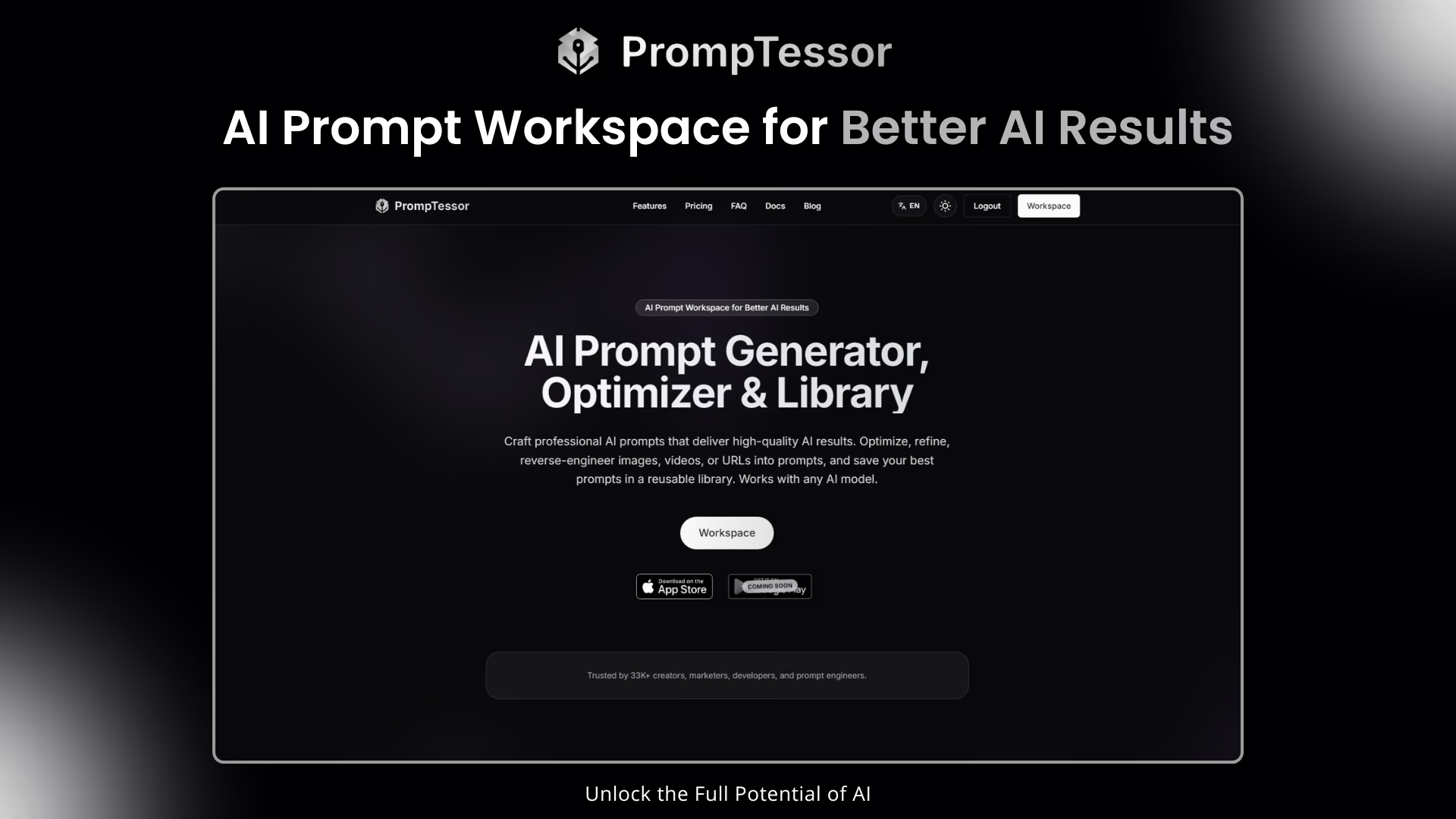
One practical way to improve this process is by using an AI prompt optimization tool like PrompTessor, which is designed to help users analyze, improve, and optimize AI prompts with deep insights, detailed metrics, and actionable suggestions. The platform focuses on turning rough or unclear prompts into production-ready prompts that are easier for AI models to understand and follow. It also includes features such as prompt scoring, optimization variations, feedback-based refinement, prompt history, and reverse prompt capabilities for images, videos, text, and URLs.
The target long tail keyword for this article is how to write better prompts using AI prompt optimization. This guide explains what that means in practice, why optimization matters, and how you can use a structured workflow to get better AI results from ChatGPT, Claude, Gemini, image generators, content tools, coding assistants, and other AI systems.
What AI Prompt Optimization Means
AI prompt optimization is the process of improving a prompt so an AI model can produce a more accurate, useful, and consistent response. A prompt is not just a question. It is a set of instructions that tells the AI what you want, what context it should consider, how the answer should be structured, what constraints it should follow, and what kind of result is considered successful.
A weak prompt usually leaves too much room for interpretation. It might be too vague, too short, missing background details, unclear about the desired output, or lacking constraints. For example, asking an AI to “write a marketing plan” may produce a generic answer because the AI does not know the target audience, business model, budget, channel, tone, timeline, or goal.
An optimized prompt gives the AI more direction. It explains the objective, defines the audience, adds relevant context, requests a specific format, and includes success criteria. This does not mean every prompt must be long. It means every important part of the task should be clear enough for the AI to respond with precision.
Why Better Prompts Lead to Better AI Results
AI models are powerful, but they still depend heavily on the quality of the input. When the input is unclear, the output often becomes generic, incomplete, or misaligned. Better prompts reduce that friction by making your request easier to interpret.
Good prompts help AI understand what matters most. They reduce unnecessary back and forth, improve response structure, and make the output easier to use immediately. This is especially important for work that requires consistency, such as content writing, coding, research summaries, product planning, email drafting, customer support, data analysis, and creative generation.
AI prompt optimization also helps you learn from each prompt. Instead of treating every result as random, you can see which part of the prompt needs improvement. Maybe the goal is clear, but the context is weak. Maybe the output format is strong, but the constraints are missing. Maybe the prompt includes enough details, but the instruction order makes it harder for the AI to follow. A structured analysis makes these issues easier to detect.
The Core Elements of a Strong Prompt
To write better prompts, you need to understand the core elements that make a prompt effective. PrompTessor evaluates prompts through important dimensions such as clarity, specificity, context, goal orientation, structure, and constraints. These elements work together to shape the quality of the final AI output.
- Clarity: The prompt should be easy to understand and free from confusing instructions.
- Specificity: The prompt should include enough detail so the AI knows exactly what to produce.
- Context: The prompt should provide background information that helps the AI tailor the answer.
- Goal orientation: The prompt should explain the purpose of the request and the desired outcome.
- Structure: The prompt should organize instructions in a logical way.
- Constraints: The prompt should define limits, rules, tone, format, length, audience, or other requirements.
When one of these elements is weak, the output can suffer. For example, a prompt with good context but no clear output format may produce a long answer that is difficult to use. A prompt with a clear format but no goal may produce organized content that still misses the real intent. AI prompt optimization helps balance these elements.
How to Write Better Prompts Using AI Prompt Optimization
The easiest way to improve your prompts is to follow a repeatable workflow. Instead of writing a prompt once and hoping it works, you can treat it like a draft that gets reviewed, scored, and refined.
- Start with your rough prompt. Write the prompt naturally, even if it is not perfect yet.
- Analyze the prompt. Look for missing context, unclear goals, weak structure, vague wording, or absent constraints.
- Review the score and reasoning. A prompt score helps you quickly understand how effective the prompt is likely to be.
- Generate optimized variations. Create several improved versions for different use cases or levels of detail.
- Test the improved prompt. Run the optimized prompt in your preferred AI model and compare the result.
- Refine with feedback. Add feedback based on what the output still lacks, then improve the prompt again.
- Save what works. Keep successful prompts in a history or reusable prompt library so you can build on them later.
This workflow turns prompt writing into a practical improvement process. You are no longer starting from zero every time. You are learning what makes the prompt perform better and applying those lessons to future tasks.
Example of a Weak Prompt and an Optimized Prompt
Here is a simple example. A weak prompt might be: “Write a social media post for my app.” This prompt is short, but it does not explain the app, the audience, the platform, the tone, the goal, or the format. The AI might still produce something, but the result will likely feel generic.
A better optimized version would be: “Write a LinkedIn post for a solo founder launching an AI prompt optimization tool. The goal is to explain why better prompts lead to better AI results. Use a helpful and educational tone, avoid sounding too salesy, keep it under 180 words, and end with a soft question that encourages comments.”
The optimized prompt works better because it gives the AI a clear task, audience, goal, channel, tone, length, and ending style. It reduces ambiguity and makes the expected output easier to deliver.
You can take this further by asking for multiple variations. For example, one version could be educational, another could be founder-led, and another could be more direct and conversion focused. Optimization variations are helpful because a single prompt can often be improved in different directions depending on your goal.
Using Prompt Scoring to Find Weak Spots
One of the most useful parts of AI prompt optimization is scoring. A score gives you a quick signal about how strong a prompt is, but the reasoning behind the score is even more important. If a prompt receives a lower score, you need to know why.
For example, a prompt may score well for clarity because the task is understandable, but score lower for context because it does not explain the target audience or background. Another prompt may be specific but poorly structured, which can cause the AI to miss or mix instructions. By breaking the prompt into separate metrics, you can improve the exact parts that matter.
PrompTessor includes effectiveness scoring and detailed metric-based analysis. This helps users move beyond subjective judgment. Instead of simply asking, “Is this prompt good?” you can ask, “Which part of this prompt is limiting the quality of the response?” That is a much more useful question.
Refining Prompts With Feedback
Even an optimized prompt may need another round of improvement after testing. AI output is not always perfect on the first attempt because your real preference may become clearer only after you see the result. This is where feedback-based refinement becomes valuable.
For example, you might test an optimized prompt and realize the response is too formal, too long, too generic, or not specific enough to your product. Instead of rewriting everything manually, you can give feedback such as “make it more concise,” “add more beginner-friendly explanation,” “use a more natural tone,” or “focus more on practical examples.” The prompt can then be refined based on that feedback.
This creates a loop: prompt, analyze, optimize, test, refine, and reuse. Over time, this loop helps you build stronger prompts and understand how to communicate with AI more effectively.
Common Prompt Mistakes AI Optimization Can Fix
Many people struggle with prompts because they assume the AI already understands their full intent. In reality, the AI only responds based on what the prompt provides. AI prompt optimization helps catch common mistakes before they lead to poor output.
- Vague instructions: Asking for something broad without defining the expected result.
- Missing context: Leaving out product details, audience information, background, or examples.
- No output format: Not telling the AI whether you want a table, list, article, email, code block, summary, or step-by-step guide.
- Conflicting instructions: Asking for multiple things that do not fit together clearly.
- No constraints: Forgetting to define length, tone, style, target reader, or things to avoid.
- Weak goal: Not explaining what the final output should help you achieve.
Fixing these issues can dramatically improve the usefulness of AI responses. The goal is not to make prompts unnecessarily complicated. The goal is to make them complete enough for the task.
How Reverse Prompting Can Help You Learn Better Prompt Structure
Another useful way to improve your prompt writing is to study existing content and understand what kind of prompt might have created it. Reverse prompting helps with this. Instead of starting from a blank page, you can analyze an image, text, video, or URL and generate prompt variations that could recreate a similar result.
This is helpful for creators, marketers, designers, and AI users who see an output they like but do not know how to write a prompt that produces something similar. By reverse-engineering the structure, style, tone, and likely instruction pattern, you can learn how stronger prompts are built.
Reverse prompting should not be used to copy blindly. Its real value is learning the structure behind effective AI outputs. You can then adapt that structure for your own use case, brand, audience, and goal.
Practical Tips for Writing Better Prompts
Once you understand the basics, better prompt writing becomes much easier. You can use the following principles whenever you write prompts for AI tools.
- Start with the goal: Tell the AI what you want to achieve before adding details.
- Provide useful context: Include the background information needed to make the output specific.
- Define the audience: Explain who the output is for and what they care about.
- Set the format: Ask for a list, table, JSON, article, outline, code block, or another structure.
- Add constraints: Mention length, tone, style, reading level, platform, or rules to follow.
- Ask for reasoning when needed: For strategy, analysis, and comparison tasks, request clear reasoning behind the answer.
- Iterate after testing: Use feedback to improve the prompt instead of accepting the first version.
These tips are simple, but they are powerful when applied consistently. A prompt that includes goal, context, format, and constraints will usually perform better than a prompt that only asks a broad question.
Who Should Use AI Prompt Optimization
AI prompt optimization is useful for anyone who relies on AI for work, learning, or creative production. Content creators can use it to generate better articles, captions, scripts, and social posts. Marketers can use it for campaign ideas, positioning, email sequences, and content strategy. Developers can use it to make coding prompts more precise. Founders can use it for product planning, landing page copy, user research, and business analysis.
It is also valuable for beginners because it teaches prompt engineering through feedback. Instead of memorizing templates, users can understand why a prompt works, what is missing, and how to improve it. For advanced users, optimization can save time by producing structured variations and helping standardize prompt quality across repeated workflows.
Final Thoughts
Learning how to write better prompts using AI prompt optimization is one of the most practical ways to get more value from AI tools. Better prompts create better outputs because they give the AI clearer goals, stronger context, better structure, and more useful constraints.
PrompTessor helps make this process more systematic by combining prompt analysis, scoring, optimization variations, feedback refinement, reverse prompt capabilities, prompt history, and multilingual support. Instead of relying on trial and error, you can improve prompts with a clearer workflow and understand exactly what needs to change.
The most important lesson is simple: do not treat prompts as one-time commands. Treat them as working drafts that can be analyzed, improved, tested, and refined. When you approach prompting this way, AI becomes more consistent, more useful, and much easier to control.