
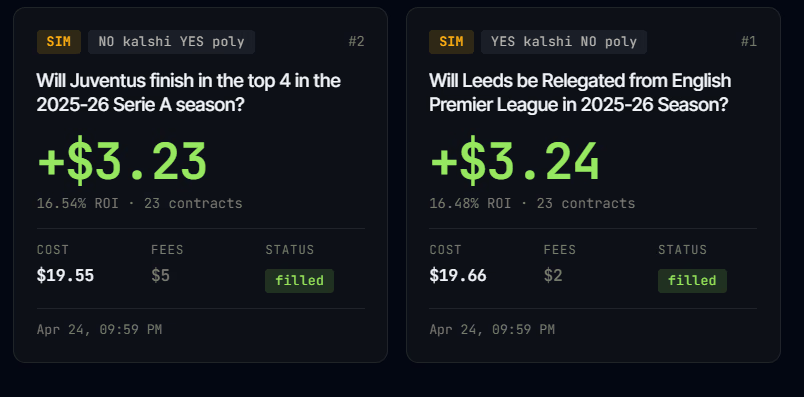
Prediction market arbitrage is one of the most consistently profitable strategies in algorithmic trading — but until recently, it required deep technical expertise, constant monitoring, and fast manual execution. Arbitrage Agent changes that entirely.
What Is Prediction Market Arbitrage?
Prediction markets like Polymarket and Kalshi allow traders to bet on real-world outcomes — elections, economic reports, sports results, regulatory decisions. Because these platforms operate independently, they often price the same event differently.
For example: Polymarket might price "Fed rate cut in June 2026" at 62¢ YES. Kalshi might price the equivalent contract at 58¢ YES. That's a 4-cent spread on a binary outcome — a risk-free profit for anyone who can identify the match and execute both legs simultaneously.
The challenge? Finding these opportunities manually across thousands of active markets is practically impossible. Events are worded differently across platforms ("Will the Fed cut rates in June?" vs "FOMC June 2026 cut"), making direct comparison non-trivial. And by the time you spot an opportunity, it's often gone.
The Core Problem: Semantic Mismatch
This is where most manual arbitrage attempts fail. Polymarket and Kalshi rarely describe the same event with the same words. A naive price comparison — matching by keywords or exact titles — misses the vast majority of real opportunities and flags false positives that lose money when executed.
Arbitrage Agent solves this with AI-powered semantic matching. Using OpenAI embeddings, it converts every active market on both platforms into a vector representation of its meaning, not just its words. Two contracts that describe the same event — even with completely different phrasing — land close together in embedding space and get flagged as a match.
The result: 99.2% matching precision across 4,800+ active markets, with near-zero false positives.
How It Works — End to End
Arbitrage Agent operates as a fully automated pipeline with five stages:
1. Ingestion — The system connects to Polymarket and Kalshi via WebSocket and REST APIs, continuously pulling live market data — prices, order books, bid/ask spreads, expiry dates. Data is normalised into a unified internal format that abstracts away platform differences.
2. Semantic Matching — Every market is embedded and stored. The matcher runs continuously, comparing embeddings across platforms to find semantically equivalent contracts. A confidence score is assigned to each pair — only high-confidence matches proceed to the next stage.
3. Spread Calculation — For each matched pair, the engine calculates the real arbitrage spread after accounting for platform fees, position sizing constraints, and current order book depth. Small gross spreads can vanish entirely after fees — the engine filters these out.
4. Execution — When a viable opportunity is found, the bot executes both legs in parallel — one on Polymarket, one on Kalshi — targeting sub-400ms total execution. Speed matters: spreads are often available for seconds, not minutes.
5. Monitoring & Notifications — Every trade is logged with full P&L attribution. Telegram notifications fire in real time for new opportunities and executed trades. A live dashboard shows performance metrics, open positions, and historical analytics.
Why This Approach Is Different
Most arbitrage tools in traditional finance rely on direct price feeds with standardised tickers — the same asset, the same identifier, across exchanges. Prediction markets have none of that infrastructure. Every market is a unique natural language question, with no cross-platform ID.
Building a reliable arbitrage system on top of prediction markets required solving a genuinely hard NLP problem first. The semantic matching layer is what makes everything else possible. You can read the full technical breakdown on how Arbitrage Agent works.
The other key differentiator is execution architecture. Arbitrage requires atomicity — both legs must execute or neither should. A partial fill on one side creates directional exposure, turning a risk-free trade into a speculative bet. Arbitrage Agent's executor handles partial fills, slippage, and circuit breakers to prevent one-sided exposure from accumulating.
Who Is It For?
Arbitrage Agent is built for two types of users:
Starter plan — Individuals and small traders who want exposure to prediction market arbitrage without building infrastructure. The bot runs continuously, surfaces opportunities, and executes automatically. Users connect their own Polymarket and Kalshi API keys; Arbitrage Agent never holds funds.
Operator plan — Professional traders and funds who need full data access, custom strategy parameters, and priority execution. Includes API access to the full opportunity and trade history, Telegram integration, and configurable dry-run mode for strategy validation before going live.
Both plans include a dry-run mode — the bot simulates trades without executing, letting users validate performance before committing capital.
The Dry-Run Mode
Before going live, every user is encouraged to run in dry-run mode. The system identifies real opportunities and calculates real expected P&L — but doesn't place orders. This lets you see exactly what the bot would have done, with realistic fee accounting, over days or weeks of actual market conditions.
It's the closest thing to a live backtest: the opportunities are real, the spreads are real, only the execution is simulated.
Security Model
Arbitrage Agent operates on a strict security model: API keys are encrypted at rest, never logged in plaintext, and never transmitted outside the execution environment. The system uses read-only keys wherever possible, requesting write permissions only for the specific order endpoints required.
User authentication and subscription management is handled via Clerk, with JWT verification on every API call. User data is scoped by verified identity — cross-account data access is architecturally impossible.
Transparency and Limitations
Prediction market arbitrage is not a guaranteed money printer. Spreads have narrowed as the space has become more competitive. Execution risk — API latency, order rejection, partial fills — can turn a positive-spread trade into a small loss. Position limits on both platforms constrain maximum size per opportunity.
What Arbitrage Agent provides is systematic edge — finding and executing opportunities faster and more reliably than any manual approach, with full fee accounting so the P&L you see reflects what you actually keep.
Getting Started
Arbitrage Agent is currently in early access, with waitlist sign-up open at arbitrage-agent.com. Test users get full platform access including live opportunity tracking and dry-run execution during the pre-launch period.
The platform requires Polymarket and Kalshi accounts with API access enabled. Setup takes under 10 minutes — connect your keys, configure notification preferences, and the bot handles the rest.
For traders looking to participate in prediction markets without taking directional views on political or economic outcomes, automated arbitrage is one of the few genuinely market-neutral strategies available. Arbitrage Agent makes it accessible without requiring you to build the infrastructure yourself.