
If you sell products online, you already know the problem: getting professional product photos is slow, expensive, and needs to happen every time you add a new SKU.
A standard product photography session costs between $50 and $300. That's before editing, reshoots, or platform-specific formatting. For sellers with 10, 50, or 100 SKUs, this math becomes impossible fast.
But in 2025, that's changing. AI-powered product photography tools are making it possible to produce marketplace-ready visuals in minutes — without a photographer, a studio, or a design background.
This article breaks down why product photography matters so much for e-commerce conversion, what AI tools can now do, and how sellers are using platforms like ReCardEx to compete with bigger brands on a fraction of the budget.
Why Product Photography Is the #1 Conversion Lever for Online Sellers
When a shopper lands on a product listing, the image is the first thing they see — before the title, before the price, before the reviews. Studies consistently show that product images are the single biggest factor in purchase decisions for online shoppers.
On Amazon, listings with high-quality main images and multiple lifestyle shots consistently outperform those with simple white-background photos. On Etsy, aesthetic and mood-driven photography is table stakes. On Shopify, brand consistency across product images directly impacts whether a visitor trusts the store enough to buy.
The problem is that most small and medium sellers simply can't afford to keep up. The economics of traditional product photography don't scale.
Consider a typical dropshipping business or private label brand launching five new products per month. At $100–200 per shoot, that's $500–1000 in photography costs alone — before ads, inventory, or fulfillment. And that assumes the photographer delivers on time and the images pass platform requirements on the first try.
For many sellers, the result is cutting corners: using supplier-provided images that are shared across thousands of competing listings, or publishing smartphone photos that undermine the product's perceived value.
What Marketplace Image Requirements Actually Look Like
Each major platform has its own strict requirements for product images, and failing to meet them means your listing gets suppressed or rejected.
Amazon requires main images to have a pure white background (RGB 255, 255, 255), with the product filling at least 85% of the frame, at a minimum of 1000 pixels on the longest side to enable zoom. Additional images can show lifestyle scenes, infographics, or packaging, but each has its own dimension and file size constraints.
Etsy allows more creative freedom but rewards strong aesthetic consistency. Listings with cohesive, well-lit photography rank higher in search and convert significantly better.
Shopify doesn't mandate specific formats, but consistent aspect ratios, clean backgrounds, and multiple angles are considered baseline expectations for any store trying to look professional.
Meeting all these requirements manually — formatting each image to the right pixel dimensions, color profile, and background — takes time and expertise that most sellers don't have.
How AI Product Photography Tools Work
The core workflow of an AI product photo tool is simple: you provide a product image, and the system generates professional output based on your inputs.
Under the hood, modern tools use a combination of computer vision, generative image models, and platform-specific templates to handle the heavy lifting.
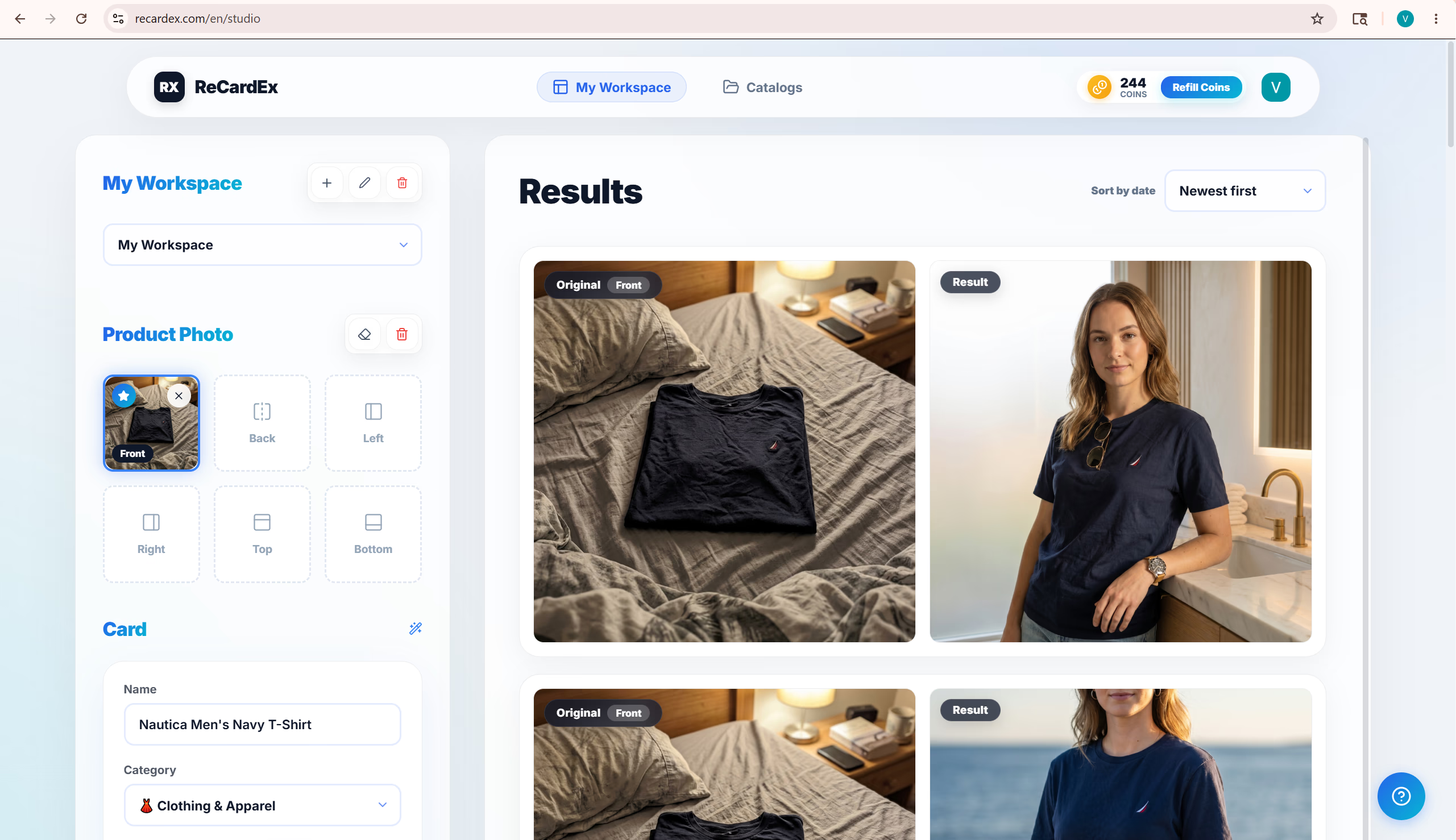
Background removal is handled automatically using segmentation models that isolate the product from any background in the source image — even a messy kitchen table or a wrinkled sheet. The result is a clean cutout that can be placed on a white background for Amazon compliance, or composited into a lifestyle scene.
Lifestyle scene generation takes the product and places it in a contextually appropriate environment. A skincare product might appear on a marble bathroom counter. A kitchen gadget gets placed on a wooden cutting board. The AI infers appropriate context from the product category and generates a photorealistic background.
Infographic generation is where the conversion value really kicks in. Instead of a plain product shot, the tool adds callout lines, icons, and text overlays that highlight key features — size dimensions, material quality, compatibility, or any selling points that matter to the buyer. These infographic images consistently outperform plain product shots in click-through rate tests.
Video generation takes the product assets and creates short animated clips — typically 15–30 seconds — suitable for use as Amazon A+ content, Etsy listings, or paid ads on Instagram and TikTok.
ReCardEx: AI Product Photo Studio Built for E-Commerce
ReCardEx is one of the tools built specifically for this workflow. It's designed for e-commerce sellers who need to produce professional visuals at scale, without a design background or a photography budget.
The core product takes a single product photo as input and outputs:
- Studio-quality main images formatted to Amazon, Etsy, and Shopify specifications
- Branded infographics with feature callouts, icons, and text overlays
- Short promo videos ready for use in ads or marketplace listings
The pricing model is pay-per-generation: $0.25 per image and $1.50 per video. There's no monthly subscription, no seat limit, no minimum commitment. For sellers who generate images in batches when launching new products, this is significantly more cost-effective than any subscription-based alternative.
ReCardEx is built on Google Gemini Vision, which handles the category recognition and style selection that makes generated images contextually appropriate. A product gets placed in a scene that makes sense for its category — cosmetics in a lifestyle bathroom setting, electronics on a clean tech-forward surface, food products in a kitchen context.
The platform also handles platform-specific formatting automatically, so the output is download-ready for whichever marketplace the seller is targeting.
The Real Cost Comparison
Let's put numbers to this.
A seller with 20 active SKUs, each needing a main image, two lifestyle shots, and one infographic, has 80 images to produce. At a traditional photography studio, that's at minimum $400–800 for the shoot, plus editing time.
With ReCardEx at $0.25 per image, the same 80 images cost $20.
Even if the seller needs to generate multiple variations and selects the best output, the economics are dramatically different. At $0.50–1.00 effective cost per final image (accounting for regenerations), the savings over traditional photography are 90%+.
For video content, the comparison is even more stark. A simple product video from a freelance videographer costs $200–500. At $1.50 per AI-generated video, a seller can produce 10 product videos for the cost of one traditional video.
Who Benefits Most from AI Product Photography
The sellers who get the most value from AI photography tools tend to fall into a few clear categories.
Amazon FBA and private label sellers benefit from the ability to produce Amazon-compliant main images quickly, plus the infographic capability which is directly tied to conversion rate on Amazon listings.
Etsy sellers — especially those in handmade goods, print-on-demand, and vintage — benefit from the ability to create consistent, aesthetic product photography without investing in camera equipment or learning editing software.
Shopify store owners scaling their catalog benefit from being able to maintain visual consistency across large numbers of SKUs without hiring a designer for every product launch.
Dropshippers benefit most acutely, because their entire competitive advantage depends on differentiation from other stores using the same supplier images. AI-generated original visuals are one of the few ways to stand out in a commoditized space.
Print-on-demand sellers launching multiple designs weekly need a way to generate mockup-quality visuals without waiting on manual processing for each new design.
Practical Tips for Getting the Best Output from AI Product Photo Tools
Getting great results from AI product photography tools requires a bit of input optimization. Here's what consistently improves output quality:
Start with a clean source image. The AI can remove backgrounds and adjust lighting, but it works best when the source photo shows the product clearly, without heavy shadows or extreme angles. A simple smartphone photo on a flat surface works well as a starting point.
Choose the right style for your marketplace. Amazon main images need white backgrounds for compliance. Etsy benefits from lifestyle scenes with warm, natural tones. Shopify stores often benefit from consistent minimal aesthetics. Match your output style to your platform.
Use infographics for your top sellers first. Infographic images take more time to set up effectively, but they're the highest-conversion asset type. Prioritize them for your best-performing or highest-margin products.
Batch your generations. If you're launching a new product line, generate all images in one session. The per-generation pricing model rewards batching, and you maintain stylistic consistency across related products.
What AI Photography Still Can't Replace
AI product photography tools have real limitations worth understanding.
For highly tactile products — fabrics, textures, materials where touch and feel are central to the purchase decision — AI-generated lifestyle images may not fully convey what photography of the actual product does. In these cases, hybrid approaches work well: use AI for white-background compliance images and infographics, and invest in a single real photoshoot for hero lifestyle images.
For luxury or high-end brands where photographic craftsmanship is part of the brand identity, AI tools are a supplement rather than a replacement. The goal in those cases is usually one exceptional hero image rather than efficient volume production.
For products with complex configurations — furniture that needs to be shown assembled, electronics with multiple ports and components, multi-part kits — AI tools may require more iteration to get accurate representations.
The Broader Shift in E-Commerce Visual Content
The rise of AI product photography tools is part of a broader pattern: the production cost of quality visual content is dropping toward zero.
A year ago, producing a set of professional product images for a new SKU launch was a meaningful expense that required scheduling, coordination, and lead time. Today, it's a 2-minute task that costs less than a cup of coffee.
This has two implications for e-commerce sellers. First, the cost barrier to looking professional has been eliminated — which means the baseline expectation for listing quality is rising. Sellers who still publish low-quality images are falling further behind.
Second, the sellers who figure out how to generate high-quality visuals efficiently have a compounding advantage. Every new SKU they launch has professional imagery from day one. Every listing is conversion-optimized. Every ad has video assets. At scale, this is a significant operational and competitive edge.
Getting Started
ReCardEx is available at recardex.com. The pay-per-generation model means there's no upfront commitment — you can start with a single product and see the output quality before deciding to use it at scale.
For sellers evaluating AI product photography tools, the fastest way to assess fit is to run one product through the full workflow: main image, lifestyle shot, infographic, and video. The time and cost investment is minimal, and the output quality speaks for itself.