
Most people find out they are an executor at the worst possible moment. Someone they love has died, they are grieving, and suddenly there is a pile of post, a bank that wants a death certificate, a house that needs looking after and a word they have only heard on television: probate. Nobody hands you a manual. Executor4you was built to be that manual, and to do a good share of the work for you.
What an executor actually has to do
An executor is the person named in a will to deal with the estate of the person who has died. If there is no will, a close relative usually takes on the same job as an administrator. Either way, the role is the same: collect in everything the person owned, pay what they owed, deal with any tax, and pass what is left to the people entitled to it.
In practice that means dozens of separate tasks spread over months, often more than a year. Registering the death. Finding the will. Telling banks, pension providers, insurers, utility companies, the council and government departments. Valuing the house, the savings and the belongings. Working out whether inheritance tax is due. Applying for probate. Selling or transferring property. Paying debts and bills. Keeping a record of every penny in and out. Finally, sharing out the estate and showing the beneficiaries the accounts.
None of it is impossible, but it is a lot, and much of it comes with deadlines that are easy to miss when you are grieving and have never done it before.
Why many executors pay thousands for help
Faced with all that, many families hand the whole thing to a solicitor or a probate firm. For a complicated estate, or one with a dispute, that can be the right choice. But professional estate administration is often charged by the hour or as a percentage of the estate, and for an ordinary estate the bill can easily run into thousands of pounds, all of it coming out of what the family would otherwise inherit.
A large number of estates are straightforward: a house, some savings, a pension, a few bills. The executor is perfectly capable of dealing with them; what they lack is a clear plan and the time to work out what to do next. That is the gap Executor4you fills.
One step at a time
Executor4you turns the whole job into a step-by-step checklist, in the order you need to do things. It starts with the first few days (registering the death, finding the will, securing the home) and works through to the final distribution and the estate accounts. At every point you can see what is done, what is next, and what can wait.
Each step explains in plain English what it is, why it matters and how to do it, with links to the official forms where they exist. You do not need any legal knowledge to start; you just open the next step.
Deadlines worked out for you
Some parts of estate administration have legal or practical deadlines. Inheritance tax, for example, is normally due by the end of the sixth month after the month in which the person died, and interest starts to run after that even if probate has not been granted. There are time limits around claims against the estate, tax returns for the period up to the date of death and for the estate itself, and the period executors usually wait before distributing.
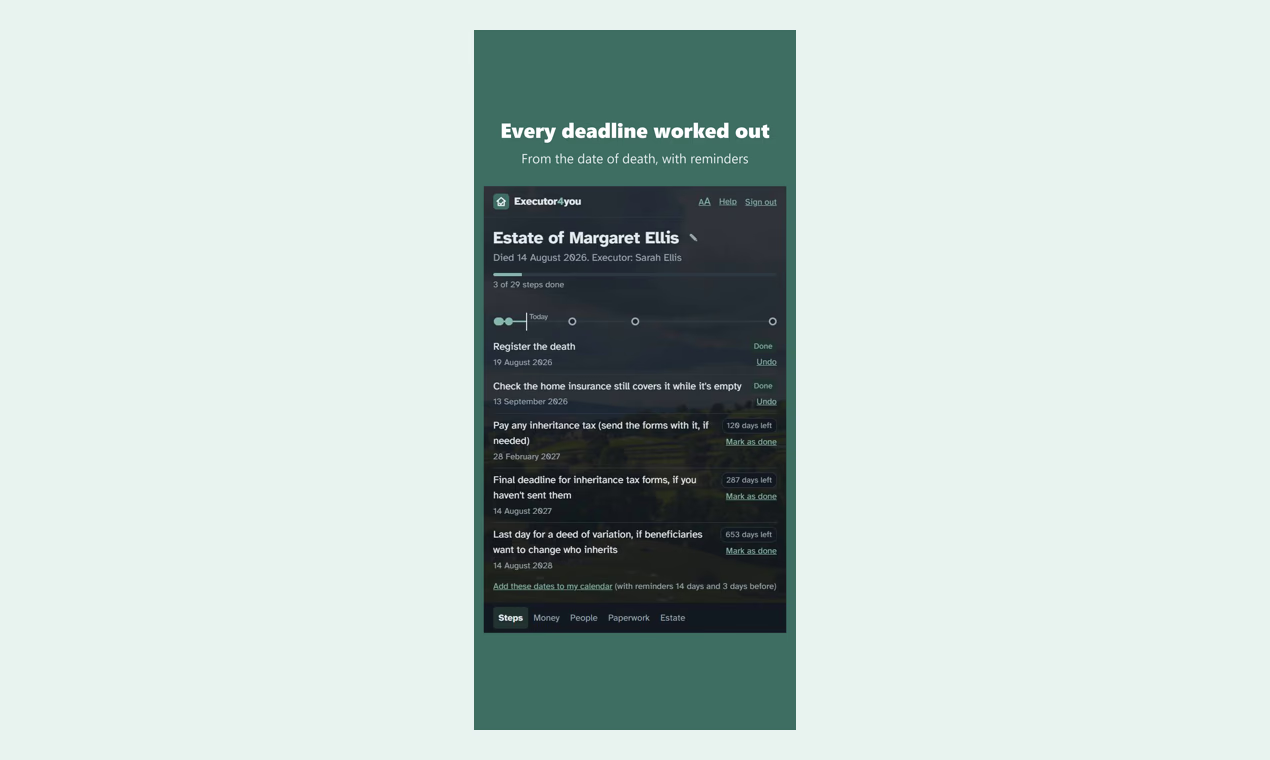
Executor4you works out these dates from the date of death and the details of the estate, shows them on a timeline and reminds you by email before they arrive. Co-executors can get the reminders too, so nothing depends on one person remembering.
Who to tell, and what to send them
One of the most time-consuming parts of being an executor is contacting every organisation the person had dealings with. Each one has its own bereavement team, its own address and its own idea of what documents it needs.
Executor4you has the bereavement contact details for over 100 UK organisations built in: the major banks and building societies, pension providers, insurers, energy and water companies, phone and broadband providers, and government services. Add the organisations the person dealt with, and Executor4you writes the letters for you, with the right reference numbers and the details each organisation asks for. You can print them, download them, or email them straight from the app with the documents attached.
Valuing the estate and inheritance tax
To apply for probate and to work out whether inheritance tax is due, you need to know what the estate is worth on the date of death. Executor4you keeps a list of every asset and debt as you find them: property, bank accounts, savings, investments, pensions, vehicles, belongings, and the bills and loans that need paying.
As the figures come in, it keeps a running total and helps you see where the estate stands against the inheritance tax thresholds. Many estates owe no inheritance tax at all and can be reported to HMRC as excepted estates; others need the full inheritance tax account. Executor4you's guides explain the difference and point you to the right forms.
Estate accounts built as you go
At the end of the process, beneficiaries are entitled to see how the estate was dealt with: what came in, what was paid out, and how the remainder was divided. Many executors dread this part, because it means going back through months of bank statements and receipts.
With Executor4you, the accounts build themselves as you work. Every payment received, every bill paid and every distribution is recorded against the estate, so the final estate accounts are ready when you are. You can match items against the estate bank account statement, and the matching happens on your own device rather than uploading the statement.
Sharing the load with co-executors and family
Estates are often handled by two or more executors, sometimes living in different parts of the country. Executor4you lets you invite co-executors to the same estate, so everyone sees the same checklist, documents and figures, and each change is recorded with who made it.
Beneficiaries often just want to know how things are going. Executors can create a progress link that shows the estate's progress and key dates, and the accounts if you choose, without giving anyone access to your notes, documents or contact details. That one link can save a great many phone calls.
Help with the paperwork itself
Executors receive a lot of official letters, and they are not always easy to understand. In Executor4you you can ask the app to read a letter, the will, the death certificate or the grant of probate, and it explains what the document says and what, if anything, you need to do. You can also ask questions about the estate in plain English and get an answer that takes your estate's dates and steps into account.
Plan ahead for your own family
Many people who have been through being an executor come away thinking: I never want my family to go through this search. Executor4you includes a free plan-ahead tool for exactly that. You write down where everything is: your will, your accounts and policies, your pensions, the organisations that would need to be told, and your wishes, such as your funeral wishes. You can share the plan with the people you trust. If the worst happens, one of them can turn it into an estate in Executor4you and start with everything already filled in.
Try it before you sign up
You can look round a complete example estate without creating an account, to see how the checklist, timeline, letters and accounts work on a realistic case. There are also free guides on the website covering topics such as executor duties, how to apply for probate, inheritance tax thresholds, the executor's year, deeds of variation, selling a house in probate and what happens when there is no will.
Pricing
Executor4you is free to set up. Starting an estate, the deadlines and reminders, and the plan-ahead tool are free. Unlocking the full estate costs £9.99 a month after a 14-day free trial, or £99 once for the whole estate, however long it takes. For most families that is a small fraction of what professional estate administration would cost.
Where it works, and who makes it
Executor4you works in any web browser and as a Windows app from the Microsoft Store, with iPhone and Android apps on the way. It is made in the UK by Charter Enterprise, a small independent business registered with the Information Commissioner's Office. Estate records are stored in London, documents are encrypted at rest, and the service never sells your data or uses it for advertising.
When to get professional help
Executor4you is not a law firm and does not give legal advice. For most straightforward estates it gives executors everything they need to do the job themselves, but some situations really do need a solicitor: a will that is being contested, a beneficiary who cannot be traced, an insolvent estate, complex trusts or business assets, or property abroad. Executor4you's guides flag these situations so you know when to ask for help.
Getting started
If you have just been named as an executor and do not know where to begin, start at executor4you.co.uk. Look round the example estate, set up your own for free, and open the first step. You do not have to work it all out at once. You just have to do the next thing, and Executor4you will tell you what that is.