
Amazon reviews are one of the richest sources of buyer truth, but they are also noisy. Some reviews are overly emotional, repetitive, off-topic, or even manipulated. If you are trying to make a confident buying decision, validate a product idea, or improve an existing listing, you need a repeatable way to separate genuine customer experience from artificial hype. This guide shows how to analyze Amazon reviews with AI to spot fake reviews while also extracting the pain points real buyers mention again and again.
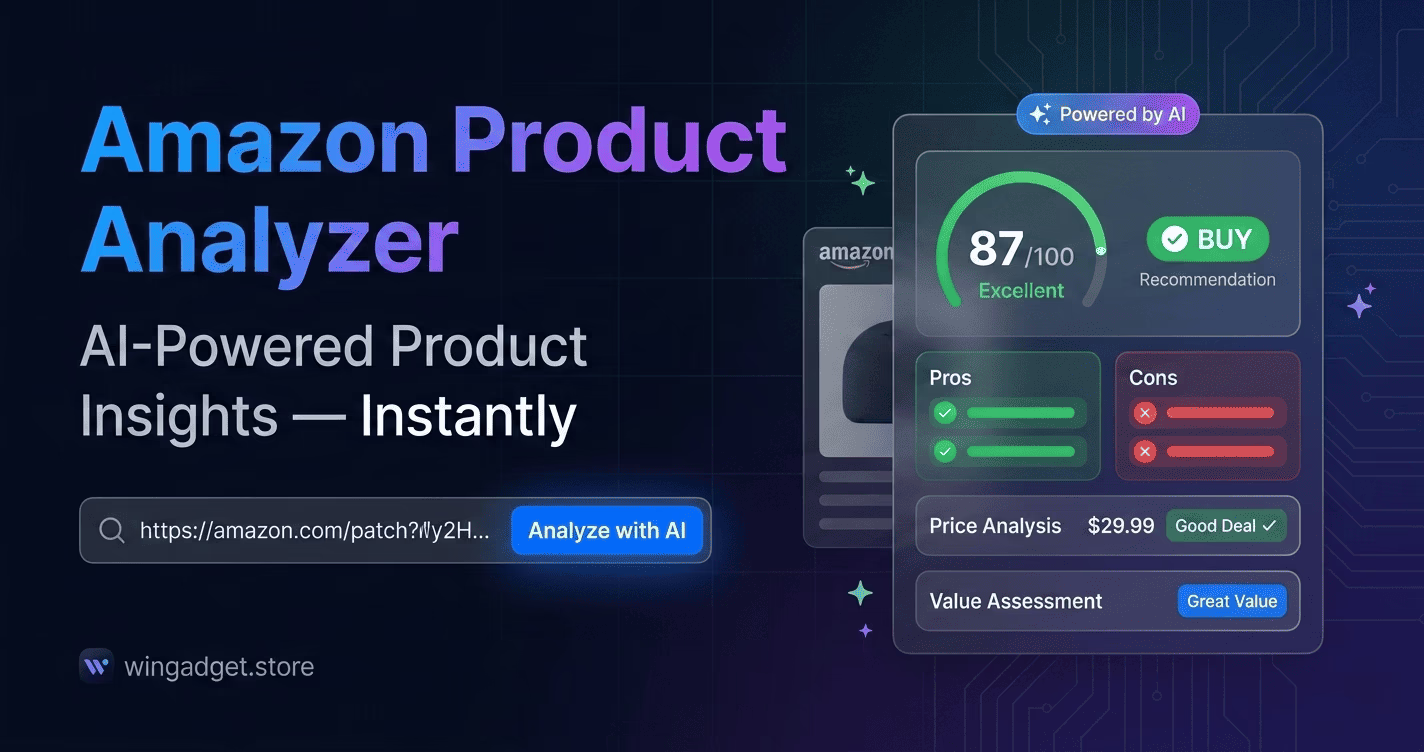
To make the process practical, we will frame the workflow around a tool built for this job: Amazon Product Analyzer, which provides instant AI analysis for Amazon products. Even if you use a different method later, the steps and checks below will help you build a consistent review analysis system.
Why AI review analysis matters (and what “good” analysis looks like)
Manually reading 200 to 2,000 reviews is slow, and your brain is biased toward the most vivid stories. AI helps by scanning patterns across many reviews and summarizing them in a structured way, so you can focus on what is statistically common and decision-relevant rather than what is memorable.
A good AI-driven review analysis should deliver four outcomes:
- Authenticity signals: red flags and confidence indicators for suspicious review patterns.
- Pain point clustering: repeated complaints grouped into clear themes (for example: battery life, sizing, packaging, durability).
- Benefit clustering: what customers consistently love and why that matters (for example: comfort, speed, build quality).
- Actionable recommendations: what to do next, such as what to verify before buying, what questions to ask, or what product changes to consider.
This is exactly the difference between “a summary” and a decision tool. The rest of this article shows you how to get those outcomes reliably.
Common types of fake and low-quality reviews you should detect
When people say “fake reviews,” they often mean multiple behaviors. AI works best when you define what you are trying to detect. Here are the most common categories that distort the truth:
- Incentivized positivity: overly enthusiastic reviews that sound like marketing copy and avoid specifics.
- Coordinated review bursts: many reviews posted in a short window with similar phrasing or structure.
- Reviewer profile anomalies: accounts that review many unrelated products with similar tone, timing, or star distribution.
- Irrelevant or mismatched variants: reviews talking about a different version, size, or bundled accessory.
- Copy-paste patterns: repeated phrases, repeated “pros/cons” formatting, or templated language across reviewers.
- Extreme one-star attacks: short, vague negative reviews that do not describe real usage, sometimes targeting competitors.
Not every suspicious review is “fake,” and not every genuine review is helpful. The goal is to score trustworthiness and extract high-signal feedback from the highest-quality subset.
What AI looks for when spotting fake-review signals
AI does not magically “know” whether a review is fake. Instead, it detects patterns that correlate with manipulation or low information content. When you analyze Amazon reviews with AI to spot fake reviews, ask the model to evaluate signals in three layers:
1) Language signals
These are textual markers inside the review itself. Examples include generic praise, lack of product-specific details, repeated slogans, unnatural keyword stuffing, or oddly formal language for a consumer review.
2) Behavioral signals
These are timing and distribution patterns. Examples include many reviews posted within a short timeframe, sudden star-rating shifts, or bursts of five-star ratings right after a product launch.
3) Consistency signals
These compare the review’s claims to other reviews. If one group says “battery lasts 10 hours” and another says “dies in 45 minutes,” the model can flag this as a conflict and recommend deeper checks, such as verifying which variant or manufacturing batch the reviewers received.
The best approach is not to delete anything. Instead, you segment reviews into buckets like “high trust,” “medium trust,” and “low trust,” then base your conclusions mainly on the high-trust bucket while still acknowledging recurring issues across all buckets.
A step-by-step workflow using Amazon Product Analyzer
Amazon Product Analyzer is designed to provide instant AI analysis for Amazon products, which is ideal when you want speed without losing structure. Use this workflow to turn raw review text into clear decisions.
- Choose your goal before you analyze.
Are you buying for yourself, validating a product niche, improving an existing product, or writing a product brief? Your “pain points that matter” depend on the goal. - Collect a representative set of reviews.
Do not rely only on “most recent” or “top reviews.” You want a mix of ratings (5, 4, 3, 2, 1), and if possible, a mix across time. - Run the product through Amazon Product Analyzer.
Ask it to output: (a) suspicious review signals, (b) top pain points, (c) top benefits, and (d) a short decision summary. - Request clustering, not just summarization.
Clustering forces the AI to group recurring themes and list supporting evidence patterns rather than producing a vague paragraph. - Validate the top 3 claims manually.
AI saves time, but you should still verify the biggest conclusions by reading a handful of representative reviews in each cluster. - Turn insights into actions.
For buyers: build a checklist of what to verify. For sellers: create a product improvement plan and update the listing to pre-empt confusion.
This approach is repeatable, and that repeatability is the real advantage. You are building a consistent method for how to analyze Amazon reviews with AI to spot fake reviews, not just doing a one-off scan.
The prompt framework: questions that extract pain points and authenticity signals
Even with a dedicated analyzer, the quality of the output depends on the questions you ask. Use prompts that force specificity. Here are prompt patterns you can adapt:
- Authenticity scoring: “Categorize reviews into high/medium/low trust and explain the signals used for each bucket.”
- Pain point extraction: “List the top 7 complaints, ranked by frequency and severity, and provide what ‘good resolution’ would look like for each.”
- Benefit extraction: “List the top 5 benefits customers consistently mention and which buyer types care most about each benefit.”
- Contradictions: “Identify claims that conflict between reviewers and suggest reasons (variant differences, expectations, use cases).”
- Use-case segmentation: “Group feedback by use case (gift, daily use, travel, professional use) and note which groups are most satisfied.”
If you want to rank for this topic, it helps to remember that most people searching the keyword phrase want a practical method. These prompts turn AI into a systematic analyst rather than a summarizer.
How to interpret the results: frequency, severity, and fixability
A common mistake is treating the “top complaint” as the most important complaint. AI output becomes much more valuable when you interpret issues using three lenses:
- Frequency: How often does it show up across reviews?
- Severity: When it happens, does it ruin the experience or is it a minor annoyance?
- Fixability: Can the issue be solved with better instructions, packaging, sizing guidance, or a product change?
For example, “arrived without instructions” may be frequent but highly fixable, while “overheats after 10 minutes” may be less frequent but catastrophic when it occurs. Ask your AI analysis to label each pain point with these three attributes so you can prioritize correctly.
Signals that usually indicate real buyer pain points (not just noise)
When you analyze Amazon reviews with AI to spot fake reviews, you also want the AI to detect “realness” in complaints. Genuine pain points often share traits like:
- Specific context: the customer mentions how they used the product and what happened.
- Measured expectations: they compare the product to a prior product or a clear requirement.
- Trade-off language: “I like X, but Y is an issue,” which is harder to fake consistently.
- Repeatable failure modes: multiple people describe the same issue in different words (for example: zipper breaks at the seam, not just “bad quality”).
Ask Amazon Product Analyzer to highlight reviews that include concrete usage scenarios and to quote short, paraphrased snippets or describe the common scenario patterns (without needing to rely on a single dramatic review).
Practical “fake review” red flags AI can catch quickly
Here are red flags that AI is particularly good at surfacing fast, especially when you have dozens or hundreds of reviews:
- Repetitive phrasing: many reviews using near-identical adjectives and sentence structure.
- Generic benefit lists: praise that could apply to almost any product in the category.
- Overuse of product name: unnatural repetition of the exact title or key phrase.
- Sudden sentiment shift: a cluster of five-star reviews appears right after a wave of negative ones.
- Thin content: very short reviews with extreme ratings and no details.
Important: one red flag does not prove manipulation. The correct outcome is “lower trust weight,” not “definitely fake.” AI should help you weigh reviews, not make absolute claims.
Turning review insights into smarter buying decisions
If you are a buyer, the output from an AI review analysis is most useful when it becomes a checklist. After using Amazon Product Analyzer, build a short “verify before purchase” list based on the top pain points and contradictions.
Example checklist items might include:
- Fit and sizing: confirm measurements, common sizing complaints, and whether issues are tied to a specific variant.
- Durability: look for repeated failure points (hinges, zippers, seals, connectors).
- Battery and charging: confirm real-world runtime and common charging problems.
- Quality control: check how often defects are mentioned and whether replacements solve it.
- Support and returns: note patterns in customer support feedback if present in reviews.
This is how AI helps you act. It compresses review reading into a set of concrete checks that reduce regret.
Turning review insights into product and listing improvements (for sellers and builders)
If you sell on Amazon or are researching a product to launch, AI-based review analysis can function like a lightweight voice-of-customer program. Use the pain point clusters to guide changes in three areas:
- Product changes: strengthen weak components, adjust materials, improve packaging, or update accessories.
- Instructional changes: include clearer setup steps, troubleshooting, care instructions, or QR-style onboarding (even simple printed steps can reduce returns).
- Listing changes: clarify compatibility, sizing, what is included, and realistic expectations so fewer buyers feel misled.
Also pay attention to “expectation mismatch” pain points. Many negative reviews happen when buyers assumed something that was never promised. Clearer wording and better imagery can reduce these issues without changing the product.
Best practices to get reliable AI outputs (and avoid hallucinations)
AI tools work best when the input is representative and the instructions are constrained. Use these best practices to keep outputs grounded:
- Demand structure: ask for ranked lists, clusters, and labels (frequency, severity, fixability).
- Ask for uncertainty: request confidence levels and what would change the conclusion.
- Separate “signals” from “verdicts”: require the AI to describe patterns rather than declaring reviews fake.
- Cross-check contradictions: have the AI list conflicting claims and plausible reasons.
- Re-run with different slices: analyze only 1–3 star reviews, then only 4–5 star reviews, and compare themes.
When you combine structured prompts with a tool like Amazon Product Analyzer, you get consistent outputs that are easier to trust and easier to act on.
Limitations and ethical considerations
No method is perfect. Keep these limitations in mind:
- AI cannot verify identity: it detects patterns, not ground truth about who wrote a review.
- Biased samples exist: some buyers only review when angry, while others only review when delighted.
- Category differences matter: what counts as “normal phrasing” varies by product type and price point.
- Real bursts happen: seasonal spikes, promotions, or viral exposure can create legitimate review surges.
The most responsible approach is to treat AI authenticity outputs as risk signals, then verify by reading representative reviews and considering overall patterns.
Quick checklist: how to analyze Amazon reviews with AI to spot fake reviews
Use this condensed checklist when you want a fast, repeatable process:
- Analyze a balanced set of reviews across star ratings and time.
- Run the product through Amazon Product Analyzer for instant AI analysis.
- Request three outputs: authenticity signals, pain point clusters, benefit clusters.
- Rank pain points by frequency, severity, and fixability.
- Flag contradictions and likely causes (variant differences, use-case differences).
- Manually verify the top 3 themes with a small sample of reviews.
- Convert insights into actions: buyer verification checklist or seller improvement plan.
This process keeps you focused on real buyer experience while reducing the impact of manipulated or low-information reviews.
Final thoughts
Learning how to analyze Amazon reviews with AI to spot fake reviews is less about catching every suspicious post and more about building a trustworthy picture of reality. When you use AI to cluster pain points, detect contradictions, and lower the weight of low-trust patterns, you can make better buying decisions and build better products.
With a purpose-built tool like Amazon Product Analyzer, you can move from “scrolling reviews” to a structured, repeatable workflow that highlights what real customers love, what frustrates them, and what is most likely to be exaggerated. That is the difference between being influenced by reviews and actually learning from them.