Most AI meeting assistants focus on what happens after a meeting ends. They generate summaries, action items, transcripts, and notes once the conversation is already over. While those features are useful, they do not solve one of the biggest challenges in modern business meetings: verifying information while decisions are being made.
Whether it is a founder discussing market opportunities, a recruiter evaluating a candidate's experience, a sales team reviewing competitor claims, or a remote team debating strategic priorities, meetings are filled with statistics, assumptions, opinions, and factual statements. Participants often have only seconds to determine whether information is accurate before moving on to the next topic.
This creates a significant problem. Teams frequently make decisions based on incomplete information, outdated data, or unverified claims. Once a meeting ends, it can be difficult and time-consuming to revisit every statement and confirm its accuracy.
This is where AI fact checking in meetings is becoming increasingly valuable. Instead of waiting until after the discussion, modern meeting intelligence platforms can help users verify claims and statistics in real time, allowing teams to make better decisions while conversations are still happening.
As organizations continue to adopt remote work and rely more heavily on video conferencing platforms like Google Meet, real-time meeting intelligence is evolving into a critical productivity and decision-support capability.
Why Fact Checking During Meetings Matters
Business decisions often depend on information shared verbally during meetings. Participants may reference market trends, customer feedback, financial projections, hiring benchmarks, industry reports, competitor activities, or performance metrics.
In many cases, nobody immediately verifies these statements. Team members assume the information is accurate and continue the discussion. Later, they may discover that important assumptions were incorrect, outdated, or missing critical context.
The consequences can be significant.
- Startups may pursue the wrong market opportunity.
- Recruiters may make hiring decisions based on inaccurate information.
- Sales teams may respond incorrectly to competitor positioning.
- Product teams may prioritize features based on faulty assumptions.
- Leadership teams may make strategic decisions using outdated data.
Fact checking during the meeting helps reduce these risks before they affect business outcomes.
The Problem with Traditional Meeting Workflows
Most organizations still rely on a manual verification process. Someone takes notes during the meeting, participants discuss action items, and research is conducted afterward if questions arise.
This approach introduces several challenges.
- Important claims may never be revisited.
- Context can be forgotten after the meeting ends.
- Teams spend additional hours researching discussions.
- Incorrect assumptions may influence decisions before verification occurs.
- Follow-up investigations create unnecessary delays.
The reality is that most professionals are already overwhelmed with meetings. Adding more post-meeting research often results in critical questions remaining unanswered.
This is why organizations are increasingly looking for tools that can assist during conversations rather than simply documenting them afterward.
What Is AI Fact Checking in Meetings?
AI fact checking in meetings refers to the ability of artificial intelligence systems to analyze conversations, identify factual claims, and help users validate information while discussions are actively taking place.
Instead of acting only as a transcription tool, an AI meeting assistant listens to the conversation, understands context, detects potentially important claims, and provides verification support when needed.
This transforms the role of AI from passive documentation to active meeting intelligence.
Rather than simply recording what was said, the system helps participants evaluate whether what was said is accurate, relevant, and supported by reliable information.
The result is better-informed conversations and stronger decision-making processes.
How Real-Time Fact Checking Works During Google Meet Calls
Modern AI meeting intelligence platforms can integrate directly into Google Meet workflows without disrupting the conversation.
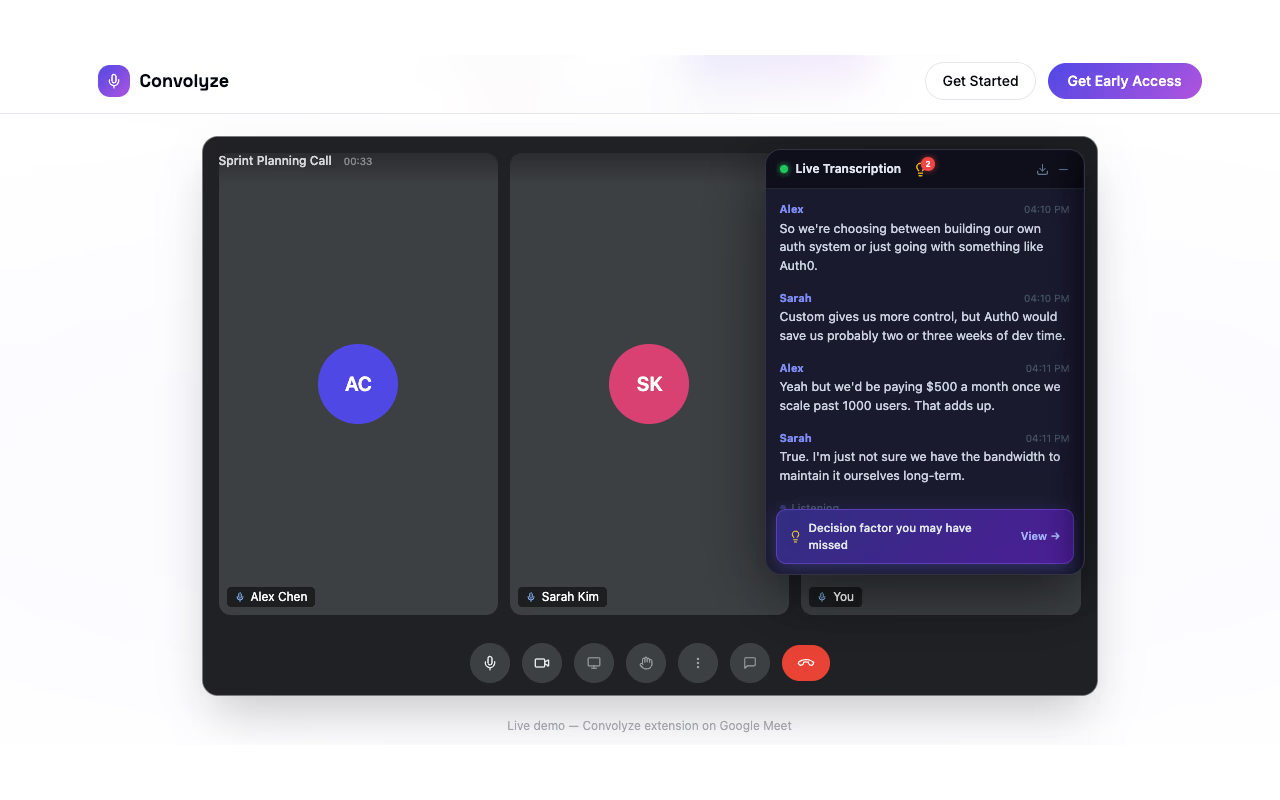
As participants speak, AI systems generate live transcripts and analyze discussion topics. When factual statements, statistics, market claims, or important assumptions are detected, the system can provide additional context and verification support.
This allows participants to evaluate information immediately instead of relying solely on memory or conducting research after the meeting.
The most effective implementations operate seamlessly in the background, allowing users to remain focused on the conversation while receiving contextual intelligence when it matters most.
For fast-moving discussions, this capability can significantly improve the quality of decisions made during the meeting itself.
Beyond Note Taking: The Rise of Meeting Intelligence
Many AI meeting tools focus primarily on transcription, summaries, and action items. While these features save time, they do not fundamentally improve the quality of conversations.
A new category is emerging that focuses on meeting intelligence rather than simple meeting documentation.
Meeting intelligence platforms aim to help participants think better, ask better questions, identify risks, uncover blind spots, and validate information while discussions are taking place.
This shift represents a major evolution in how organizations use AI during collaboration.
Instead of replacing note-taking, AI becomes a real-time decision-support system that actively contributes value throughout the meeting.
How Convolyze Approaches Real-Time Fact Checking
Convolyze was designed around the idea that the most important moments in a meeting happen during the discussion, not after it.
While many meeting assistants focus primarily on recording conversations, Convolyze combines live transcription, AI insights, contextual recommendations, and fact-checking capabilities to support users in real time.
As conversations unfold inside Google Meet, the platform analyzes discussion topics and helps participants verify information without interrupting the flow of the meeting.
This approach is particularly useful when conversations involve strategic planning, customer research, hiring decisions, market analysis, fundraising discussions, or competitive intelligence.
Rather than simply creating a record of the meeting, the platform aims to improve the quality of decisions being made inside the meeting itself.
Use Cases for Founders
Startup founders spend a significant portion of their time in meetings that influence the future direction of their businesses.
Investor discussions, customer discovery interviews, product strategy sessions, and partnership negotiations often involve numerous assumptions and market claims.
Real-time fact checking helps founders:
- Validate market statistics during discussions.
- Verify competitive claims.
- Assess assumptions used in strategic planning.
- Identify gaps in decision-making logic.
- Reduce the risk of acting on inaccurate information.
Because startup environments move quickly, immediate access to reliable information can create a meaningful competitive advantage.
Use Cases for Recruiters and Hiring Teams
Recruiters face a unique challenge during interviews. They must evaluate candidates while maintaining engagement and building rapport.
Interview conversations often include technical claims, career achievements, salary benchmarks, industry references, and role-specific knowledge.
AI-powered meeting intelligence can help recruiters:
- Document interviews automatically.
- Verify claims and qualifications.
- Generate follow-up questions.
- Capture candidate insights consistently.
- Reduce administrative workload.
This allows recruiters to focus more on the candidate experience while improving the quality of hiring decisions.
Use Cases for Remote Teams
Remote teams depend heavily on virtual meetings to stay aligned. Yet distributed organizations often struggle with information gaps, misunderstandings, and inconsistent documentation.
Real-time fact checking and meeting intelligence help remote teams maintain higher-quality discussions by ensuring important claims can be evaluated immediately.
Combined with live transcription and post-meeting summaries, AI-powered meeting intelligence creates a more reliable knowledge-sharing process across the organization.
This is especially valuable for globally distributed teams working across multiple time zones.
The Benefits of Verifying Information Before Decisions Are Made
The biggest advantage of real-time fact checking is simple: it allows organizations to make decisions using more reliable information.
When claims can be evaluated during the conversation, teams spend less time correcting mistakes later.
Benefits include:
- Higher confidence in decision-making.
- Reduced misinformation.
- Improved strategic discussions.
- More productive meetings.
- Faster execution after meetings conclude.
- Stronger collaboration across teams.
Instead of discovering inaccuracies days later, participants can address them immediately and continue moving forward with confidence.
Why Real-Time AI Assistance Is the Future of Meetings
The first generation of meeting assistants focused on recording conversations. The second generation focused on summarizing them. The next generation is focused on actively improving them.
Organizations increasingly expect AI to provide value during conversations rather than simply documenting outcomes.
As AI models become more capable of understanding context, reasoning about information, and surfacing relevant insights, meeting assistants will evolve into intelligent collaborators that help teams make better decisions in real time.
Fact checking, contextual recommendations, risk identification, and decision support are likely to become standard capabilities rather than optional features.
Businesses that adopt these technologies early may gain advantages in productivity, accuracy, and decision quality.
Final Thoughts
Meetings drive many of the most important decisions inside modern organizations. Yet those decisions are often influenced by assumptions, statistics, and claims that go unverified until long after the conversation ends.
AI fact checking in meetings helps solve this problem by bringing verification and decision support directly into the discussion. Instead of waiting until after the meeting to investigate important questions, participants can evaluate information in real time and make more informed choices.
Platforms like Convolyze represent a shift from traditional note-taking tools toward a new category of meeting intelligence software. By combining live transcription, AI insights, contextual recommendations, and real-time fact checking inside Google Meet, teams can spend less time questioning information and more time making confident decisions.
As businesses continue to rely on virtual collaboration, real-time meeting intelligence will likely become one of the most valuable applications of AI in the workplace.
Learn more about Convolyze: https://convolyze.io